 뒤로
뒤로General Chemistry 1 Midterm Study Guidance
스터디 가이드 - 스마트 노트
 자료에 맞춘 맞춤형 노트, 핵심 정의, 예시, 맥락을 확장해 제공합니다.
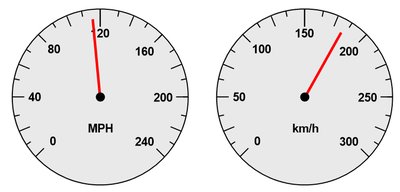
Q11. A vehicle's speedometer is shown below. What is its reading in km/hr and mi/hr? How many significant figures should the reading have?
Background
Topic: Significant Figures and Unit Conversion
This question tests your ability to interpret measurements from an instrument, convert between units (mph to km/h), and determine the correct number of significant figures based on the precision of the measurement.
Key Terms and Formulas:
Significant Figures: The digits in a measurement that are known with certainty plus one digit that is estimated.
Unit Conversion:
Step-by-Step Guidance
Observe the speedometer readings. The left dial shows the speed in mph, and the right dial shows the speed in km/h.
Estimate the value indicated by the needle on each dial. Consider the scale and the smallest division to determine the precision.
Determine how many significant figures are appropriate for each reading based on the instrument's scale and the position of the needle.
If you need to convert between mph and km/h, use the conversion factor: .
Try solving on your own before revealing the answer!
Final Answer:
The speedometer reads 115 mph (3 significant figures) and 185 km/h (3 significant figures).
Both readings are rounded to the nearest whole number, reflecting the precision of the instrument. The correct answer is:
115 mph with 3 significant figures and 185 km/h with 3 significant figures
This matches option (a) in the original question.
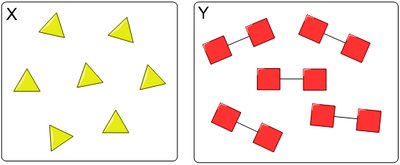
Q26. Visualize elements X and Y as described: Element X (atomic element): Atoms represented by triangles. Element Y (diatomic molecular element): Atoms represented by squares. Draw molecular-level views of each of these elements.
Background
Topic: Molecular and Atomic Elements
This question tests your understanding of how elements exist at the molecular level. Atomic elements are composed of individual atoms, while diatomic molecular elements are composed of pairs of atoms bonded together.
Key Terms:
Atomic Element: An element whose basic unit is a single atom (e.g., Ne, Ar).
Diatomic Molecular Element: An element whose basic unit is a molecule made of two atoms (e.g., O2, N2).
Step-by-Step Guidance
Identify the representation for each element: triangles for X (atomic), squares for Y (diatomic).
For element X, draw individual triangles spaced apart, representing single atoms.
For element Y, pair up squares with a line connecting each pair, representing diatomic molecules.
Compare the provided images to see which matches the description: X should have unpaired triangles, Y should have paired squares.
Try solving on your own before revealing the answer!
Final Answer:
The correct molecular-level view is the one where X is represented by individual triangles (atomic element) and Y is represented by pairs of squares (diatomic molecular element).
This matches the image labeled image_3 in the options.
