 뒤로
뒤로General Chemistry 1A Sample Exam – Step-by-Step Study Guidance
스터디 가이드 - 스마트 노트
 자료에 맞춘 맞춤형 노트, 핵심 정의, 예시, 맥락을 확장해 제공합니다.
Q27. The density of a rock is measured by volume displacement of water and the images of the measurement done in a graduated cylinder are given below. The mass of the rock is 78.45 g. From the images, report the volume of water and calculate the density of the rock. Give the correct number of significant figures in all your answers.
Background
Topic: Density and Volume by Water Displacement
This question tests your understanding of how to determine the density of an irregularly shaped object using the water displacement method. You will use the change in water volume to find the volume of the rock, then use the mass and volume to calculate density.
Key Terms and Formulas
Density (): The mass per unit volume of a substance.
Water Displacement: The volume of water displaced by the rock equals the volume of the rock.
Key formulas:
Volume of rock = Final volume (with rock) – Initial volume (without rock)
Step-by-Step Guidance
Examine the graduated cylinder images to determine the initial and final water volumes. Read the bottom of the meniscus for each measurement.
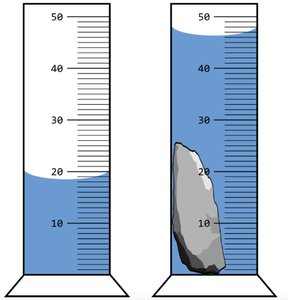
Calculate the volume of the rock by subtracting the initial water volume from the final water volume.
Record the mass of the rock (given as 78.45 g).
Use the density formula to set up the calculation for the density of the rock. Be sure to keep track of significant figures based on the measurements provided.
To convert the density from g/mL to kg/m3, use the conversion factor: .
Try solving on your own before revealing the answer!
Final Answer:
Initial volume: 18.0 mL Final volume: 28.5 mL Volume of rock: 10.5 mL Density: Density in kg/m3:
We used the difference in water volume to find the rock's volume, then divided the mass by this volume to get the density. The conversion to kg/m3 uses the standard factor for g/mL to kg/m3.
Q28. From the images of the buret given below, what is the initial buret reading for the titration? What is the final reading? How much liquid was dispensed? (4 points) Give the correct number of significant figures. Is buret a TC only glassware or a TD only glassware or both?
Background
Topic: Laboratory Measurements – Buret Readings
This question tests your ability to accurately read a buret, calculate the volume of liquid dispensed, and understand the function of laboratory glassware (To Contain vs. To Deliver).
Key Terms and Formulas
Buret: A piece of volumetric glassware used to deliver precise volumes of liquid, typically in titrations.
TD (To Deliver): Glassware calibrated to deliver a specific volume.
Volume dispensed: Final reading – Initial reading
Step-by-Step Guidance
Carefully read the initial and final buret readings from the images, making sure to read at the bottom of the meniscus and record to the correct number of decimal places.
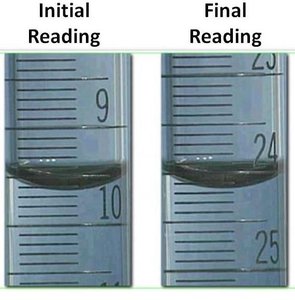
Subtract the initial reading from the final reading to determine the volume of liquid dispensed.
Consider the function of a buret: is it designed to contain (TC) or to deliver (TD) a measured volume?
Try solving on your own before revealing the answer!
Final Answer:
Initial buret reading: 9.10 mL Final buret reading: 24.36 mL Volume dispensed: 15.26 mL Buret is a TD (To Deliver) glassware.
The buret is calibrated to deliver the measured volume, not just to contain it. The readings are taken to two decimal places for accuracy.
Q29. Given below is the standard curve for the absorbances for various concentration of a compound. The concentration is in mg/L. Answer the questions below based on the graph. (3 points)
Which is the independent variable?
What will be the absorbance of a solution that has a concentration of 8.73 mg/L? Give 3 sig figs in your answer.
Background
Topic: Spectrophotometry and Standard Curves
This question tests your understanding of how to interpret a standard curve and use it to determine the absorbance of a solution at a given concentration. It also checks your knowledge of independent and dependent variables in an experiment.
Key Terms and Formulas
Standard Curve: A plot of absorbance (y-axis) versus concentration (x-axis) used to determine unknown concentrations.
Independent Variable: The variable that is changed or controlled in a scientific experiment (here, concentration).
Equation of the line: (where is absorbance and is concentration in mg/L)
Step-by-Step Guidance
Identify the independent variable by looking at the x-axis of the graph.
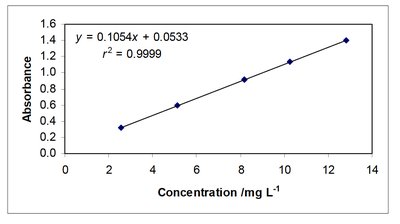
To find the absorbance for a concentration of 8.73 mg/L, substitute into the equation .
Set up the calculation, but do not compute the final value yet. Remember to keep three significant figures in your answer.
Try solving on your own before revealing the answer!
Final Answer:
Independent variable: Concentration (mg/L) Absorbance at 8.73 mg/L:
We substituted the concentration into the linear equation and rounded to three significant figures as required.
Q26. Write the correct name for the glassware given below:
Background
Topic: Laboratory Equipment Identification
This question tests your ability to recognize and correctly name common laboratory glassware used in chemistry labs.
Key Terms
Erlenmeyer Flask: A conical flask used for mixing, heating, and storing liquids.
Step-by-Step Guidance
Observe the shape and markings of the glassware in the image.
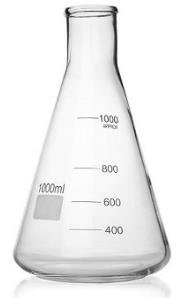
Recall the distinguishing features of an Erlenmeyer flask: conical body, flat bottom, narrow neck, and volume markings.
Write the correct name for this piece of glassware.
Try solving on your own before revealing the answer!
Final Answer:
Erlenmeyer flask
This flask is commonly used for titrations, mixing solutions, and heating liquids in the laboratory.
