뒤로
뒤로General Chemistry Exam & Study Guide: Step-by-Step Guidance
스터디 가이드 - 스마트 노트
 자료에 맞춘 맞춤형 노트, 핵심 정의, 예시, 맥락을 확장해 제공합니다.
Q1. Which of the following is an illustration of the law of constant composition?
Background
Topic: Law of Constant Composition
This question tests your understanding of how pure compounds always contain the same proportion of elements by mass, regardless of the source or method of preparation.
Key Terms:
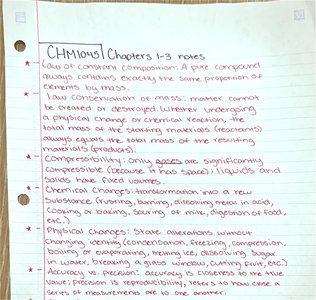
Law of Constant Composition: The principle that a chemical compound always contains the same elements in the same proportion by mass.
Compound: A substance formed when two or more elements are chemically bonded.
Step-by-Step Guidance
Read each answer choice carefully and identify which describes a compound with a fixed ratio of elements by mass.
Recall that mixtures do not have fixed ratios, while compounds do.
Look for the answer that mentions a specific mass ratio or percentage composition for a compound.
Eliminate choices that refer to mixtures or variable compositions.
Try solving on your own before revealing the answer!
Final Answer: B) Water is 11% hydrogen and 89% oxygen by mass
This illustrates the law of constant composition because water always contains hydrogen and oxygen in a fixed mass ratio, regardless of its source.
Q2. Which states of matter are significantly compressible?
Background
Topic: Properties of States of Matter
This question tests your knowledge of the physical properties of solids, liquids, and gases, specifically their compressibility.
Key Terms:
Compressibility: The ability of a substance to decrease in volume under pressure.
States of Matter: Solid, liquid, gas.
Step-by-Step Guidance
Recall that solids and liquids have particles packed closely together, making them difficult to compress.
Gases have particles far apart, allowing them to be compressed easily.
Identify which state(s) are described as significantly compressible.
Try solving on your own before revealing the answer!
Final Answer: C) gases only
Gases are significantly compressible because their particles are far apart, unlike solids and liquids.
Q3. In the following list, which is not an example of a chemical reaction?
Background
Topic: Chemical vs. Physical Changes
This question tests your ability to distinguish between chemical reactions (where new substances are formed) and physical changes (where the substance remains the same).
Key Terms:
Chemical Reaction: A process where substances change into new substances.
Physical Change: A change in state or appearance without forming a new substance.
Step-by-Step Guidance
Review each option and determine if a new substance is formed.
Identify which option describes a change in state or appearance only.
Eliminate choices that involve chemical transformations.
Try solving on your own before revealing the answer!
Final Answer: C) the condensation of water vapor
Condensation is a physical change (gas to liquid), not a chemical reaction.
Q4. Accuracy refers to...
Background
Topic: Measurement in Chemistry
This question tests your understanding of the difference between accuracy and precision in scientific measurements.
Key Terms:
Accuracy: How close a measured value is to the true or accepted value.
Precision: How close repeated measurements are to each other.
Step-by-Step Guidance
Recall the definitions of accuracy and precision.
Identify which answer choice describes closeness to the true value.
Eliminate choices that refer to consistency or repeated measurements.
Try solving on your own before revealing the answer!
Final Answer: C) how close a measured number is to the actual value
Accuracy is about how close your measurement is to the true value.
Q5. Which of the items below would be considered the most dense?
Background
Topic: Density Calculations
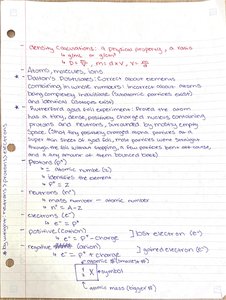
This question tests your ability to calculate and compare densities using mass and volume.
Key Formula:
Where:
Mass: measured in grams (g)
Volume: measured in milliliters (mL) or cubic centimeters (cm3)
Step-by-Step Guidance
For each item, use the formula .
Plug in the mass and volume values for each item.
Calculate the density for each item, but stop before the final comparison.
Identify which item has the highest calculated density.
Try solving on your own before revealing the answer!
Final Answer: D) A block of metal with a volume of 135.0 mL and a mass of 1.29 × 10³ g
This item has the highest density because the mass is much greater relative to its volume compared to the other options.
Q6. Consider the following selected postulates of Dalton's atomic theory...
Background
Topic: Dalton's Atomic Theory
This question tests your knowledge of the foundational concepts of atomic theory and which postulates are still considered valid.
Key Terms:
Dalton's Atomic Theory: Early model of the atom, some parts are still valid, others have been revised.
Atoms: Basic units of matter.
Step-by-Step Guidance
Review each postulate and consider modern scientific understanding.
Identify which statements are still accepted as true.
Eliminate statements that have been disproven or revised.
Try solving on your own before revealing the answer!
Final Answer: A) I, II, and IV
These postulates are still considered valid in modern atomic theory.
Q7. In the Rutherford nuclear atom model...
Background
Topic: Atomic Structure
This question tests your understanding of the Rutherford model, which describes the arrangement of protons, neutrons, and electrons in an atom.
Key Terms:
Rutherford Model: Electrons orbit a dense, positively charged nucleus.
Nucleus: Contains protons and neutrons.
Step-by-Step Guidance
Recall the main features of the Rutherford model.
Identify which answer choice correctly describes the location of protons, neutrons, and electrons.
Eliminate choices that misplace these particles.
Try solving on your own before revealing the answer!
Final Answer: B) The nucleus contains protons and neutrons, and electrons orbit the nucleus.
This is the key feature of the Rutherford model.
Q8. Which of the following species contains 18 electrons?
Background
Topic: Ions and Electron Counting
This question tests your ability to determine the number of electrons in ions and neutral atoms.
Key Formula:
(for cations) or (for anions)
Step-by-Step Guidance
For each species, identify the atomic number and the charge.
Calculate the number of electrons using the formula above.
Compare your results to find which species has 18 electrons.
Try solving on your own before revealing the answer!
Final Answer: D)
Argon () has 18 electrons as a neutral atom.
Q9. The correct name for MgF2 is...
Background
Topic: Nomenclature of Ionic Compounds
This question tests your ability to name binary ionic compounds using proper conventions.
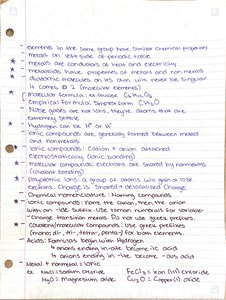
Key Terms:
Binary Ionic Compound: Composed of a metal and a nonmetal.
Naming: Metal name + nonmetal name with "-ide" ending.
Step-by-Step Guidance
Identify the cation (Mg2+) and the anion (F-).
Recall the naming rule: metal name first, then nonmetal with "-ide" ending.
Apply the rule to MgF2.
Try solving on your own before revealing the answer!
Final Answer: D) magnesium fluoride
MgF2 is named magnesium fluoride.
Q10. The correct name for Pb(NO3)2 is...
Background
Topic: Nomenclature of Ionic Compounds with Polyatomic Ions
This question tests your ability to name compounds containing polyatomic ions and metals with variable charges.
Key Terms:
Polyatomic Ion: An ion composed of multiple atoms.
Lead (Pb): Can have multiple oxidation states.
Step-by-Step Guidance
Identify the cation (Pb) and its charge based on the formula.
Identify the polyatomic ion (NO3- is nitrate).
Apply the naming rule: metal name (with charge if needed) + polyatomic ion name.
Try solving on your own before revealing the answer!
Final Answer: B) lead(II) nitrate
Pb(NO3)2 is named lead(II) nitrate because lead has a +2 charge in this compound.
Q11. The correct name for NH4Cl is...
Background
Topic: Nomenclature of Ionic Compounds with Polyatomic Ions
This question tests your ability to name compounds containing the ammonium ion.
Key Terms:
Ammonium: NH4+
Chloride: Cl-
Step-by-Step Guidance
Identify the cation (NH4+) and the anion (Cl-).
Recall the naming rule: cation name first, then anion with "-ide" ending.
Apply the rule to NH4Cl.
Try solving on your own before revealing the answer!
Final Answer: C) ammonium chloride
NH4Cl is named ammonium chloride.
Q12. The compound P2O5 is...
Background
Topic: Nomenclature of Covalent Compounds
This question tests your ability to name binary covalent compounds using prefixes.
Key Terms:
Binary Covalent Compound: Composed of two nonmetals.
Prefixes: di-, tri-, tetra-, penta-, etc.
Step-by-Step Guidance
Identify the number of atoms for each element in the formula.
Apply the appropriate prefixes to each element.
Use the "-ide" ending for the second element.
Try solving on your own before revealing the answer!
Final Answer: B) diphosphorus pentoxide
P2O5 is named diphosphorus pentoxide.
Q13. Which of the following statements concerning compounds?
Background
Topic: Properties of Compounds
This question tests your understanding of the characteristics of chemical compounds compared to elements and mixtures.
Key Terms:
Compound: Substance formed from two or more elements chemically bonded.
Mixture: Combination of substances not chemically bonded.
Step-by-Step Guidance
Review each statement and determine if it accurately describes a compound.
Recall that compounds have fixed ratios and properties different from their constituent elements.
Eliminate statements that describe mixtures or elements.
Try solving on your own before revealing the answer!
Final Answer: D) They always contain atoms of two or more elements.
Compounds are made of two or more elements chemically bonded.
Q14. What is the name of the following compound: CH3CH2OH?
Background
Topic: Organic Nomenclature
This question tests your ability to name simple organic compounds, specifically alcohols.
Key Terms:
Alcohol: Organic compound with an -OH group.
Ethyl: Two carbon chain.
Step-by-Step Guidance
Identify the number of carbon atoms in the chain.
Recognize the functional group (-OH) as an alcohol.
Apply the IUPAC naming rules for alcohols.
Try solving on your own before revealing the answer!
Final Answer: B) ethanol
CH3CH2OH is named ethanol.
Q15. Which of the following are combustion reactions?
Background
Topic: Types of Chemical Reactions
This question tests your ability to identify combustion reactions, which involve a substance reacting with oxygen to produce energy, CO2, and H2O.
Key Terms:
Combustion Reaction: Reaction with O2 producing CO2 and H2O.
Step-by-Step Guidance
Look for reactions where a hydrocarbon or other substance reacts with O2.
Check if the products include CO2 and H2O.
Eliminate reactions that do not fit this pattern.
Try solving on your own before revealing the answer!
Final Answer: C) I and III
These reactions involve a substance reacting with oxygen to produce CO2 and H2O.
Q16. When the following equation is balanced, the coefficients are...
Background
Topic: Balancing Chemical Equations
This question tests your ability to balance chemical equations by ensuring the same number of atoms for each element on both sides.
Key Terms:
Coefficient: Number placed in front of a compound to balance the equation.
Balancing: Making sure atom counts are equal on both sides.
Step-by-Step Guidance
Write down the number of atoms for each element on both sides.
Adjust coefficients to balance the atoms.
Repeat until all elements are balanced.
Try solving on your own before revealing the answer!
Final Answer: D) 1, 2, 1, 2
The balanced equation is: CH4 + 2 O2 → CO2 + 2 H2O.
Q17. Calculate the percentage by mass of Na2SO4 in a sample.
Background
Topic: Percent Composition
This question tests your ability to calculate the percent by mass of a compound in a mixture.
Key Formula:
Step-by-Step Guidance
Identify the mass of Na2SO4 and the total mass of the sample.
Plug these values into the percent by mass formula.
Calculate the percentage, but stop before the final step.
Try solving on your own before revealing the answer!
Final Answer: B) 33.3%
Using the formula, the percent by mass of Na2SO4 is 33.3%.
Q18. A sample of CH4 with a mass of 19 g contains _______ moles of it.
Background
Topic: Mole Calculations
This question tests your ability to convert mass to moles using molar mass.
Key Formula:
Step-by-Step Guidance
Find the molar mass of CH4 (C = 12.01, H = 1.01 × 4).
Plug the mass and molar mass into the formula.
Calculate the number of moles, but stop before the final step.
Try solving on your own before revealing the answer!
Final Answer: C) 1.19 mol
19 g CH4 divided by its molar mass gives 1.19 moles.
Q19. A nitrogen pellet is 63.65% by mass nitrogen. The molecular formula must be...
Background
Topic: Empirical and Molecular Formulas
This question tests your ability to determine the molecular formula based on percent composition.
Key Terms:
Percent Composition: The percentage of each element in a compound.
Molecular Formula: Actual number of atoms in a molecule.
Step-by-Step Guidance
Compare the percent composition to the formulas given.
Calculate the percent nitrogen in each formula.
Identify which formula matches the given percentage.
Try solving on your own before revealing the answer!
Final Answer: D) NH3
NH3 matches the given percent composition for nitrogen.
Q20. Magnesium burns in air with a dazzling brilliance to produce magnesium oxide...
Background
Topic: Stoichiometry
This question tests your ability to use stoichiometry to calculate the mass of product formed from a given mass of reactant.
Key Formula:
Step-by-Step Guidance
Write the balanced equation: 2 Mg + O2 → 2 MgO.
Convert the mass of Mg to moles using its molar mass.
Use the stoichiometric ratio to find moles of MgO produced.
Convert moles of MgO to mass using its molar mass.
Try solving on your own before revealing the answer!
Final Answer: C) 2.08 g
Using stoichiometry, 1.25 g Mg produces 2.08 g MgO.
Q21. Which of the following statements is true regarding strong compounds?
Background
Topic: Strong vs. Weak Electrolytes
This question tests your understanding of strong electrolytes and their behavior in solution.
Key Terms:
Strong Electrolyte: Dissociates completely in water.
Weak Electrolyte: Dissociates partially.
Step-by-Step Guidance
Recall the definition of a strong electrolyte.
Identify which statement describes complete dissociation.
Eliminate statements that refer to partial dissociation or weak electrolytes.
Try solving on your own before revealing the answer!
Final Answer: A) They dissociate completely
Strong electrolytes dissociate completely in water.
Q22. Which of the following compounds contains a polyatomic ion?
Background
Topic: Polyatomic Ions
This question tests your ability to recognize compounds containing polyatomic ions.
Key Terms:
Polyatomic Ion: An ion composed of multiple atoms.
Step-by-Step Guidance
Identify which compounds contain ions like NO3-, SO42-, etc.
Eliminate compounds with only monatomic ions.
Choose the compound with a polyatomic ion.
Try solving on your own before revealing the answer!
Final Answer: C) NaNO3
NaNO3 contains the polyatomic ion nitrate (NO3-).
Q23. Which of the following is the Lewis structure of a nitrate ion (NO3-)?
Background
Topic: Lewis Structures
This question tests your ability to draw or recognize the correct Lewis structure for a polyatomic ion.
Key Terms:
Lewis Structure: Diagram showing valence electrons and bonds.
Nitrate Ion: NO3-
Step-by-Step Guidance
Count the total number of valence electrons for NO3-.
Arrange the atoms and distribute electrons to satisfy the octet rule.
Check for resonance structures.
Try solving on your own before revealing the answer!
Final Answer: D) The structure with three resonance forms and a negative charge
The nitrate ion has three resonance structures, each with a negative charge distributed over the oxygens.