 뒤로
뒤로General Chemistry I: Matter, Measurement, Atoms, and Compounds (Chapters 1–3) – Exam 1 Review
스터디 가이드 - 스마트 노트
 자료에 맞춘 맞춤형 노트, 핵심 정의, 예시, 맥락을 확장해 제공합니다.
Chapter 1 – Matter, Measurement, and Problem Solving
Classification of Matter
Matter is anything that occupies space and has mass. It can be classified by its physical state and by its composition.
States of Matter: Solid, liquid, and gas are the three primary states, each with distinct properties.
Atoms and Molecules: Atoms are the fundamental units of matter; molecules are combinations of two or more atoms bonded together.
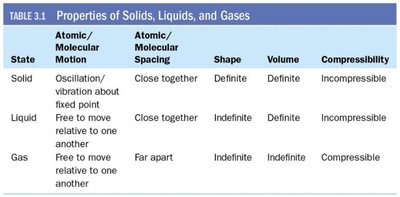
Table Purpose: Comparison of the properties of solids, liquids, and gases, including atomic/molecular motion, spacing, shape, volume, and compressibility.
Solids: Definite shape and volume, incompressible, particles vibrate about fixed positions.
Liquids: Indefinite shape, definite volume, incompressible, particles move relative to one another.
Gases: Indefinite shape and volume, compressible, particles move freely and are far apart.
Classification by Composition
Pure Substances: Composed of only one type of particle (element or compound).
Mixtures: Composed of two or more particles; can be homogeneous (uniform) or heterogeneous (non-uniform).
Elements: Substances that cannot be broken down into simpler substances.
Compounds: Substances composed of two or more elements in fixed proportions.
Homogeneous Mixtures: Uniform composition throughout (e.g., tea).
Heterogeneous Mixtures: Non-uniform composition (e.g., oil and water).
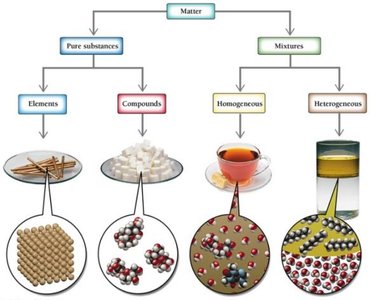
Table Purpose: Visual classification of matter by composition, showing examples of elements, compounds, and mixtures.
Physical and Chemical Properties and Changes
Properties and changes in matter can be classified as physical or chemical.
Physical Properties: Characteristics observed without changing the substance's composition (e.g., melting point, density).
Chemical Properties: Characteristics observed during a chemical change (e.g., flammability, reactivity).
Physical Changes: Changes that do not alter the composition (e.g., melting, boiling).
Chemical Changes: Changes that alter the composition (e.g., rusting, combustion).
Separation Techniques: Mixtures can be separated by physical means such as distillation, evaporation, and filtration, based on differences in physical properties.
Law of Conservation of Mass
The Law of Conservation of Mass states that matter is neither created nor destroyed in a chemical reaction. The total mass of reactants equals the total mass of products.
Measurement and SI Units
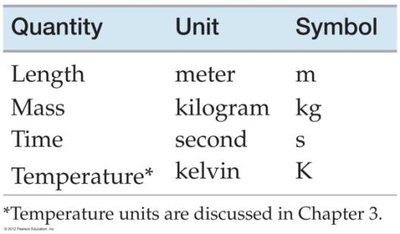
The International System of Units (SI) is the standard for scientific measurements. It includes base units for length, mass, time, and temperature.
Table Purpose: Lists the SI base units for length, mass, time, and temperature.
SI Prefixes: Prefixes are used to indicate multiples or fractions of units.
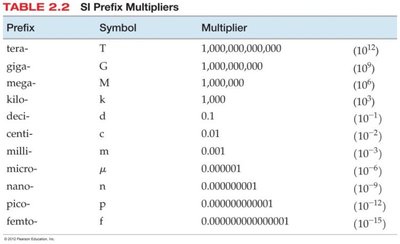
Table Purpose: Shows common SI prefixes, their symbols, and their corresponding multipliers.
Scientific Notation
Scientific notation expresses numbers as a product of a decimal part and a power of ten. It is used to handle very large or very small numbers efficiently.
For numbers greater than one, the exponent is positive.
For numbers less than one, the exponent is negative.
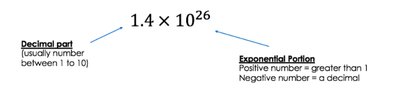
Example: ;
Significant Figures
Significant figures reflect the precision of a measured quantity.
All nonzero digits are significant.
Interior zeros (between nonzero digits) are significant.
Trailing zeros after a decimal point are significant.
Leading zeros are not significant.
Trailing zeros before an implied decimal point are ambiguous; use scientific notation to clarify.
Rounding Rules: Round down if the last digit dropped is 4 or less; round up if it is 5 or more. In multi-step calculations, round only the final answer.
Significant Figures in Calculations
Multiplication/Division: The result has the same number of significant figures as the measurement with the fewest significant figures.
Addition/Subtraction: The result has the same number of decimal places as the measurement with the fewest decimal places.
Problem Solving and Unit Conversion
Unit conversion uses conversion factors to change from one unit to another. The dimensional analysis method ensures units cancel appropriately.

Equation:
Density
Density is the ratio of mass to volume and is a key property for identifying substances and solving conversion problems.

Equation:
or
Chapter 2 – Atoms and Elements
Atomic Theory and Subatomic Particles
Atomic theory describes the structure of atoms, which are composed of protons, neutrons, and electrons.
Proton: Positively charged particle in the nucleus.
Neutron: Neutral particle in the nucleus.
Electron: Negatively charged particle outside the nucleus.
Atomic Number (Z): Number of protons in the nucleus; defines the element.
Mass Number (A): Total number of protons and neutrons.
Isotopes: Atoms of the same element with different numbers of neutrons.
Ions
Cation: Positively charged ion (loss of electrons).
Anion: Negatively charged ion (gain of electrons).
Atomic Mass and Isotopic Abundance
The atomic mass of an element is the weighted average of the masses of its isotopes, based on their natural abundance.
Equation:
The Periodic Table
The periodic table organizes elements by increasing atomic number. Elements are grouped into metals, nonmetals, and metalloids, and into families such as alkali metals, halogens, and noble gases.
Rows: Periods
Columns: Groups or families
The Mole and Avogadro's Number
A mole is a counting unit for atoms and molecules. Avogadro's number () is the number of particles in one mole.
Molar Mass: The mass (in grams) of one mole of a substance, numerically equal to the atomic or molecular mass in amu.
Chapter 3 – Molecules and Compounds
Chemical Bonds and Compounds
Chemical bonds hold atoms together in compounds. There are two main types:
Ionic Bonds: Involve the transfer of electrons from metals to nonmetals, forming ions.
Covalent Bonds: Involve the sharing of electrons between nonmetals.
Ionic Compounds: Composed of cations and anions (e.g., NaCl).
Molecular Compounds: Composed of molecules formed by covalent bonds (e.g., H2O).
Chemical Formulas
Chemical Formula: Shows the types and numbers of atoms in a compound (e.g., H2O).
Empirical Formula: Shows the simplest whole-number ratio of atoms (e.g., CH2O for glucose).
Molecular Formula: Shows the actual number of each atom in a molecule (e.g., C6H12O6).
Nomenclature of Compounds
Systematic naming of compounds follows specific rules:
Ionic Compounds: Name the cation first, then the anion. For metals with variable charge (usually transition metals), indicate the charge with a Roman numeral.
Molecular Compounds: Use prefixes to indicate the number of each atom.
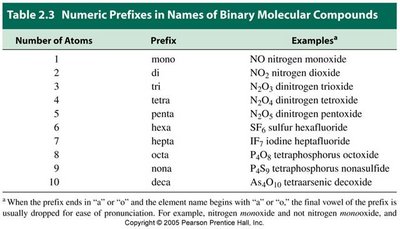
Table Purpose: Lists prefixes for the number of atoms in binary molecular compounds (e.g., mono-, di-, tri-, etc.).
Acids: Named based on the anion present; different rules for binary and oxyacids.
Polyatomic Ions: Memorize common polyatomic ions (e.g., NO3-, SO42-).
Mass Percent Composition and Molar Mass
Mass Percent Composition: The percentage by mass of each element in a compound.
Molar Mass: The mass of one mole of a compound, calculated by summing the atomic masses of all atoms in the formula.
Chemical Equations and Balancing
Chemical equations represent chemical reactions. They must be balanced to obey the law of conservation of mass.
Combustion Reactions: A fuel reacts with O2 to produce CO2 and H2O.
Example:
