 뒤로
뒤로General Chemistry Study Guide: Electron Configurations, Aufbau Principle, and Quantum Numbers
스터디 가이드 - 스마트 노트
 자료에 맞춘 맞춤형 노트, 핵심 정의, 예시, 맥락을 확장해 제공합니다.
Q1. What is the Aufbau Principle? How does it help determine the order in which electrons fill atomic orbitals?
Background
Topic: Electron Configuration and Atomic Structure
This question tests your understanding of the Aufbau Principle, which is a fundamental rule for determining the order in which electrons occupy orbitals in atoms.
Key Terms and Formulas:
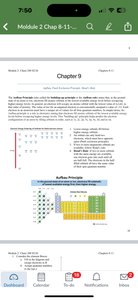
Aufbau Principle: Electrons fill atomic orbitals of the lowest available energy levels before occupying higher levels.
Order of Filling: The order is generally: 1s → 2s → 2p → 3s → 3p → 4s → 3d → 4p → 5s → 4d → 5p → 6s → 4f → 5d → 6p → 7s → 5f → 6d → 7p
Electron Configuration: The arrangement of electrons in an atom's orbitals.
Step-by-Step Guidance
Recall that the Aufbau Principle states electrons fill the lowest energy orbitals first.
Use the periodic table or an Aufbau diagram to determine the order of orbital filling.
Remember that each orbital can hold a specific number of electrons: s (2), p (6), d (10), f (14).
Apply the order to write electron configurations for elements, starting from hydrogen and moving up in atomic number.
Try solving on your own before revealing the answer!
Final Answer:
The Aufbau Principle states that electrons occupy the lowest energy orbitals available, filling them in a specific order (1s, 2s, 2p, 3s, etc.). This principle helps predict the electron configuration of elements by following the order of increasing energy levels, ensuring that electrons fill lower energy orbitals before higher ones.
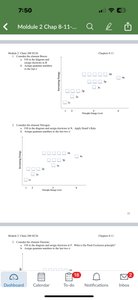
Q2. Examine the electron filling diagrams. Which orbital is being filled in each diagram, and what is the electron configuration shown?
Background
Topic: Electron Configurations and Orbital Diagrams
This question tests your ability to interpret orbital filling diagrams and translate them into electron configurations.
Key Terms and Formulas:
Orbital Diagram: A visual representation of electrons in orbitals using arrows for electrons and boxes/lines for orbitals.
Electron Configuration: Notation showing the distribution of electrons among orbitals (e.g., 1s2 2s2 2p6).
Hund's Rule: Electrons fill degenerate orbitals singly before pairing up.
Step-by-Step Guidance
Identify the type of orbital (s, p, d, or f) based on the number of boxes and their arrangement.
Count the number of arrows (electrons) in each orbital and note their spin direction.
Apply Hund's Rule to check if electrons are filling singly before pairing.
Write the electron configuration corresponding to the diagram, stopping before the final step of summing all electrons.
Try solving on your own before revealing the answer!
Final Answer:
The diagrams show electrons filling the 2p and 3p orbitals, following Hund's Rule. The electron configurations are 1s2 2s2 2p6 for a filled 2p, and 1s2 2s2 2p6 3s2 3p4 for a partially filled 3p orbital.
Q3. What are quantum numbers, and how do they describe the properties of electrons in atoms?
Background
Topic: Quantum Numbers and Atomic Structure
This question tests your understanding of the four quantum numbers that describe the unique quantum state of an electron in an atom.
Key Terms and Formulas:
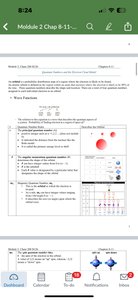
Principal Quantum Number (n): Indicates the main energy level (shell).
Angular Momentum Quantum Number (l): Indicates the subshell (s, p, d, f).
Magnetic Quantum Number (ml): Indicates the orientation of the orbital.
Spin Quantum Number (ms): Indicates the spin direction of the electron (+1/2 or -1/2).
Step-by-Step Guidance
List the four quantum numbers and what each represents.
Explain the allowed values for each quantum number (e.g., n = 1, 2, 3...; l = 0 to n-1; ml = -l to +l; ms = +1/2 or -1/2).
Describe how these numbers together specify the location and properties of an electron in an atom.
Give an example of a set of quantum numbers for a specific electron, but stop before assigning them to a particular element.
Try solving on your own before revealing the answer!
Final Answer:
The four quantum numbers are: n (principal), l (angular momentum), ml (magnetic), and ms (spin). Together, they uniquely describe each electron in an atom by specifying its energy level, subshell, orbital orientation, and spin direction.
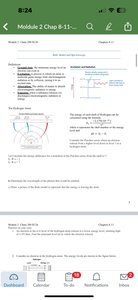
Q4. Examine the energy level diagram for the hydrogen atom. What does each line represent, and how does this relate to electron transitions?
Background
Topic: Atomic Spectra and Electron Transitions
This question tests your understanding of energy levels in the hydrogen atom and how electron transitions between these levels produce spectral lines.
Key Terms and Formulas:
Energy Level Diagram: Shows the allowed energy states for electrons in an atom.
Electron Transition: When an electron moves between energy levels, it absorbs or emits a photon.
Energy of a Photon:
Hydrogen Energy Levels:
Step-by-Step Guidance
Identify the meaning of each horizontal line in the diagram (each represents a quantized energy level for the electron).
Explain what happens when an electron moves from a higher to a lower energy level (emission of a photon).
Describe what happens when an electron moves from a lower to a higher energy level (absorption of a photon).
Relate these transitions to the observed spectral lines in the hydrogen emission spectrum, but stop before calculating specific wavelengths.
Try solving on your own before revealing the answer!
Final Answer:
Each line in the energy level diagram represents a specific allowed energy state for the electron in a hydrogen atom. When an electron transitions between these levels, it absorbs or emits energy as a photon, producing the spectral lines observed in hydrogen's emission or absorption spectrum.
Q5. What is Hund's Rule, and how does it affect the way electrons fill degenerate orbitals?
Background
Topic: Electron Configuration and Orbital Filling
This question tests your understanding of Hund's Rule, which governs the arrangement of electrons in orbitals of the same energy (degenerate orbitals).
Key Terms and Formulas:
Hund's Rule: Electrons occupy degenerate orbitals singly with parallel spins before pairing up.
Degenerate Orbitals: Orbitals with the same energy (e.g., the three p orbitals in a given shell).
Step-by-Step Guidance
Recall that degenerate orbitals are those with the same energy (e.g., p, d, or f orbitals in the same shell).
State Hund's Rule: electrons fill each degenerate orbital singly before any orbital gets a second electron.
Explain why this minimizes electron-electron repulsion and stabilizes the atom.
Apply Hund's Rule to a set of p orbitals, showing how electrons are distributed, but stop before showing the complete configuration for a specific element.
Try solving on your own before revealing the answer!
Final Answer:
Hund's Rule states that electrons fill degenerate orbitals singly and with parallel spins before pairing up. This arrangement minimizes electron repulsion and leads to the most stable configuration for the atom.
