 뒤로
뒤로CHEM 131 Chapter 5: Limiting Reactants, Solution Stoichiometry, and Aqueous Reactions
스터디 가이드 - 스마트 노트
 자료에 맞춘 맞춤형 노트, 핵심 정의, 예시, 맥락을 확장해 제공합니다.
Limiting and Excess Reactants
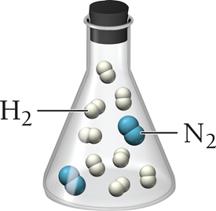
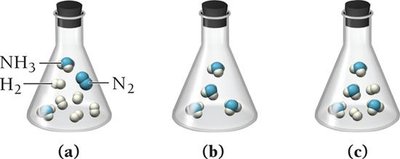
Visualizing Limiting vs. Excess Reactants
In chemical reactions, the limiting reactant is the substance that is completely consumed first, thus determining the maximum amount of product that can be formed. The excess reactant is the substance that remains after the reaction is complete. Identifying these reactants is crucial for predicting yields and understanding reaction stoichiometry.
Limiting Reactant: The reactant that produces the smallest amount of product when calculations are performed for each reactant.
Excess Reactant: The reactant that is not completely used up in the reaction.
Example: For the reaction , if you start with a mixture of and , the reactant that runs out first limits the amount of produced.
Calculating Limiting Reactant and Theoretical Yield
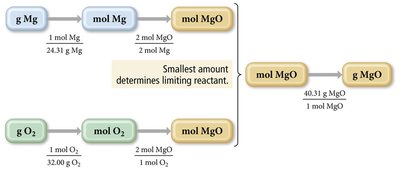
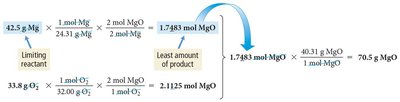
To determine the limiting reactant and theoretical yield, convert the mass of each reactant to moles, use stoichiometry to find the amount of product each can form, and identify the smallest value. The reactant that forms the least product is limiting.
Convert grams of each reactant to moles.
Use the balanced equation to convert moles of reactant to moles of product.
The reactant that produces the least amount of product is the limiting reactant.
The theoretical yield is the amount of product formed from the limiting reactant.
Reactions of Alkali Metals and Halogens
Alkali Metal Reactions
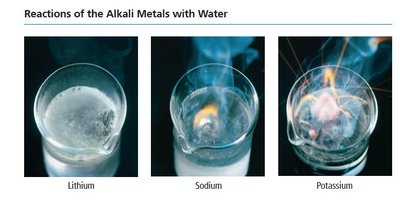
Alkali metals (Group 1) react vigorously with nonmetals and water. Their reactions with water produce hydrogen gas and a basic solution containing the alkali metal hydroxide.
Reaction with Water:
Example: Sodium reacts with water to form sodium hydroxide and hydrogen gas.
Halogens
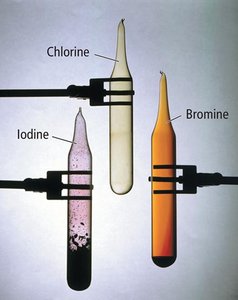
Halogens (Group 17) are highly reactive nonmetals that form salts with metals and react with hydrogen to form hydrogen halides.
Reaction with Metals:
Reaction with Hydrogen: , where X is a halogen.
Introduction to Solutions and Aqueous Reactions
Solution Concentration
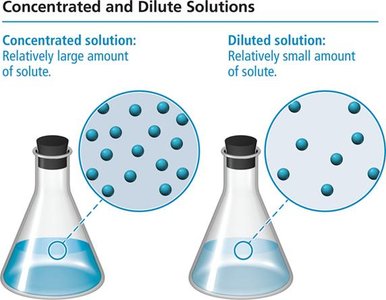
A solution is a homogeneous mixture of two or more substances. The solute is the minor component, and the solvent is the major component. Solutions can be described as dilute or concentrated based on the amount of solute present.
Dilute Solution: Small amount of solute relative to solvent.
Concentrated Solution: Large amount of solute relative to solvent.
Molarity
Molarity (M) is a common unit for expressing solution concentration, defined as the number of moles of solute per liter of solution.
Formula:

Preparing Solutions of Specified Concentration
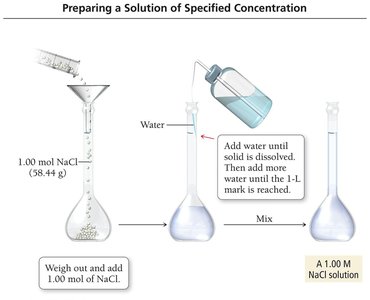
To prepare a solution of a specific molarity, dissolve the calculated amount of solute in a volumetric flask and add solvent up to the desired volume.
Weigh the required mass of solute.
Add to a volumetric flask and dissolve in solvent.
Fill to the calibration mark with solvent.
Using Molarity in Calculations
Molarity can be used as a conversion factor between moles of solute and liters of solution.
To find moles:
To find volume:



Solution Stoichiometry
In aqueous reactions, the volume and concentration of a reactant can be used to calculate the amount in moles, which can then be related to other reactants or products using stoichiometry.
General plan: Volume A → Amount A (in moles) → Amount B (in moles) → Volume B

Types of Aqueous Solutions and Solubility
Electrolyte and Nonelectrolyte Solutions
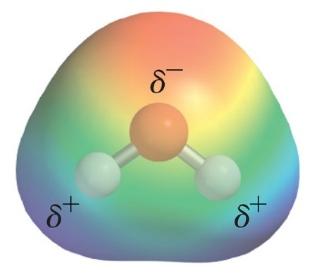
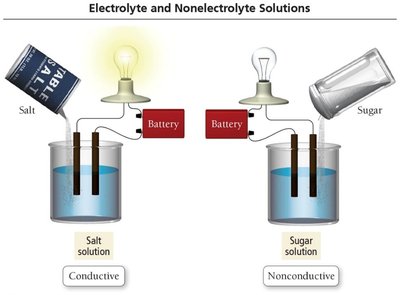
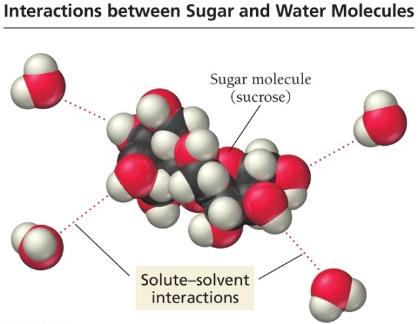
Electrolytes are substances that dissolve in water to form solutions that conduct electricity, typically ionic compounds. Nonelectrolytes do not conduct electricity, such as most molecular compounds like sugar.
Strong Electrolytes: Completely dissociate into ions (e.g., NaCl).
Weak Electrolytes: Partially dissociate into ions (e.g., acetic acid).
Nonelectrolytes: Do not dissociate into ions (e.g., sucrose).
Dissolution of Ionic and Molecular Compounds
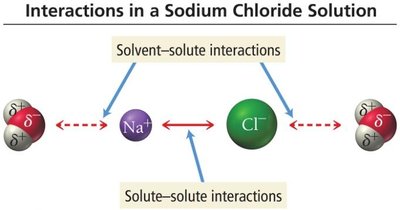
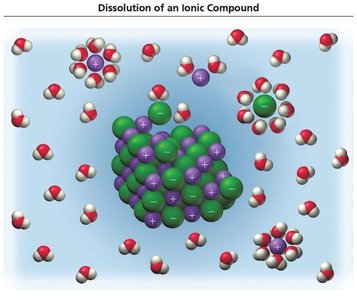
When ionic compounds dissolve, they separate into their constituent ions. Molecular compounds like sugar dissolve without forming ions.
Example (Ionic):
Example (Molecular): Sucrose dissolves as intact molecules.
Solubility Rules
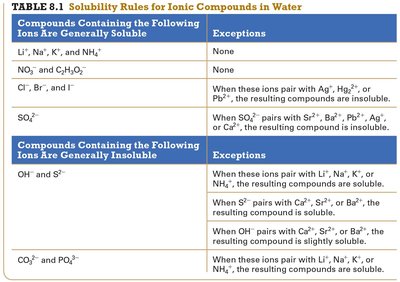
Solubility rules help predict whether an ionic compound will dissolve in water. Compounds containing alkali metal ions and ammonium are generally soluble, while those containing carbonate or phosphate are generally insoluble unless paired with certain cations.
Compounds Generally Soluble | Exceptions |
|---|---|
Li+, Na+, K+, NH4+ | None |
NO3-, C2H3O2- | None |
Cl-, Br-, I- | Ag+, Hg22+, Pb2+ |
SO42- | Sr2+, Ba2+, Pb2+, Ca2+ |
Compounds Generally Insoluble | Exceptions |
OH-, S2- | Li+, Na+, K+, NH4+, Ca2+, Sr2+, Ba2+ |
CO32-, PO43- | Li+, Na+, K+, NH4+ |
Precipitation Reactions
Formation of a Precipitate
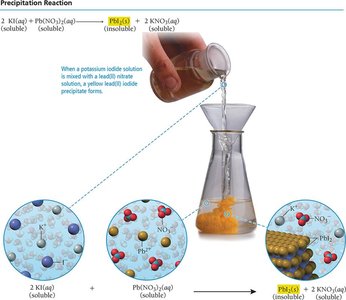
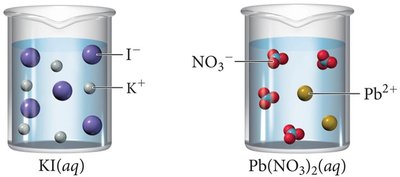
Precipitation reactions occur when two aqueous solutions are mixed and an insoluble solid (precipitate) forms. The reaction can be predicted using solubility rules.
Example:
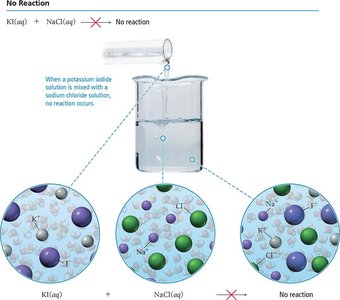
If no insoluble product forms, write "no reaction".
Predicting Precipitation Reactions
To predict the products of a precipitation reaction:
Identify the ions present in each reactant.
Exchange the ions to form possible products.
Use solubility rules to determine if a precipitate forms.
Write the balanced equation, indicating the state of each product.
Representing Aqueous Reactions
Molecular, Complete Ionic, and Net Ionic Equations
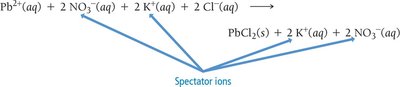
Chemical reactions in solution can be represented in three ways:
Molecular Equation: Shows all compounds as neutral substances.
Complete Ionic Equation: Shows all strong electrolytes as ions.
Net Ionic Equation: Shows only the species that actually change during the reaction (no spectator ions).
Acid–Base Reactions
Arrhenius Definitions
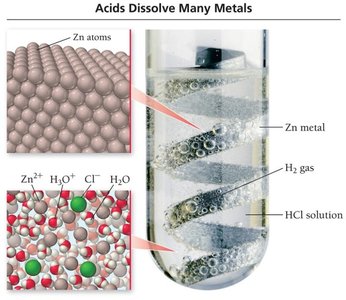
According to Arrhenius, an acid produces ions in aqueous solution, while a base produces ions. Acid–base reactions are also called neutralization reactions, producing water and a salt.
Example:
Net Ionic Equation:
Acid–Base Titration
A titration is a laboratory technique used to determine the concentration of an unknown solution by reacting it with a solution of known concentration. The equivalence point is when stoichiometric amounts of acid and base have reacted.
Indicator: A dye that changes color at (or near) the equivalence point.
Gas-Evolution and Redox Reactions
Gas-Evolution Reactions
Some reactions in aqueous solution produce a gas, either directly or by decomposition of an intermediate product. Common gases evolved include , , , and .
Example:
Oxidation–Reduction (Redox) Reactions
Redox reactions involve the transfer of electrons between substances. Oxidation is the loss of electrons, and reduction is the gain of electrons. The substance that loses electrons is oxidized (reducing agent), and the one that gains electrons is reduced (oxidizing agent).
Example:
Oxidation:
Reduction:
Assigning Oxidation States
Oxidation states are assigned using a set of rules to track electron transfer in redox reactions. Free elements have an oxidation state of 0, monatomic ions equal their charge, and the sum of oxidation states in a compound is zero.
Oxygen is usually -2, hydrogen is +1, and halogens are usually -1.
Metal Activity Series
The activity series ranks metals by their tendency to be oxidized. A metal higher in the series will reduce the ions of a metal lower in the series, predicting whether a redox reaction will occur spontaneously.
