 뒤로
뒤로Matter and Measurement: Foundations of General Chemistry
스터디 가이드 - 스마트 노트
 자료에 맞춘 맞춤형 노트, 핵심 정의, 예시, 맥락을 확장해 제공합니다.
Matter and Measurement
Classification of Matter
Matter is anything that occupies space and has mass. It can be classified based on its composition and physical state.
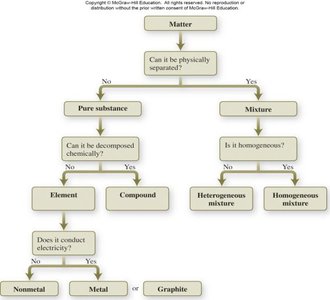
Pure Substances: Have a uniform chemical composition throughout and from sample to sample. They can be elements or compounds.
Mixtures: Composed of two or more pure substances. Mixtures can be homogeneous (uniform composition) or heterogeneous (non-uniform composition).
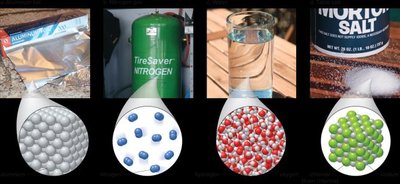
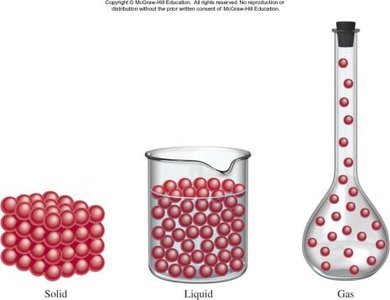
States of Matter: Solid (definite shape and volume), Liquid (definite volume, no definite shape), Gas (no definite shape or volume).

Elements: Substances that cannot be decomposed into simpler substances by chemical means.
Compounds: Substances composed of two or more elements in a fixed ratio.
Homogeneous Mixtures (Solutions): Uniform composition throughout.
Heterogeneous Mixtures: Non-uniform composition, components are distinguishable.
Physical and Chemical Properties and Changes
Properties of matter can be classified as physical or chemical, and changes can be physical or chemical.
Physical Properties: Can be observed without changing the chemical identity of the substance (e.g., color, melting point, density).
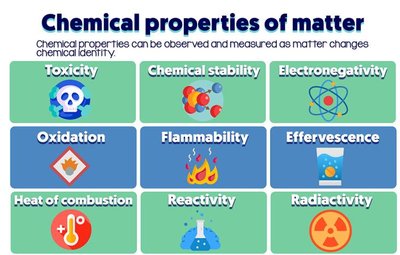
Chemical Properties: Describe how a substance reacts with other substances (e.g., flammability, reactivity).
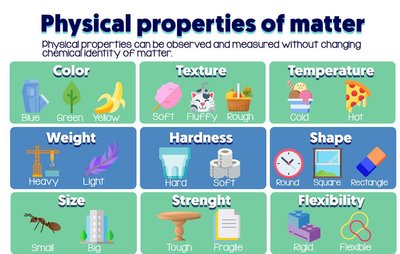
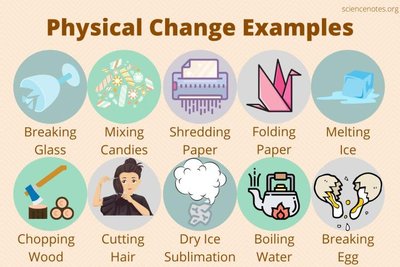
Physical Changes: Changes that do not alter the chemical composition (e.g., melting, boiling, dissolving).
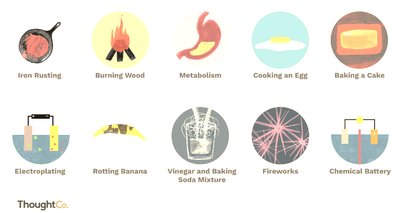
Chemical Changes: Changes that result in the formation of new substances (e.g., rusting, burning).
Properties of Matter: Intensive and Extensive
Properties can also be classified based on their dependence on the amount of matter present.
Extensive Properties: Depend on the amount of matter (e.g., mass, volume).
Intensive Properties: Independent of the amount of matter (e.g., density, temperature).
Measurement and Units
Measurements in chemistry require standardized units and careful attention to precision and accuracy.
SI Units: The International System of Units is used for scientific measurements (e.g., meter for length, kilogram for mass, second for time).
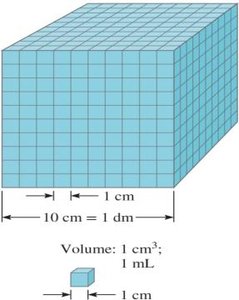
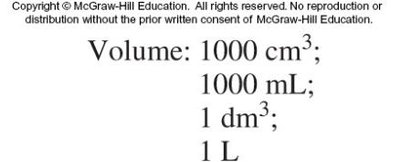
Derived Units: Formed from base units (e.g., volume in cubic meters, density in kg/m3).
Mass vs. Weight: Mass is the amount of matter; weight is the force of gravity on that mass.
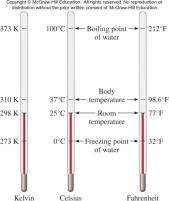
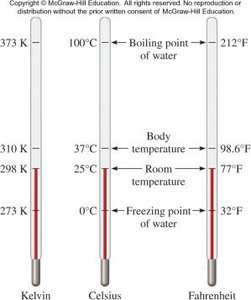
Temperature Scales: Celsius (°C), Kelvin (K), and Fahrenheit (°F). Kelvin is the SI unit for temperature.
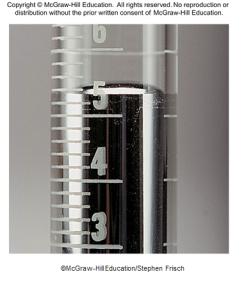
Density
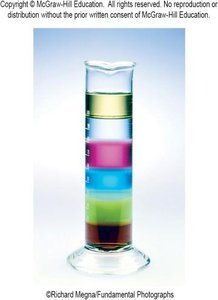
Density is an important intensive property defined as mass per unit volume.
Formula:
Units: Commonly g/cm3 or g/mL for liquids and solids; kg/m3 for gases.
Significant Figures and Scientific Notation
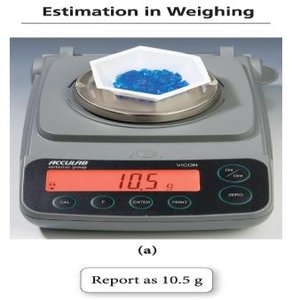
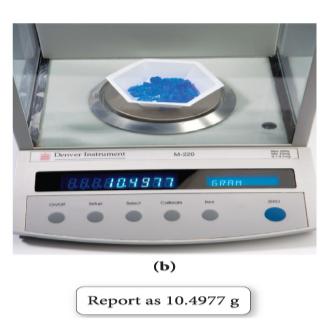
Significant figures reflect the precision of a measurement. Scientific notation is used to express very large or small numbers.
Rules for Significant Figures: All nonzero digits are significant; zeros between nonzero digits are significant; leading zeros are not significant; trailing zeros are significant only if there is a decimal point.
Calculations: For multiplication/division, the result has as many significant figures as the measurement with the fewest. For addition/subtraction, the result has as many decimal places as the measurement with the fewest decimal places.

Scientific Notation: Numbers are written as , where is a number between 1 and 10, and is an integer.
Precision, Accuracy, and Error
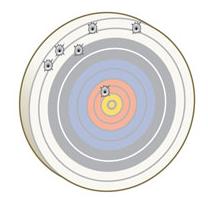
Reliability of measurements is assessed by precision and accuracy.
Precision: How close repeated measurements are to each other.
Accuracy: How close a measurement is to the true value.
Random Error: Error that varies unpredictably.
Systematic Error: Error that is consistently too high or too low.
Dimensional Analysis and Conversion Factors
Dimensional analysis is a method for converting between units using conversion factors.
Conversion Factor: A ratio equal to one, used to convert from one unit to another (e.g., ).
Process: Multiply the original quantity by conversion factors so that units cancel appropriately, leaving the desired unit.
Tables
Table: Some Common Elements and Their Symbols
Name | Symbol | Name | Symbol | Name | Symbol |
|---|---|---|---|---|---|
Aluminum | Al | Fluorine | F | Oxygen | O |
Gold | Au | Hydrogen | H | Phosphorus | P |
Iron | Fe | Lead | Pb | Silver | Ag |
Magnesium | Mg | Sodium | Na | Sulfur | S |
Chlorine | Cl | Zinc | Zn | Copper | Cu |
Table: SI Base Units
Base Quantity | Name of Unit | Symbol |
|---|---|---|
Length | meter | m |
Mass | kilogram | kg |
Time | second | s |
Temperature | kelvin | K |
Amount of substance | mole | mol |
Table: Densities of Some Common Substances
Substance | Physical State | Density (g/mL) |
|---|---|---|
Helium | Gas | 0.000178 |
Oxygen | Gas | 0.00143 |
Cooking oil | Liquid | 0.92 |
Water | Liquid | 1.00 |
Mercury | Liquid | 13.6 |
Gold | Solid | 19.3 |
Copper | Solid | 8.92 |
Zinc | Solid | 7.14 |
Ice | Solid | 0.92 |
Examples
Density Calculation: If a gold ingot has a mass of 301 g and a volume of 15.6 cm3, its density is .
Temperature Conversion: To convert from Celsius to Kelvin:
Significant Figures in Multiplication: (rounded to 3 significant figures)
Additional info: This summary covers the foundational concepts of matter and measurement, including classification, properties, changes, measurement techniques, and the importance of significant figures and unit conversions in chemistry. These concepts are essential for all subsequent topics in General Chemistry.
