 뒤로
뒤로Periodic Patterns in the Main-Group Elements: Groups 5A(15), 6A(16), 7A(17), and 8A(18)
스터디 가이드 - 스마트 노트
 자료에 맞춘 맞춤형 노트, 핵심 정의, 예시, 맥락을 확장해 제공합니다.
Periodic Patterns in the Main-Group Elements
Introduction
This section explores the chemistry of the main-group elements, focusing on periodic trends, structures, and chemical properties of Groups 5A(15) through 8A(18). These groups include the nitrogen, oxygen, halogen, and noble gas families, each exhibiting unique behaviors and trends across the periodic table.
Group 5A(15): The Nitrogen Family
Physical and Chemical Properties
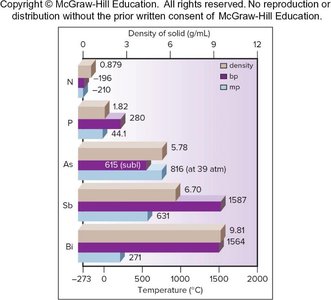
Nitrogen (N2) is a diatomic gas with a very low boiling point due to weak intermolecular forces.
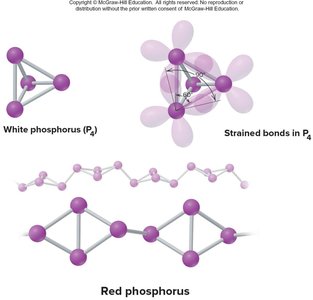
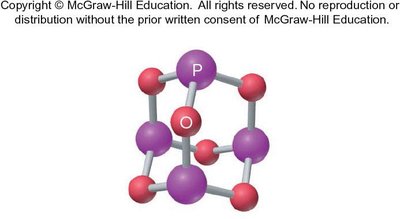
Phosphorus (P4) exists as tetrahedral molecules with stronger dispersion forces than N2.
Arsenic (As) and Antimony (Sb) form covalent network structures, resulting in high melting points.
Bismuth (Bi) exhibits metallic bonding and has a lower melting point than As or Sb.
Trends and Reactivity
Nitrogen tends to gain three electrons to form N3− in compounds with active metals.
Heavier group members are more metallic and lose electrons to form cations.
Oxides transition from acidic (N) to amphoteric (Sb) to basic (Bi) down the group.
All group members form hydrides (EH3), but only NH3 is stable and non-toxic.
Oxides of Nitrogen
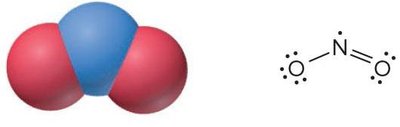
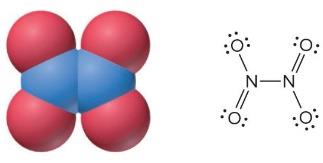
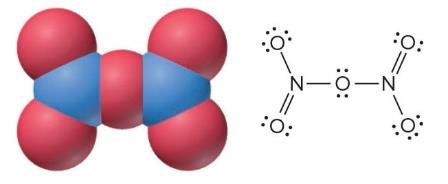
Nitrogen forms six stable oxides, all with positive enthalpies of formation due to the strong N≡N bond.
Key reactions:
Ammonia oxidation:
Disproportionation:
NO2 is a component of photochemical smog.
Structures and Properties of Nitrogen Oxides
The following table summarizes the main nitrogen oxides:
Formula | Name | Oxidation State of N | ΔHf° (kJ/mol) | Comments |
|---|---|---|---|---|
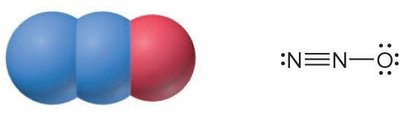
N2O | Dinitrogen monoxide | +1 | 82.0 | Colorless gas; dental anesthetic |
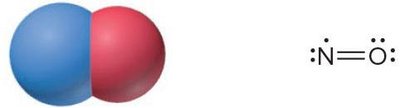
NO | Nitrogen monoxide | +2 | 90.3 | Colorless, paramagnetic gas; air pollutant |
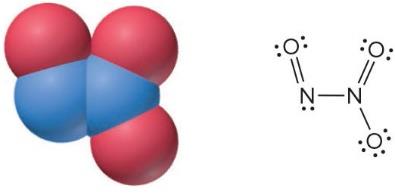
N2O3 | Dinitrogen trioxide | +3 | 83.7 | Reddish-brown gas; dissociates to NO and NO2 |
NO2 | Nitrogen dioxide | +4 | 33.2 | Orange-brown, paramagnetic gas; poisonous |
N2O4 | Dinitrogen tetroxide | +4 | 9.16 | Colorless to yellow liquid; dissociates to NO2 |
N2O5 | Dinitrogen pentoxide | +5 | 11.3 | Colorless, volatile solid |
Nitrogen Oxoacids and Oxoanions
Nitric acid (HNO3) is a strong acid and oxidizing agent, produced industrially by the Ostwald process.
Nitrate (NO3−) is a strong oxidizer; all nitrate salts are water soluble.
Nitrous acid (HNO2) is much weaker than nitric acid, consistent with the trend that more O atoms increase acid strength.
Important Oxides and Oxoacids of Phosphorus
P4O6: Phosphorus in +3 oxidation state.
P4O10: Phosphorus in +5 oxidation state; a powerful drying agent.
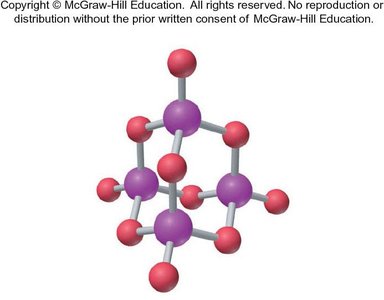
H3PO3: Only two acidic hydrogens; the third is bonded to P and does not dissociate.
H3PO4: Three acidic hydrogens; weak acid, but all three H+ can be lost in strong base to give phosphate anion.
Polyphosphates
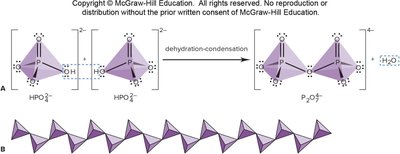
Hydrogen phosphates lose water upon heating to form polyphosphates, which contain P–O–P linkages.
Summary Table: Group 5A(15) Elements
Group 6A(16): The Oxygen Family
Physical and Chemical Properties
Oxygen (O2) is a low-boiling diatomic gas essential for life.
Sulfur (S8) is a polyatomic molecular solid with many allotropes due to catenation.
Selenium (Se) is a gray metalloid; Tellurium (Te) has a covalent network structure; Polonium (Po) is metallic.
Allotropes of Oxygen and Sulfur
Oxygen: O2 (essential) and O3 (ozone, poisonous).
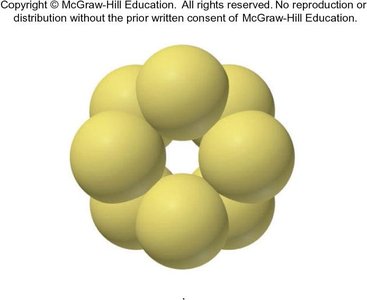
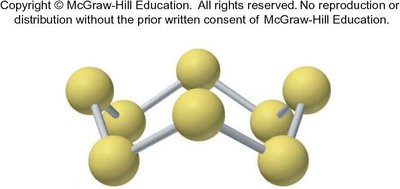
Sulfur: More than 10 allotropes, most stable is orthorhombic α-S8 (crown-shaped ring).
Hydrides and Halides
Oxygen forms H2O and H2O2; the latter has O in a -1 oxidation state.
Other group hydrides (e.g., H2S) are toxic gases.
Hydride bond angles decrease and bond lengths increase down the group.
Group 6A elements (except O) form a wide range of halides; stability increases with central atom size.
Oxygen Species: Oxides, Superoxides, Peroxides
Dioxygen (O2): Neutral, double bond, paramagnetic.
Superoxide (O2−): Radical, -1 charge, bond order 1.5.
Peroxide (O22−): Single bond, -2 charge.
Oxide (O2−): Monatomic ion, noble gas configuration.
Highlights of Sulfur Chemistry
Sulfur Dioxide (SO2): S in +4 state, colorless, choking gas.
Sulfur Trioxide (SO3): S in +6 state.
Sulfurous Acid (H2SO3): Weak acid, two acidic protons.
Sulfuric Acid (H2SO4): Strong acid, important industrial chemical, excellent dehydrating agent.
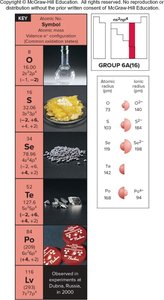
Summary Table: Group 6A(16) Elements
Group 7A(17): The Halogens
Physical and Chemical Properties
Halogens are highly reactive nonmetals, needing one electron to fill their valence shell.
Reactivity decreases down the group as electronegativity decreases.
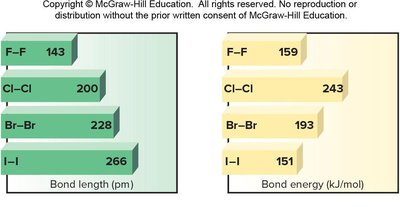
Bond energies and bond lengths vary; F2 has an anomalously weak bond due to lone pair repulsions.
Reactivity and Oxidizing Ability
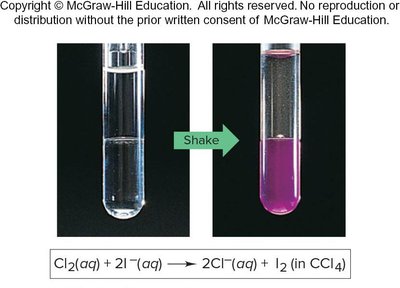
Halogens oxidize many metals and nonmetals; react with H2 to form HX.
Undergo disproportionation in water and base, forming hypohalites and halates.
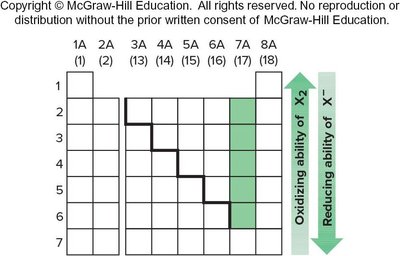
Oxidizing ability decreases down the group; reducing ability of X− increases.
Interhalogen Compounds and Oxoacids
Halogens form interhalogen compounds; central atom is less electronegative and in a positive oxidation state.
Odd-numbered groups show odd oxidation states; even-numbered groups show even oxidation states.
Halogen oxoacids: Acid strength increases with halogen electronegativity and oxidation state.
Central Atom | Hypohalous Acid (HOX) | Halous Acid (HOXO) | Halic Acid (HOXO2) | Perhalic Acid (HOXO3) |
|---|---|---|---|---|
Fluorine | HOF | — | — | — |
Chlorine | HOCl | HOClO | HOClO2 | HOClO3 |
Bromine | HOBr | HOBrO | HOBrO2 | HOBrO3 |
Iodine | HOI | — | HOIO2 | HOIO3, (HO)5IO |

Group 8A(18): The Noble Gases
Physical and Chemical Properties
Noble gases have full valence shells, making them chemically inert.
They are the smallest elements in their periods, with the highest ionization energies.
Atomic size increases and ionization energy decreases down the group.
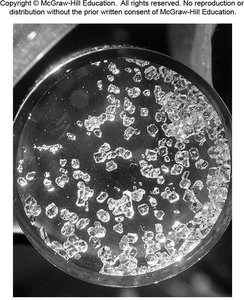
Very low melting and boiling points; only Kr, Xe, and Rn form compounds, with Xe being the most reactive.
Summary
Main-group elements show clear periodic trends in structure, bonding, and reactivity.
Understanding these trends is essential for predicting chemical behavior and properties across the periodic table.
