 뒤로
뒤로Periodic Properties of the Elements: Electronic Structure, Periodicity, and Trends
스터디 가이드 - 스마트 노트
 자료에 맞춘 맞춤형 노트, 핵심 정의, 예시, 맥락을 확장해 제공합니다.
Electronic Structure of Atoms
Quantum Numbers and Electron Spin
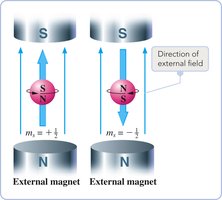
Each electron in an atom is described by four quantum numbers: the principal quantum number (n), angular momentum quantum number (l), magnetic quantum number (m_l), and spin quantum number (m_s). The spin quantum number (m_s) can have values of +½ or -½, corresponding to the two possible orientations of electron spin. Electron spin gives rise to magnetic properties, as demonstrated by the splitting of a beam of hydrogen atoms in a magnetic field.
n: Principal quantum number (energy level)
l: Angular momentum quantum number (subshell type: s, p, d, f)
m_l: Magnetic quantum number (orbital orientation)
m_s: Spin quantum number (+½ or -½)
Example: The Stern-Gerlach experiment demonstrated the two possible spin states of electrons.
Electron Configurations and the Pauli Exclusion Principle
An electron configuration describes the distribution of electrons among the available subshells. The Pauli exclusion principle states that no two electrons in an atom can have the same set of four quantum numbers. Thus, an orbital can hold a maximum of two electrons, which must have opposite spins.
s subshell: 1 orbital, max 2 electrons
p subshell: 3 orbitals, max 6 electrons
d subshell: 5 orbitals, max 10 electrons
f subshell: 7 orbitals, max 14 electrons
The Building-Up (Aufbau) Principle
The building-up principle (Aufbau principle) is used to determine the ground-state electron configuration of atoms by filling orbitals in order of increasing energy. The general order is:
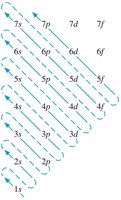
Example: The electron configuration of boron (Z = 5) is 1s2 2s2 2p1.
Writing Electron Configurations Using the Periodic Table
The periodic table can be used to determine electron configurations. The period number corresponds to the principal quantum number (n), and the table is divided into blocks (s, p, d, f) corresponding to the subshell being filled.
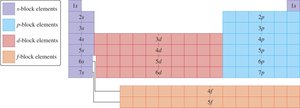
s-block: Groups 1 and 2
p-block: Groups 13–18
d-block: Transition metals (Groups 3–12)
f-block: Lanthanides and actinides
Example: The electron configuration of cobalt (Z = 27) is 1s2 2s2 2p6 3s2 3p6 4s2 3d7.
Types of Electron Configurations
Complete configuration: Lists all subshells (e.g., Br: 1s2 2s2 2p6 3s2 3p6 4s2 3d10 4p5)
Noble-gas core: Uses the previous noble gas as a core (e.g., Br: [Ar] 3d10 4s2 4p5)
Valence configuration: Shows only electrons outside the noble-gas core (e.g., Br: 4s2 4p5)
Exceptions to the Building-Up Order
Some elements, such as chromium (Cr) and copper (Cu), have electron configurations that differ from the predicted order due to increased stability of half-filled or fully filled d subshells.
Cr: 1s2 2s2 2p6 3s2 3p6 3d5 4s1
Cu: 1s2 2s2 2p6 3s2 3p6 3d10 4s1
Orbital Diagrams and Hund’s Rule
Orbital Diagrams
Orbital diagrams visually represent the arrangement of electrons in orbitals. Each orbital is shown as a circle or box, and electrons are represented by arrows indicating spin direction.
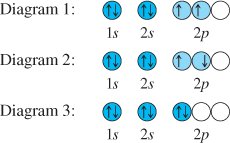
Example: For carbon (Z = 6), the orbital diagram is:
1s: ↑↓
2s: ↑↓
2p: ↑ ↑ (one electron in each of two 2p orbitals, parallel spins)
Hund’s Rule
Hund’s rule states that the lowest-energy arrangement of electrons in a subshell is achieved by placing electrons in separate orbitals with parallel spins before pairing them. This minimizes electron-electron repulsion and stabilizes the atom.
Example: For nitrogen (Z = 7), the 2p electrons occupy three separate orbitals with parallel spins.
Allowed and Forbidden Configurations
According to the Pauli exclusion principle, certain electron configurations are not allowed. For example, a p subshell cannot hold more than 6 electrons, and two electrons in the same orbital must have opposite spins.
Magnetic Properties of Atoms
Paramagnetism and Diamagnetism
Atoms with unpaired electrons are paramagnetic and are weakly attracted by a magnetic field. Atoms with only paired electrons are diamagnetic and are not attracted by a magnetic field.
Paramagnetic: Oxygen (O), due to unpaired electrons
Diamagnetic: Neon (Ne), all electrons are paired
Periodicity of the Elements
Mendeleev’s Periodic Law
The periodic law states that when elements are arranged by increasing atomic number, their physical and chemical properties show periodic trends. These trends are explained by the periodicity of electron configurations.
Atomic Radius
The atomic radius is a measure of the size of an atom. It increases down a group (due to additional electron shells) and decreases across a period (due to increasing effective nuclear charge).
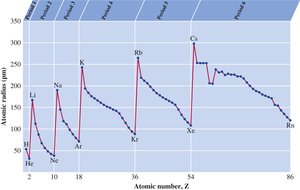
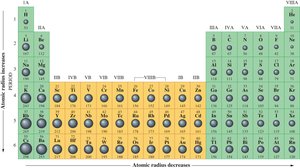
Group trend: Atomic radius increases down a group.
Period trend: Atomic radius decreases across a period.
Effective Nuclear Charge (Zeff)
The effective nuclear charge is the net positive charge experienced by an electron in a multi-electron atom. It increases across a period, causing atomic size to decrease.
Ionization Energy
Ionization energy is the energy required to remove an electron from a gaseous atom. It generally increases across a period and decreases down a group.
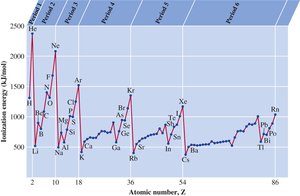
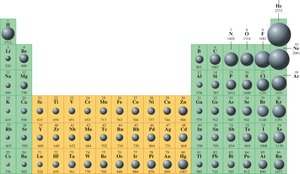
Group trend: Ionization energy decreases down a group.
Period trend: Ionization energy increases across a period.
There are small deviations between Groups IIA and IIIA, and VA and VIA, due to subshell stability.
Electron Affinity
Electron affinity is the energy change when an electron is added to a neutral atom. A more negative value indicates a greater tendency to gain an electron. Electron affinity generally becomes more negative across a period, with exceptions in Groups IIA and VA.
Metallic Character
Metallic character increases down a group and decreases across a period. Metals have low ionization energies and tend to lose electrons, while nonmetals have high ionization energies and tend to gain electrons.
Periodicity in the Main-Group Elements
Oxides of Main-Group Elements
Basic oxides: React with acids; most metal oxides
Acidic oxides: React with bases; most nonmetal oxides
Amphoteric oxides: React with both acids and bases
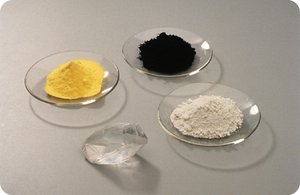
Example: Group IIIA oxides: B2O3 (acidic), Al2O3 (amphoteric)
Electron Configurations of Ions
Main-Group Ions
Main-group elements form ions by gaining or losing electrons to achieve a noble-gas configuration. For example, Cl (Z = 17) gains one electron to form Cl− with the configuration 1s2 2s2 2p6 3s2 3p6.
Transition Metal Ions
Transition metals typically lose ns electrons before (n–1)d electrons. For example, Fe (Z = 26):
Fe: [Ar] 4s2 3d6
Fe2+: [Ar] 3d6
Fe3+: [Ar] 3d5
Ionic Radii and Isoelectronic Series
Ionic radius is the size of an ion. Cations are smaller than their parent atoms, while anions are larger. In an isoelectronic series (ions with the same number of electrons), ionic radius decreases with increasing atomic number.
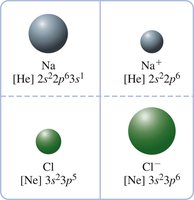
Example: Na+ is smaller than Na; Cl− is larger than Cl.
Summary Table: Ground-State Electron Configurations (Z = 1 to 36)
Z | Element | Configuration | Z | Element | Configuration |
|---|---|---|---|---|---|
1 | H | 1s1 | 19 | K | 1s22s22p63s23p64s1 |
2 | He | 1s2 | 20 | Ca | 1s22s22p63s23p64s2 |
3 | Li | 1s22s1 | 21 | Sc | 1s22s22p63s23p64s23d1 |
4 | Be | 1s22s2 | 22 | Ti | 1s22s22p63s23p64s23d2 |
5 | B | 1s22s22p1 | 23 | V | 1s22s22p63s23p64s23d3 |
6 | C | 1s22s22p2 | 24 | Cr | 1s22s22p63s23p64s13d5 |
7 | N | 1s22s22p3 | 25 | Mn | 1s22s22p63s23p64s23d5 |
8 | O | 1s22s22p4 | 26 | Fe | 1s22s22p63s23p64s23d6 |
9 | F | 1s22s22p5 | 27 | Co | 1s22s22p63s23p64s23d7 |
10 | Ne | 1s22s22p6 | 28 | Ni | 1s22s22p63s23p64s23d8 |
11 | Na | 1s22s22p63s1 | 29 | Cu | 1s22s22p63s23p64s13d10 |
12 | Mg | 1s22s22p63s2 | 30 | Zn | 1s22s22p63s23p64s23d10 |
13 | Al | 1s22s22p63s23p1 | 31 | Ga | 1s22s22p63s23p64s23d104p1 |
14 | Si | 1s22s22p63s23p2 | 32 | Ge | 1s22s22p63s23p64s23d104p2 |
15 | P | 1s22s22p63s23p3 | 33 | As | 1s22s22p63s23p64s23d104p3 |
16 | S | 1s22s22p63s23p4 | 34 | Se | 1s22s22p63s23p64s23d104p4 |
17 | Cl | 1s22s22p63s23p5 | 35 | Br | 1s22s22p63s23p64s23d104p5 |
18 | Ar | 1s22s22p63s23p6 | 36 | Kr | 1s22s22p63s23p64s23d104p6 |
Additional info: This table summarizes the ground-state electron configurations for the first 36 elements, which is essential for understanding periodic trends and chemical behavior.
