 뒤로
뒤로CHEM 131 Chapter 9: Periodic Properties of the Elements: Structure, Trends, and Electron Configuration
스터디 가이드 - 스마트 노트
 자료에 맞춘 맞춤형 노트, 핵심 정의, 예시, 맥락을 확장해 제공합니다.
Periodic Properties of the Elements
Introduction to the Periodic Table
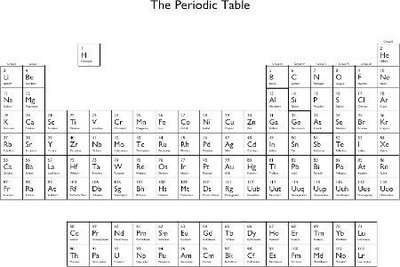
The periodic table is a systematic arrangement of elements that reveals recurring trends in their chemical and physical properties. Its structure is based on atomic number, electron configuration, and recurring chemical characteristics.
Dmitry Mendeleev designed the first widely recognized periodic table in 1869, ordering elements by atomic mass and grouping those with similar properties.
The periodic law states: When elements are arranged in order of increasing atomic number, certain sets of properties recur periodically.
Modern periodic tables are organized by atomic number (number of protons), not atomic mass.

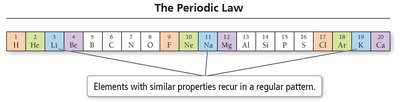
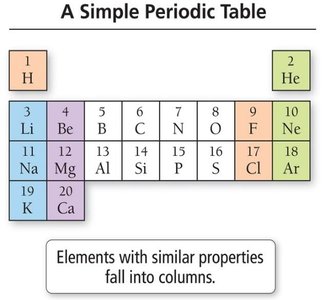
Classification of Elements
Elements are classified based on their electron configuration and general properties:
Main-group elements (s- and p-block)
Transition metals (d-block)
Inner transition metals (f-block)
By properties: metals, nonmetals, and metalloids
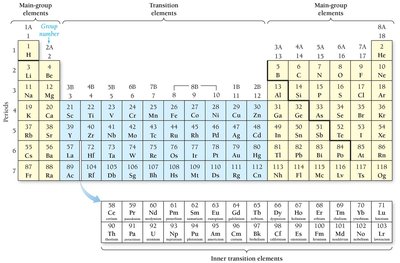
Quantum Numbers and Electron Configuration
Quantum Numbers
Quantum numbers describe the unique quantum state of an electron in an atom:
Principal quantum number (n): Indicates the main energy level or shell.
Angular momentum quantum number (l): Indicates the subshell (s, p, d, f).
Magnetic quantum number (ml): Specifies the orbital within a subshell.
Spin quantum number (ms): Specifies the electron's spin (+1/2 or -1/2).
The Pauli Exclusion Principle states that no two electrons in an atom can have the same set of four quantum numbers.
Electron Configuration Principles
Aufbau Principle: Electrons fill orbitals from lowest to highest energy.
Hund's Rule: Electrons occupy degenerate orbitals singly before pairing.
Maximum electrons per sublevel: s (2), p (6), d (10), f (14).
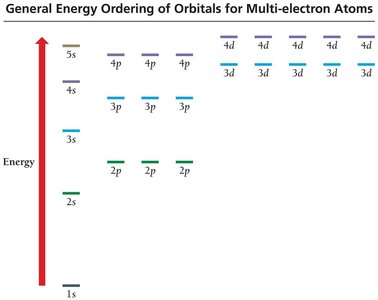
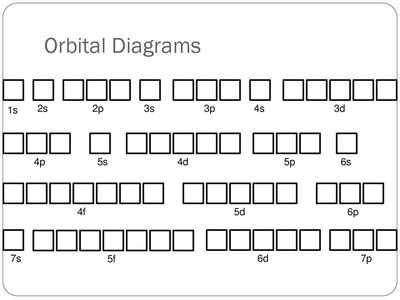
Electron Configurations and Orbital Diagrams
Electron configurations show the distribution of electrons among orbitals. Orbital diagrams visually represent electron spins in each orbital.
Example (He): 1s2 (two electrons in the 1s orbital, paired spins)
Example (Li): 1s22s1 (two electrons in 1s, one in 2s)
Example (C): 1s22s22p2 (two electrons in 1s, two in 2s, two in 2p)
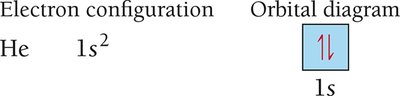
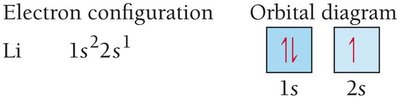

Core and Valence Electrons
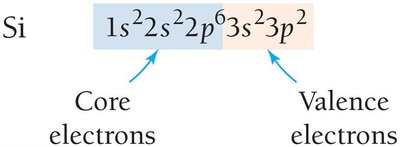
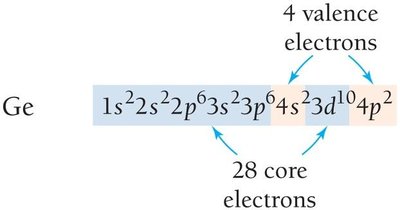
Core electrons are in inner shells and do not participate in bonding. Valence electrons are in the outermost shell and determine chemical reactivity.
The main group number corresponds to the number of valence electrons.
Valence electrons are found in the highest principal energy level (n).
Shielding, Penetration, and Effective Nuclear Charge
Coulomb's Law and Electron Interactions
Electrons are attracted to the nucleus and repelled by other electrons. The strength of these interactions is described by Coulomb's Law:
Attraction increases with greater nuclear charge and decreases with distance.
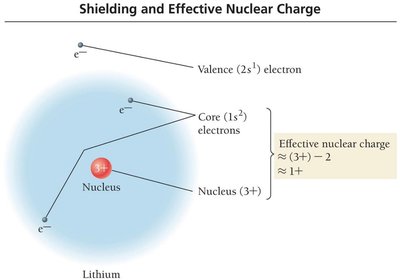
Electrons in inner shells shield outer electrons from the full nuclear charge.
The effective nuclear charge (Zeff) is the net positive charge experienced by valence electrons:
Z = nuclear charge (number of protons)
S = shielding constant (number of core electrons)
Periodic Trends
Atomic and Ionic Radii
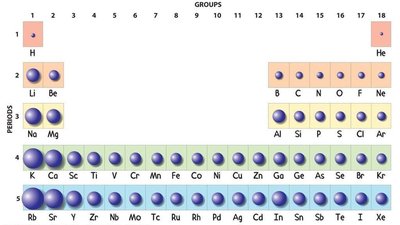
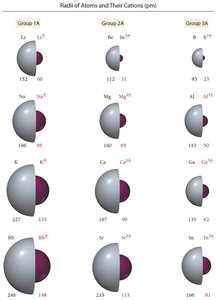
Atomic and ionic radii show predictable trends across the periodic table:
Atomic radius decreases across a period (left to right) due to increasing Zeff.
Atomic radius increases down a group due to higher principal quantum numbers (n).
Cations are smaller than their parent atoms; anions are larger.
Ionization Energy
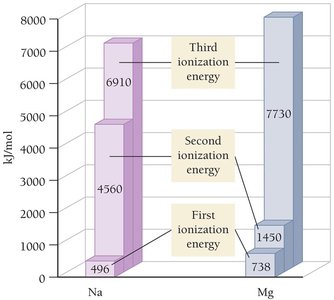
Ionization energy (IE) is the energy required to remove an electron from a gaseous atom or ion.
IE increases across a period (left to right) and decreases down a group.
Each successive electron removed requires more energy.
Large jump in IE when removing core electrons.
Electron Affinity
Electron affinity (EA) is the energy change when an electron is added to a gaseous atom.
EA becomes more negative (more exothermic) across a period.
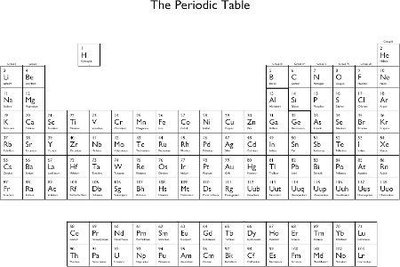
Halogens have the highest (most negative) electron affinities.
Metallic Character
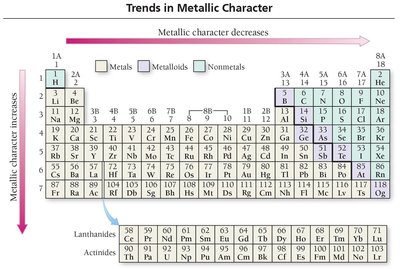
Metallic character refers to how readily an atom loses electrons. It increases down a group and decreases across a period.
Metals are malleable, ductile, conduct heat and electricity, and tend to lose electrons (form cations).
Nonmetals are brittle, insulators, and tend to gain electrons (form anions).
Metalloids have properties intermediate between metals and nonmetals.
Special Cases and Exceptions
Transition and Inner Transition Metals
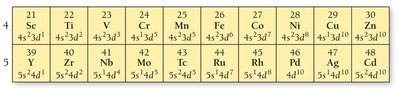
Transition metals (d-block) and inner transition metals (f-block) often have irregular electron configurations due to the close energy levels of s and d (or f) orbitals.
Examples: Cr, Cu, Mo, Ru, Pd have experimentally observed configurations that differ from the expected pattern.
Magnetic Properties
Atoms or ions with unpaired electrons are paramagnetic (attracted to magnetic fields), while those with all electrons paired are diamagnetic (slightly repelled by magnetic fields).
Summary Table: Periodic Trends
Property | Across a Period (→) | Down a Group (↓) |
|---|---|---|
Atomic Radius | Decreases | Increases |
Ionization Energy | Increases | Decreases |
Electron Affinity | Becomes more negative | Varies (less negative) |
Metallic Character | Decreases | Increases |
Conclusion
Understanding the periodic table and periodic trends is fundamental to predicting and explaining the chemical behavior of elements. Mastery of electron configurations, quantum numbers, and periodic properties provides a strong foundation for further study in chemistry.
