 뒤로
뒤로Phase Equilibrium in Two-Component Systems: Liquid-Liquid and Solid-Liquid Equilibria
스터디 가이드 - 스마트 노트
 자료에 맞춘 맞춤형 노트, 핵심 정의, 예시, 맥락을 확장해 제공합니다.
Phase Equilibrium in Two-Component Systems
Introduction to Phase Equilibrium
Phase equilibrium in two-component systems is a fundamental concept in physical chemistry, describing how mixtures of two substances behave under varying conditions of temperature and composition. These systems can exhibit a variety of phase behaviors, including complete miscibility, partial miscibility, and immiscibility in both liquid and solid states. Understanding these equilibria is essential for predicting the behavior of mixtures in chemical processes and materials science.
Liquid-Liquid Equilibrium
Complete and Partial Miscibility
Liquid-liquid equilibrium describes the behavior of two liquids when mixed together. Depending on their molecular interactions, the liquids may be completely miscible (mix in all proportions) or only partially miscible (form two separate liquid phases under certain conditions).
Completely Miscible Liquids: Examples include ethanol and water, which mix in any proportion to form a single homogeneous phase.
Partially Miscible Liquids: Examples include 1-butanol and water, which form two liquid phases: one rich in water with a small amount of 1-butanol, and one rich in 1-butanol with a small amount of water.
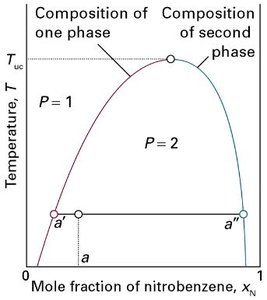
Example: The hexane-nitrobenzene system is a classic example of partial miscibility, where the two liquids form two separate phases at certain compositions and temperatures.
Temperature–Composition Diagrams
Temperature–composition (T-x) diagrams are used to represent the phase behavior of binary mixtures. The diagram shows regions where one or two liquid phases exist, depending on temperature and composition. The critical solution temperature (Tc) is the temperature above which the two liquids are miscible in all proportions.
Below Tc, two liquid phases coexist for certain compositions.
Above Tc, the liquids are completely miscible.

The Lever Rule
The lever rule is a graphical method used to determine the relative amounts of each phase present in a two-phase region of a phase diagram. It is based on mass balance and the tie-line connecting the compositions of the coexisting phases.
Formula:
Where and are the amounts of phases α and β, is the overall composition, and , are the compositions of the two phases.
Example: For a mixture of 50 g hexane and 50 g nitrobenzene at 290 K, the compositions of the phases and their proportions can be determined using the lever rule.
Other Examples of Partial Miscibility
Some systems, such as water and nicotine under pressure, also exhibit partial miscibility, with two-phase regions bounded by upper and lower critical solution temperatures.

Solid Solutions and Solid-Liquid Equilibrium
Solid Solutions: Substitutional and Interstitial
Solid solutions are homogeneous crystalline phases that contain two or more species. They are classified based on how the solute atoms are incorporated into the solvent lattice:
Substitutional Solid Solutions: Solute atoms replace solvent atoms in the lattice. Example: Copper-nickel alloys.
Interstitial Solid Solutions: Smaller solute atoms occupy interstitial spaces in the solvent lattice. Example: Carbon in iron (steel).


Solid-Liquid Equilibrium: Phase Diagrams
Solid-liquid equilibrium in two-component systems is typically represented by phase diagrams plotting temperature versus composition at constant pressure (usually 1 atm). These diagrams reveal the regions of liquid, solid, and mixed-phase existence.
Liquid-phase miscibility and solid-phase miscibility: Both components are miscible in liquid and solid states (e.g., Cu-Ni system).
Liquid-phase miscibility and solid-phase immiscibility: Components are miscible in the liquid state but form separate solid phases upon cooling (e.g., some semiconductor materials).
Liquid-phase miscibility and solid-phase partial miscibility: Components are miscible in the liquid state but only partially miscible in the solid state (e.g., Cu-Ag system).
Compound formation: Components form a new solid compound in addition to the original phases (e.g., phenol and aniline).
Example: Cu-Ni System (Complete Miscibility)
The copper-nickel system forms an ideal solid solution, with complete miscibility in both liquid and solid states. The phase diagram shows a continuous transition from liquid to solid solution as the mixture cools.

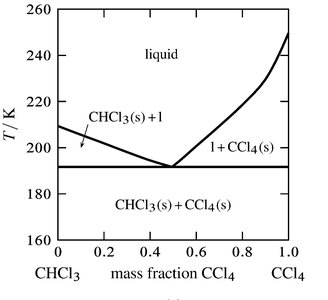
Example: Chloroform and Carbon Tetrachloride (Solid-Phase Immiscibility)
In the chloroform-carbon tetrachloride system, the liquids are miscible, but the solids are immiscible, resulting in a eutectic point where both solids crystallize out together.
Example: Cu-Ag System (Partial Solid Miscibility)
The copper-silver system exhibits partial miscibility in the solid state. Upon cooling, two solid phases (α and β) form, each saturated with the other component. The eutectic composition is the lowest temperature at which the liquid phase can exist.

Solid-Liquid Equilibrium with Compound Formation
Some binary systems form a new solid compound that can coexist with the liquid and the original solids. For example, phenol and aniline form a stable compound (C6H5OH·C6H5NH2) in addition to the pure components.

Summary Table: Types of Phase Equilibria in Two-Component Systems
Type of Equilibrium | Liquid Phase Behavior | Solid Phase Behavior | Example |
|---|---|---|---|
Complete miscibility | Miscible in all proportions | Miscible in all proportions | Cu-Ni |
Partial miscibility | Miscible above Tc, two phases below | Varies | Hexane-nitrobenzene |
Solid-phase immiscibility | Miscible | Immiscible | CHCl3-CCl4 |
Partial solid miscibility | Miscible | Partially miscible | Cu-Ag |
Compound formation | Miscible | Compound + original solids | Phenol-aniline |
Key Equations
Lever Rule:
Conclusion
Understanding phase equilibrium in two-component systems is crucial for predicting the behavior of mixtures in chemical engineering, metallurgy, and materials science. The use of phase diagrams, the lever rule, and knowledge of miscibility types allows chemists to design and control processes involving mixtures of liquids and solids.
