 뒤로
뒤로Phase Equilibrium of Pure Substances: Definitions, Diagrams, and Thermodynamic Aspects
스터디 가이드 - 스마트 노트
 자료에 맞춘 맞춤형 노트, 핵심 정의, 예시, 맥락을 확장해 제공합니다.
Phase Equilibrium of Pure Substances
Introduction to Phase Equilibrium
Phase equilibrium is a fundamental concept in thermodynamics and physical chemistry, describing the balance between different physical states (phases) of a pure substance under specific conditions of temperature and pressure. Understanding phase equilibrium is essential for interpreting phase diagrams, predicting phase transitions, and applying thermodynamic principles to real-world systems.
Key Definitions
Phase
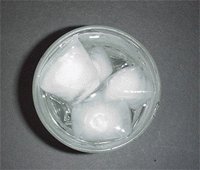
A phase is a form of matter that is uniform in chemical composition and physical state. Phases are separated by distinct boundaries and can be solid, liquid, or gas. In a homogeneous system, all intensive properties (such as density, temperature, and chemical potential) are constant throughout the phase.
Example: Ice cubes in water represent two phases: solid (ice) and liquid (water).
Phase Equilibrium
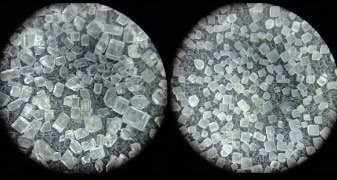
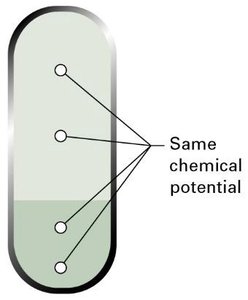
Phase equilibrium occurs when multiple phases coexist without net change over time. At equilibrium, the chemical potential of each component is the same in all phases present. For example, in a closed container with liquid water and its vapor, the rate of evaporation equals the rate of condensation.
Example: A mixture of salt and sugar crystals is a system with two solid phases, each retaining its own properties.
Chemical Potential (μ)
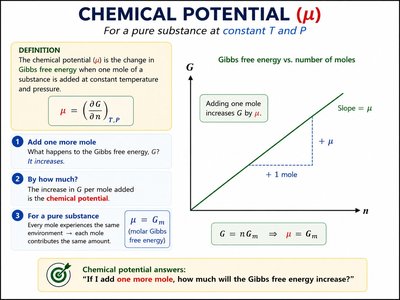
The chemical potential (μ) is the partial molar Gibbs free energy of a substance. It represents the "driving force" for mass transfer and phase change. For a pure substance, the chemical potential is equal to the molar Gibbs energy (). At equilibrium, the chemical potential is uniform throughout all phases present.
Formula:
SI Unit: Joules per mole (J/mol)
Vapour Pressure
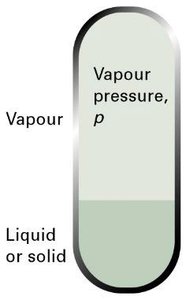
Vapour pressure is the pressure exerted by a vapor in equilibrium with its liquid or solid phase at a given temperature. At equilibrium, the chemical potential of the substance is the same in both the vapor and condensed phases. Vapour pressure increases with temperature.
Example: In a closed container, the vapor above a liquid exerts a characteristic pressure at equilibrium.
Thermodynamic Aspects of Phase Transformations
Enthalpy Changes in Phase Transitions
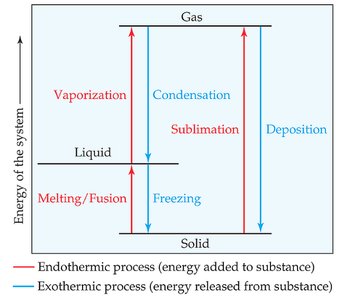
Phase transitions involve energy changes, typically measured as enthalpy changes (). Common transitions include fusion (melting), vaporization, condensation, freezing, and sublimation. These processes are classified as endothermic (energy absorbed) or exothermic (energy released).
Endothermic: Melting, vaporization, sublimation
Exothermic: Freezing, condensation, deposition
Phase Diagrams
p-T (Pressure-Temperature) Diagrams
A p-T diagram (phase diagram) maps the regions of stability for solid, liquid, and gas phases of a pure substance as a function of pressure and temperature. Key features include phase boundaries, triple points (where three phases coexist), and critical points (end of the liquid-gas boundary).
Phases: Solid, liquid, gas
Phase Boundaries: Lines separating regions where different phases are stable
Triple Point: Unique set of conditions where all three phases coexist
Critical Point: The end point of the liquid-gas boundary, above which the distinction between liquid and gas disappears
Boiling Point and External Pressure
The boiling point is the temperature at which the vapor pressure of a liquid equals the external pressure. At higher altitudes (lower atmospheric pressure), the boiling point of water is lower. The normal boiling point is measured at 1 atm, while the standard boiling point is at 1 bar (1.00 bar = 0.987 atm).
Thermodynamic Criteria of Phase Stability
Equilibrium Condition
For two or more phases to be in equilibrium, the chemical potential of the substance must be equal in all phases. This is a direct consequence of the second law of thermodynamics.
Summary Table: Key Terms and Concepts
Term | Definition | Example |
|---|---|---|
Phase | Uniform region of matter in chemical composition and physical state | Ice (solid), water (liquid), water vapor (gas) |
Chemical Potential (μ) | Partial molar Gibbs free energy; driving force for phase change | μ = Gm |
Vapour Pressure | Pressure exerted by vapor in equilibrium with its condensed phase | Water vapor above liquid water in a closed container |
Boiling Point | Temperature at which vapor pressure equals external pressure | 100°C at 1 atm for water |
Additional info:
The Clapeyron equation and Clausius-Clapeyron equation are used to quantify the relationship between pressure, temperature, and phase transitions, but are not detailed in this summary.
Phase diagrams are essential tools for predicting the behavior of substances under varying conditions and are widely used in chemistry and engineering.
