 뒤로
뒤로Properties of Solutions: Phase Transitions, Concentration, and Colligative Properties
스터디 가이드 - 스마트 노트
 자료에 맞춘 맞춤형 노트, 핵심 정의, 예시, 맥락을 확장해 제공합니다.
Properties of Solutions
Phase Transitions and Phase Diagrams
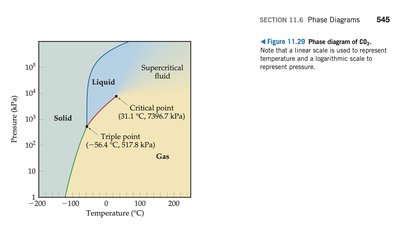
Phase transitions describe the changes between solid, liquid, and gas states of matter. Phase diagrams visually represent these transitions as a function of temperature and pressure, showing regions where each phase is stable and the boundaries where transitions occur.
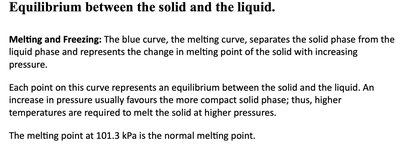
Melting and Freezing: The melting curve separates solid from liquid. Higher pressure generally favors the more compact solid phase, requiring higher temperatures to melt.
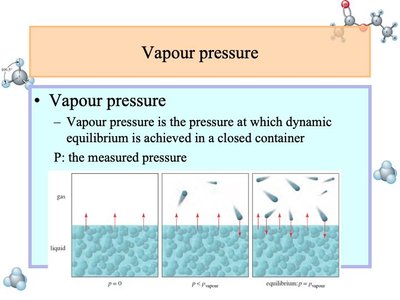
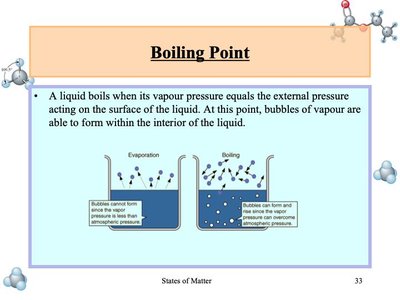
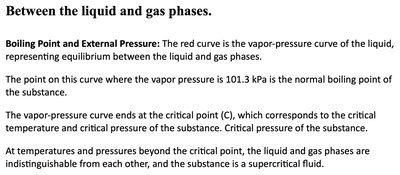
Boiling Point and External Pressure: The boiling point is where the vapor pressure of a liquid equals the external pressure. At this point, bubbles of vapor can form within the liquid.
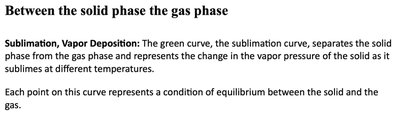
Sublimation: The sublimation curve separates solid from gas, representing the equilibrium as solids directly convert to gases.
Critical Point: Beyond the critical temperature and pressure, liquid and gas phases become indistinguishable, forming a supercritical fluid.
Example: At the top of Mt. Everest, the atmospheric pressure is much lower, so water boils at only 70°C instead of 100°C.

Location | Feet Above Sea Level | Atmospheric P (torr) | Boiling Point (°C) |
|---|---|---|---|
Top of Mt Everest, Tibet | 29,028 | 240 | 70 |


Intermolecular Forces
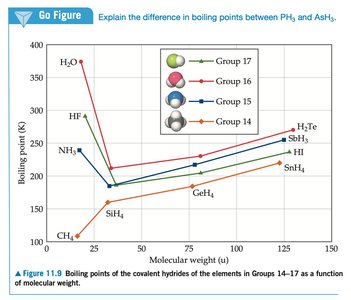
Intermolecular forces are attractions between molecules that influence physical properties such as boiling and melting points. There are three main types:
Dispersion Forces (London Forces): Present in all molecules, especially nonpolar ones. They arise from temporary dipoles due to electron movement. Strength increases with molecular size and polarizability.
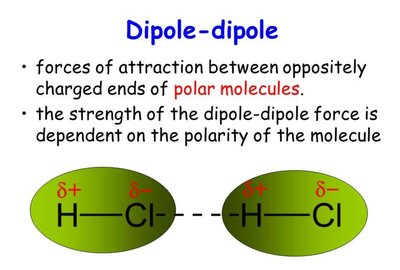
Dipole–Dipole Attractions: Occur between polar molecules with permanent dipoles. The positive end of one molecule attracts the negative end of another.
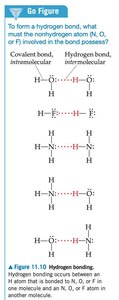
Hydrogen Bonding: A special, strong dipole–dipole interaction involving hydrogen bonded to highly electronegative atoms (N, O, F). Responsible for high boiling points in substances like water, HF, and NH3.
Example: HCl molecules exhibit dipole–dipole attractions, with δ⁺ hydrogen attracting δ⁻ chlorine in neighboring molecules.



Solution Components and Concentration
Solution Components
A solution consists of a solvent (major component, phase unchanged) and a solute (minor component, dissolved).
Concentration of Solutions
Concentration expresses the amount of solute in a given quantity of solvent or solution. Common expressions include:
Mass percent (m/m%):
Molarity (M):
Molality (m):
Mole fraction ():
Parts per million (ppm):
Example: Calculating mass percent of glucose in water:
Given: 13.5 g glucose in 0.100 kg water
Mass percent =

Example: Calculating mole fraction and molality for HCl in water:
Mole fraction HCl:
Molality HCl:

Colligative Properties of Solutions
Definition and Applications
Colligative properties are physical properties of solutions that depend on the number of solute particles, not their identity. Examples include freezing point depression, boiling point elevation, and osmotic pressure.
Freezing Point Depression: The freezing point of a solution is lower than that of the pure solvent. The change is proportional to solute molality.
Boiling Point Elevation: The boiling point of a solution is higher than that of the pure solvent.
Osmosis: The movement of solvent through a semipermeable membrane from lower to higher solute concentration.
Example: Antifreeze in car radiators lowers freezing point and raises boiling point, protecting engines in extreme temperatures.
Freezing Point Depression Formula
van’t Hoff factor (i): Number of particles solute produces in solution (i = 1 for nonelectrolytes, i > 1 for electrolytes).
Kf: Proportionality constant.
m: Molality of solute.
Electrolytes vs. Nonelectrolytes: Electrolytes dissociate into ions, increasing the van’t Hoff factor and the effect on colligative properties.
Osmosis and Osmotic Pressure
Osmosis is the net movement of solvent molecules through a semipermeable membrane toward higher solute concentration. The pressure required to stop this flow is the osmotic pressure ().
Where is osmotic pressure, is volume, is moles of solute, is the gas constant, and is temperature.
Example: The average osmotic pressure of blood is 7.72 atm at 25°C. The molarity of glucose required to be isotonic with blood can be calculated using the osmotic pressure formula.
Summary Table: Colligative Properties
Property | Formula | Key Factors |
|---|---|---|
Freezing Point Depression | van’t Hoff factor, molality, solvent constant | |
Boiling Point Elevation | van’t Hoff factor, molality, solvent constant | |
Osmotic Pressure | Molarity, gas constant, temperature |
Additional info: All equations are provided in standard chemistry notation. Examples and sample calculations are included to reinforce concepts. Images and tables are selected strictly for direct relevance to the explanation of each topic.
