 뒤로
뒤로Quantum-Mechanical Model of the Atom: Study Guidance
스터디 가이드 - 스마트 노트
 자료에 맞춘 맞춤형 노트, 핵심 정의, 예시, 맥락을 확장해 제공합니다.
Q1. A particular form of electromagnetic radiation has a frequency of Hz.
(a) What is its wavelength in nanometers? In meters?
(b) To what region of the electromagnetic spectrum would you assign it?
(c) What is the energy (in joules) of one quantum of this radiation?
Background
Topic: Electromagnetic Radiation and Quantum Theory
This question tests your understanding of the relationship between frequency, wavelength, and energy for electromagnetic radiation, as well as your ability to classify radiation by its wavelength or frequency.
Key Terms and Formulas:
Speed of light: m/s
Planck's constant: J·s
Wavelength (), Frequency (), Energy ()
Key formulas:
Step-by-Step Guidance
Start by identifying the given frequency: Hz.
Use the formula to calculate the wavelength in meters.
Convert the wavelength from meters to nanometers by multiplying by .
Determine which region of the electromagnetic spectrum this wavelength falls into (e.g., visible, UV, IR).
Set up the energy calculation using .
Try solving on your own before revealing the answer!
Final Answer:
(a) Wavelength: nm (or m)
(b) Region: UV (Ultraviolet)
(c) Energy: J
We used the formulas for wavelength and energy, and classified the region based on the calculated wavelength.
Q2. Calculate:
(a) The frequency when light of wavelength 450 nm is emitted
(b) The energy when a photon of UV light has a wavelength of 250 nm
(c) The wavelength (in nm) of radiation whose frequency is s
(e) The total energy in photons of gamma radiation having m
(f) Identify the energy of a photon of microwave radiation with frequency s
(g) When light of frequency s shines on the surface of gold metal, the kinetic energy of ejected electrons is found to be J. What is the work function of gold?
Background
Topic: Electromagnetic Radiation, Photons, and Photoelectric Effect
This question covers calculations involving wavelength, frequency, photon energy, and the photoelectric effect.
Key Terms and Formulas:
Total energy:
Photoelectric effect: (where is the work function)
Step-by-Step Guidance
For each part, identify the given values (wavelength, frequency, number of photons, etc.).
Use or as needed to convert between wavelength and frequency.
Apply to find the energy of a photon.
For total energy, multiply the energy per photon by the number of photons.
For the photoelectric effect, rearrange to solve for the work function .
Try solving on your own before revealing the answer!
Final Answers:
(a) Frequency: Hz
(b) Energy: J
(c) Wavelength: nm
(e) Total energy: J
(f) Energy: J
(g) Work function of gold: J
Each calculation uses the appropriate formula for the physical quantity involved.
Q3. Identify the difference between a continuous spectrum and a line spectrum by giving examples.
Background
Topic: Atomic Spectra
This question tests your understanding of the types of spectra produced by different sources and their significance in atomic theory.
Key Terms:
Continuous spectrum: Contains all wavelengths within a given range (e.g., sunlight, incandescent bulb).
Line spectrum: Contains only specific wavelengths (e.g., hydrogen emission spectrum).
Step-by-Step Guidance
Define what a continuous spectrum is and provide an example.
Define what a line spectrum is and provide an example.
Explain why atoms produce line spectra (quantized energy levels).
Try solving on your own before revealing the answer!
Final Answer:
A continuous spectrum contains all wavelengths (e.g., sunlight), while a line spectrum contains only specific wavelengths (e.g., hydrogen emission spectrum). Line spectra arise because atoms have quantized energy levels.
Q4. Identify and sketch the shapes of s, p, and d orbitals respectively.
Background
Topic: Atomic Orbitals
This question tests your knowledge of the shapes and types of atomic orbitals.
Key Terms:
s orbital: Spherical shape
p orbital: Dumbbell shape
d orbital: Cloverleaf shape
Step-by-Step Guidance
Describe the shape of the s orbital (spherical).
Describe the shape of the p orbital (dumbbell).
Describe the shape of the d orbital (cloverleaf).
Sketch or visualize each orbital shape.
Try solving on your own before revealing the answer!
Final Answer:
s orbital: spherical; p orbital: dumbbell; d orbital: cloverleaf. These shapes reflect the probability distributions of electrons in each orbital type.
Q5. Name the orbitals described by the following quantum numbers:
(a) ,
(b) ,
(c) ,
(d) ,
Background
Topic: Quantum Numbers and Orbitals
This question tests your ability to identify orbitals based on principal () and angular momentum () quantum numbers.
Key Terms:
: Principal quantum number (energy level)
: Angular momentum quantum number (orbital type: 0=s, 1=p, 2=d, 3=f)
Step-by-Step Guidance
Match each value to its corresponding orbital type (s, p, d, f).
Combine and to name the orbital (e.g., 2p, 3p, 4f, 4d).
Try solving on your own before revealing the answer!
Final Answer:
(a) 2p
(b) 3p
(c) 4f
(d) 4d
Q6. Write the sublevel filling order of Aufbau Principle.
Background
Topic: Electron Configuration and Aufbau Principle
This question tests your understanding of the order in which atomic orbitals are filled.
Key Terms:
Aufbau Principle: Electrons fill the lowest energy orbitals first.
Step-by-Step Guidance
Recall the order of orbital filling: 1s, 2s, 2p, 3s, 3p, 4s, 3d, 4p, etc.
Use the (n+l) rule to determine the order if needed.
Try solving on your own before revealing the answer!
Final Answer:
1s → 2s → 2p → 3s → 3p → 4s → 3d → 4p → 5s → 4d → 5p → 6s → 4f → 5d → 6p → 7s → 5f → 6d → 7p
Q7. Give the n and l values for the following orbitals:
(a) 4d
(b) 3p
(c) 4f
(d) 5s
Background
Topic: Quantum Numbers
This question tests your ability to assign quantum numbers to specific orbitals.
Key Terms:
: Principal quantum number
: Angular momentum quantum number (0=s, 1=p, 2=d, 3=f)
Step-by-Step Guidance
For each orbital, identify the principal quantum number () from the number in front.
Assign the correct value based on the orbital type (s, p, d, f).
Try solving on your own before revealing the answer!
Final Answer:
(a) 4d: ,
(b) 3p: ,
(c) 4f: ,
(d) 5s: ,
Q8. Is the following representing as a permissible set of quantum numbers?
(a) , , ,
(b) , , ,
(c) , , ,
(d) , , ,
Background
Topic: Quantum Numbers and Permissibility
This question tests your understanding of the rules for quantum numbers and whether a given set is allowed.
Key Terms:
: Must be a positive integer
: Must be
: Must be
: Must be or
Step-by-Step Guidance
Check each set for being non-negative and less than .
Check for being within the range to .
Check for being or .
Try solving on your own before revealing the answer!
Final Answer:
(a) Not permissible ( cannot be negative)
(b) Not permissible ( cannot equal )
(c) Permissible
(d) Not permissible ( out of range)
Q9. A medical imaging centre calibrates its X-ray source and trains interns in atomic structure. An intern measures X-ray photons at m and is asked to explain how electronic structure relates to emission.
(a) Compute the frequency and energy of a single photon at this wavelength.
(b) Identify the region of the electromagnetic spectrum where their purpose is used for diagnostic imaging or CT scan.
(c) For calcium () used as a contrast agent:
i) Write its ground-state electron configuration and noble configuration
ii) Give the four quantum numbers for the last electron
iii) Write the orbital diagram for the calcium ion
Background
Topic: X-ray Photons, Electron Configuration, and Quantum Numbers
This question tests your ability to calculate photon properties, identify EM spectrum regions, and describe electron configurations and quantum numbers.
Key Terms and Formulas:
Electron configuration notation
Quantum numbers: , , ,
Step-by-Step Guidance
Calculate frequency using .
Calculate energy using .
Identify the region of the EM spectrum based on wavelength.
Write the ground-state electron configuration for calcium.
Write the noble gas configuration for calcium.
Assign quantum numbers for the last electron in calcium.
Set up the orbital diagram for the calcium ion.
Try solving on your own before revealing the answer!

Final Answer:
(a) Frequency: s; Energy: J
(b) X-ray region ( m)
(c) i) Ca: ; [Ar]
ii) , , , (or )
iii) Orbital diagram for Ca: Remove two electrons from 4s
Q10. An engineer analyses the electron configuration of phosphorus (Z = 15) added to silicon chips.
(a) Write the full electron configuration and draw the orbital diagram.
(b) Suggest how quantum numbers (, , , ) describe the valence electron.
(c) Identify the orbital diagram of phosphide ion.
Background
Topic: Electron Configuration and Quantum Numbers
This question tests your ability to write electron configurations, draw orbital diagrams, and assign quantum numbers to valence electrons.
Key Terms:
Electron configuration
Orbital diagram
Quantum numbers
Step-by-Step Guidance
Write the full electron configuration for phosphorus ().
Draw the orbital diagram for phosphorus.
Assign quantum numbers for a 3p valence electron.
Set up the orbital diagram for the phosphide ion (P).
Try solving on your own before revealing the answer!

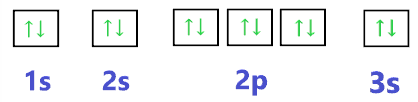
Final Answer:
(a) Electron configuration:
(b) Quantum numbers for 3p electron: , , ,
(c) Orbital diagram for P: 3p is fully filled
Q11. An excimer laser used in eye surgery emits UV light of 193 nm.
(a) Determine the frequency and energy per photon.
(b) Which region of the EM spectrum does 193 nm fall into?
Background
Topic: Electromagnetic Radiation and Photons
This question tests your ability to calculate frequency and energy for a given wavelength and classify the region of the EM spectrum.
Key Terms and Formulas:
Step-by-Step Guidance
Convert 193 nm to meters.
Calculate frequency using .
Calculate energy per photon using .
Identify the region of the EM spectrum for 193 nm.
Try solving on your own before revealing the answer!
Final Answer:
(a) Frequency: s; Energy: J
(b) UV region
Q12. Write the condensed ground-state electron configuration and draw the orbital diagram of the following:
(a) Na
(b) Br
(c) F
(d) Al
(e) Fe
Background
Topic: Electron Configuration and Orbital Diagrams
This question tests your ability to write condensed electron configurations and draw orbital diagrams for atoms and ions.
Key Terms:
Condensed electron configuration (using noble gas notation)
Orbital diagram
Step-by-Step Guidance
Identify the atomic number and charge for each species.
Write the condensed electron configuration using noble gas notation.
Set up the orbital diagram for each atom/ion.
Try solving on your own before revealing the answer!
Final Answer:
(a) Na: [Ne]
(b) Br: [Ar]
(c) F: [Ne]
(d) Al: [Ne]
(e) Fe: [Ar]
