 뒤로
뒤로Quantum Theory and the Electronic Structure of Atoms: Study Notes
스터디 가이드 - 스마트 노트
 자료에 맞춘 맞춤형 노트, 핵심 정의, 예시, 맥락을 확장해 제공합니다.
Quantum Theory and the Electronic Structure of Atoms
Properties of Waves
Understanding the properties of waves is fundamental to quantum theory and the behavior of electrons in atoms. Key properties include wavelength, frequency, and amplitude.
Wavelength (λ): The distance between identical points on successive waves, typically measured in meters (m) or nanometers (nm).
Amplitude: The vertical distance from the midline of a wave to its peak or trough, representing the wave's intensity.
Frequency (ν): The number of waves passing a point per second, measured in hertz (Hz).
Speed of Light (c): In a vacuum, light travels at m/s.
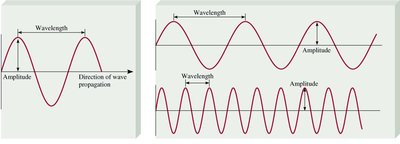
Relationship: The speed of a wave is the product of its wavelength and frequency:
Planck’s Quantum Theory
Planck proposed that energy is emitted or absorbed in discrete units called quanta. The energy (E) of a photon is related to its frequency (ν) by Planck’s equation:
Planck’s Constant (h): J·s
Energy of a photon:
Alternatively, using wavelength:

Example: Calculate the energy of a photon with a wavelength of nm (infrared region):
J
Bohr’s Atomic Model
Niels Bohr introduced a model where electrons move in fixed orbits (energy levels) around the nucleus. Each orbit corresponds to a specific energy, and electrons can jump between these levels by absorbing or emitting energy.
First Postulate: Electrons move in circular orbits around the nucleus without radiating energy.
Second Postulate: The energy of an electron in a given orbit is quantized and given by:
where J and is the principal quantum number (1, 2, 3, ...).

Third Postulate: Electrons can absorb energy and move to higher energy levels (excited state).
Fourth Postulate: When electrons fall back to lower energy levels, they emit energy as photons. The energy of the photon equals the difference between the two energy levels.

Energy Change:
Rydberg Equation and Emission Spectra
The Rydberg equation calculates the wavelength of light emitted or absorbed when an electron transitions between energy levels in a hydrogen atom:
where m-1.
Emission spectra can be classified as:
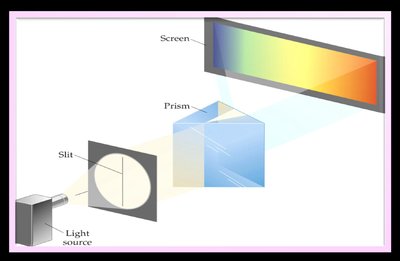
Continuous Spectrum: Contains all wavelengths without gaps (e.g., sunlight, rainbow).
Line Spectrum: Contains only specific wavelengths, seen as discrete lines (e.g., hydrogen emission spectrum).
Quantum Mechanical Model and Quantum Numbers
The quantum mechanical model describes electrons as wave-like particles in orbitals, regions of high probability for finding an electron. Each electron in an atom is described by four quantum numbers:
Principal Quantum Number (n): Indicates the energy level and size of the orbital ().
Angular Momentum Quantum Number (l): Indicates the shape of the orbital ( to ; s, p, d, f).
Magnetic Quantum Number (m_l): Indicates the orientation of the orbital ( to ).
Spin Quantum Number (m_s): Indicates the spin direction of the electron ( or ).
Example: For a 2p orbital: , , , .
Shapes of Atomic Orbitals
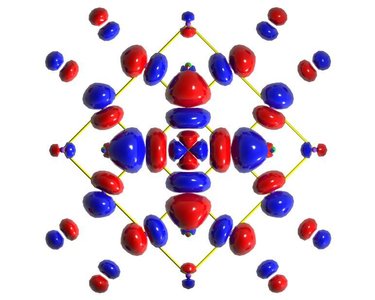
Atomic orbitals have characteristic shapes depending on the quantum numbers:
s orbitals: Spherical shape, one orientation ().
p orbitals: Dumbbell-shaped, three orientations (, ).
d orbitals: More complex shapes, five orientations (, ).
Electronic Configuration
Electronic configuration describes the arrangement of electrons in an atom’s orbitals. The following rules are used:
Aufbau Principle: Electrons fill orbitals of lowest energy first.
Pauli Exclusion Principle: Each orbital can hold a maximum of two electrons with opposite spins.
Hund’s Rule: Every orbital in a subshell is singly occupied before any is doubly occupied.
Example: Oxygen (O, 8 electrons): 1s2 2s2 2p4
Electron Configuration of Ions
When atoms form ions, electrons are added (anions) or removed (cations) to achieve noble gas configurations. For transition metals, electrons are removed first from the outermost s subshell before the d subshell.
Example: Fe: [Ar] 4s2 3d6; Fe2+: [Ar] 3d6
Magnetic Properties
Paramagnetic: Substances with unpaired electrons; attracted by a magnetic field.
Diamagnetic: Substances with all electrons paired; slightly repelled by a magnetic field.
Summary Table: Quantum Numbers and Orbitals
Quantum Number | Symbol | Possible Values | Physical Meaning |
|---|---|---|---|
Principal | n | 1, 2, 3, ... | Energy level, size of orbital |
Angular Momentum | l | 0 to n-1 | Shape of orbital (s, p, d, f) |
Magnetic | m_l | -l to +l | Orientation of orbital |
Spin | m_s | +1/2, -1/2 | Spin direction of electron |
Additional info: The quantum mechanical model and electron configuration principles are foundational for understanding chemical bonding, periodic trends, and the behavior of elements in reactions.
