 뒤로
뒤로Solids and Modern Materials: Structure, Types, and Lattice Energy
스터디 가이드 - 스마트 노트
 자료에 맞춘 맞춤형 노트, 핵심 정의, 예시, 맥락을 확장해 제공합니다.
Solids and Modern Materials
Organization of Solids & Unit Cells
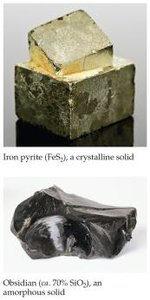
Solids are classified based on the arrangement of their constituent atoms, ions, or molecules. The two primary categories are crystalline solids and amorphous solids. Crystalline solids exhibit a regular, repeating pattern, while amorphous solids lack long-range order.
Crystalline solids: Have a well-defined, repeating structure. Their study is central to chemistry due to predictable properties.
Amorphous solids: Possess no long-range order; examples include glass and obsidian.
Unit cell: The smallest repeating unit in a crystalline solid, defined by its size, shape, and atom positions.
Lattice points: Positions in the unit cell where atoms, ions, or molecules are located.
Crystal lattice: The three-dimensional arrangement of unit cells throughout the solid.
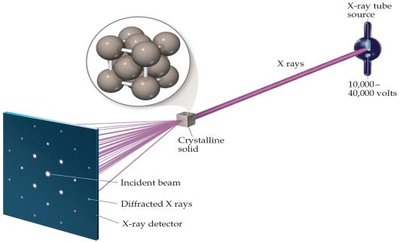
X-ray Diffraction and Crystal Structure Determination
X-ray diffraction is a powerful technique used to determine the structure of crystalline solids. By analyzing the pattern of diffracted X-rays, chemists can identify the unit cell and the arrangement of atoms within the lattice.
Incident X-rays: Strike the crystal and are diffracted by the regular arrangement of atoms.
Diffraction pattern: Reveals the positions of atoms and the geometry of the unit cell.
Historical significance: Used by Franklin, Watson, and Crick to determine the structure of DNA.
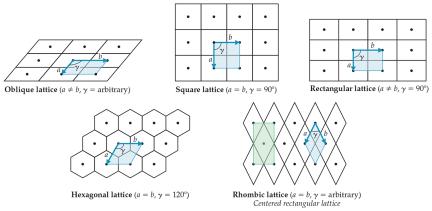
2-D and 3-D Crystal Lattices
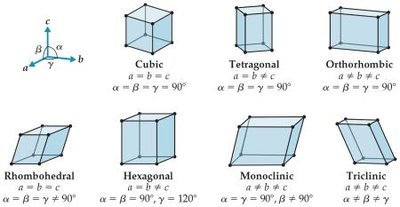
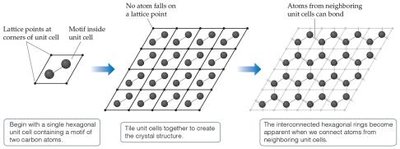
Crystal lattices can be described in two and three dimensions. The basic 2-D lattices include oblique, square, rectangular, hexagonal, and rhombic types. In three dimensions, there are seven basic lattice systems: cubic, tetragonal, orthorhombic, rhombohedral, hexagonal, monoclinic, and triclinic.
Lattice vectors: Define the edges and angles of the unit cell.
Motif: The group of atoms associated with each lattice point, which may not always be located directly on the lattice points.
Types of Cubic Lattices
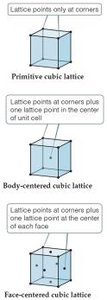
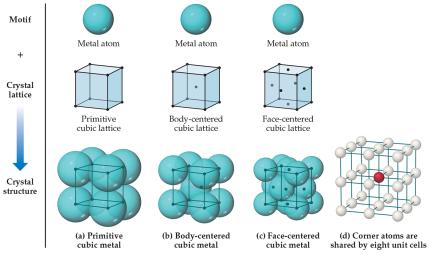
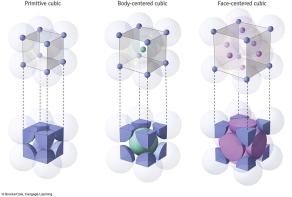
Cubic lattices are especially important in chemistry. There are three main types: primitive cubic, body-centered cubic (BCC), and face-centered cubic (FCC). Each type differs in the location of atoms within the unit cell.
Primitive cubic: Atoms only at the corners.
Body-centered cubic: Atoms at corners and one in the center.
Face-centered cubic: Atoms at corners and at the center of each face.
Packing and Stacking in Solids
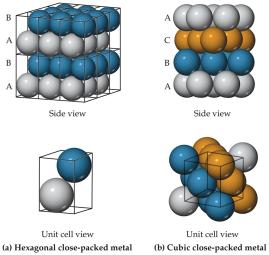
Atoms in solids pack together as closely as possible to minimize empty space. The two most common types of close packing are cubic close-packed (CCP, equivalent to FCC) and hexagonal close-packed (HCP).
Cubic close-packed (CCP): Layers are stacked in an ABCABC pattern.
Hexagonal close-packed (HCP): Layers are stacked in an ABAB pattern.
Unit Cells in Metals
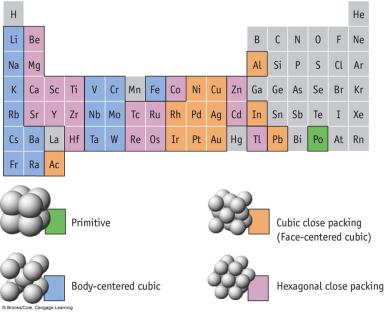
The type of unit cell adopted by a metal depends on the size of its atoms. Most metals crystallize in primitive, body-centered, or face-centered cubic structures.
Structure and Formulas of Ionic Solids
Ionic solids are composed of cations and anions arranged in a regular lattice. The number of each ion per unit cell can be determined by analyzing the positions and sharing of atoms within the cell.
Primitive cubic: Corner-centered.
Body-centered: Center atom fully within cell.
Face-centered: Face atoms shared between two cells.
Edge-centered: Edge atoms shared between four cells.
Comparing NaCl and CsCl Lattices
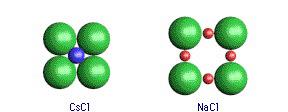
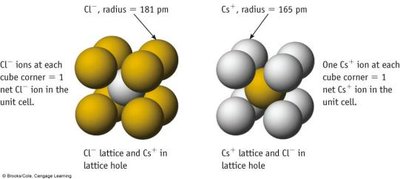
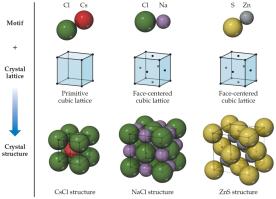
Although NaCl and CsCl both have a 1:1 ratio of cation to anion, their lattice structures differ due to the size of the cations. NaCl adopts an edge-centered structure, while CsCl is face-centered.
NaCl: Smaller Na+ ion, edge-centered lattice.
CsCl: Larger Cs+ ion, face-centered lattice.
Atoms within Cubic Cells: Contributions and Sharing
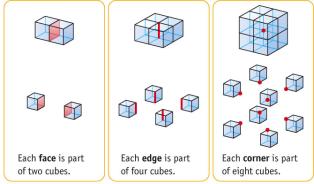
Atoms located at different positions within the unit cell contribute differently to the cell's mass and formula. The sharing of atoms among adjacent cells is crucial for calculating the number of atoms per unit cell.
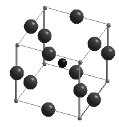
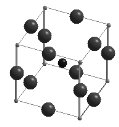
Corner atoms: Shared by 8 cells, contribute 1/8 each.
Face atoms: Shared by 2 cells, contribute 1/2 each.
Edge atoms: Shared by 4 cells, contribute 1/4 each.
Center atoms: Fully within the cell, contribute 1 each.
Atomic Contributions Table
The following table summarizes the spatial contributions of atoms in different unit cell locations:
Atom Location | % within unit cell | Spatial Contribution | Number of Unit Cells Shared |
|---|---|---|---|
Center | 100% | 1 | 1 |
Corner | 12.5% | 1/8 | 8 |
Face | 50% | 1/2 | 2 |
Edge | 25% | 1/4 | 4 |
Examples: Calculating Unit Cell Formulas
Several examples illustrate how to determine the cube formula, molecular formula, oxidation numbers, and coordination of ions in various unit cells:
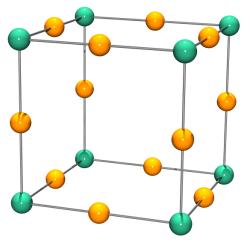
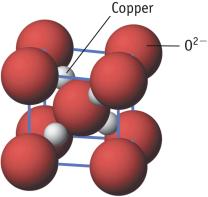
Cuprite (Cu2O): Oxide ions at corners and center, copper ions wholly within the cell.
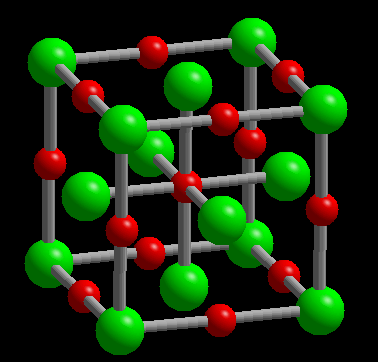
NaCl: Face-centered cubic arrangement of anions, cations in octahedral holes.
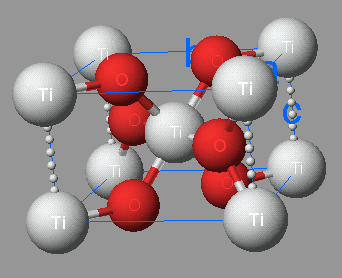
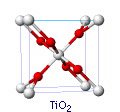
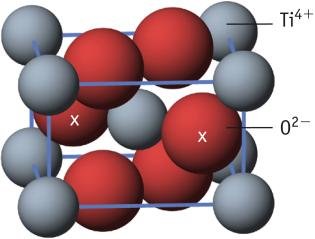
Titanium dioxide (TiO2): Ti4+ ions in octahedral holes, O2- ions at faces and edges.
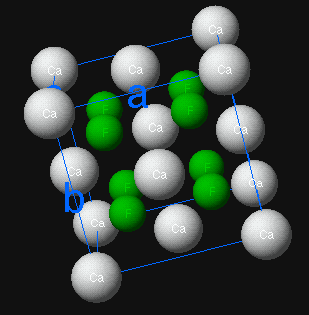
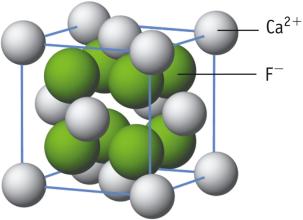
Fluorite (CaF2): Ca2+ ions at corners and faces, F- ions inside the cell.
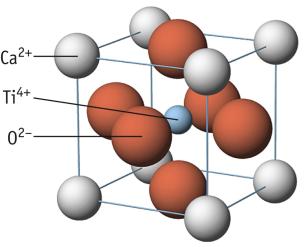
Perovskite (CaTiO3): Ti4+ in octahedral holes, Ca2+ at corners, O2- at faces.
Ionic Solids: Properties and Structures
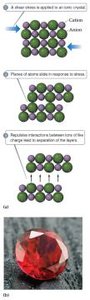
Ionic solids are held together by electrostatic attractions between cations and anions. They typically have high melting and boiling points and are electrical insulators due to charge localization on anions.
Favorable structures: Minimize cation-anion distances, maximize anion-anion and cation-cation distances.
Common structures: CsCl, NaCl (rock salt), and ZnS (zinc blende).
Effect of Ion Size and Coordination Number
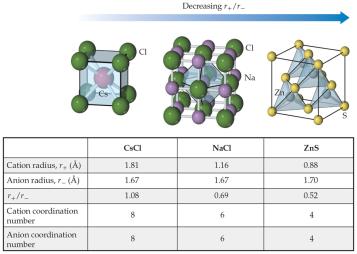
The ratio of cation to anion size (radius ratio) determines the structure adopted by ionic compounds. The coordination number is the number of oppositely charged ions in contact with a central ion.
CsCl: Coordination number 8.
NaCl: Coordination number 6.
ZnS: Coordination number 4.
Coordination Number and Ligands
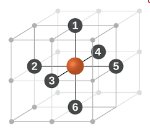
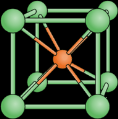
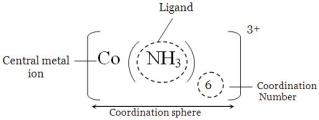
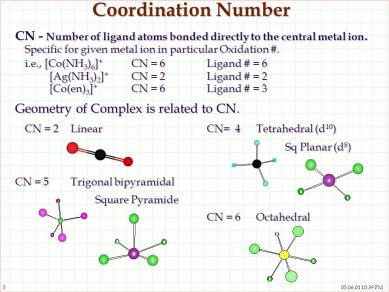
The coordination number can be determined from the chemical formula or the unit cell image. The number of ligands is generally equal to the coordination number. Geometry of complexes is related to coordination number.
Linear: CN = 2
Tetrahedral/Square planar: CN = 4
Octahedral: CN = 6
Types of Solids Based on Bonding
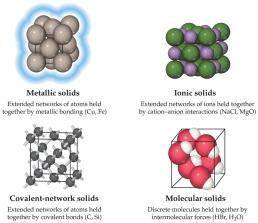
Solids are classified by the nature of their bonding:
Metallic solids: Held together by a sea of shared electrons.
Ionic solids: Sets of cations and anions attracted to each other.
Covalent-network solids: Extensive network of covalent bonds.
Molecular solids: Discrete molecules held by weak forces.
Alloys (FYI Only)
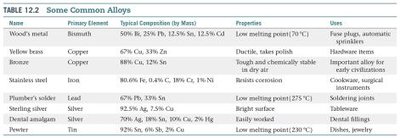
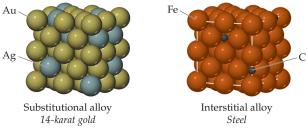
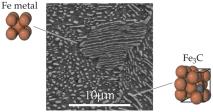
Alloys are materials containing more than one element with metallic properties. They are classified as substitutional, interstitial, or heterogeneous alloys.
Substitutional alloys: Second element replaces metal atom.
Interstitial alloys: Second element fills space in lattice.
Heterogeneous alloys: Components not dispersed uniformly.
Lattice Energy and the Born-Haber Cycle
Lattice energy is the energy released when ions in the gas phase form an ionic solid. The Born-Haber cycle is used to calculate lattice energy by applying Hess's Law, summing the energies of formation, ionization, electron affinity, and lattice formation.
Step 1: Formation of monatomic gas from elements.
Step 2: Formation of ions from monatomic gas.
Step 3: Formation of solid from ions (lattice energy).
Equation:
Example: For NaCl:
Na(s) → Na(g): 107.3 kJ/mol
Na(g) → Na+(g) + e-: 490 kJ/mol
½ Cl2(g) → Cl(g): 121.3 kJ/mol
Cl(g) + e- → Cl-(g): -349 kJ/mol
Na+(g) + Cl-(g) → NaCl(s): -752 kJ/mol
Na(s) + ½ Cl2(g) → NaCl(s): -411 kJ/mol
Additional info: The Born-Haber cycle is a practical application of Hess's Law for ionic compounds, allowing indirect determination of lattice energies.
