 뒤로
뒤로Solution Chemistry and Precipitate Reactions: Study Notes
스터디 가이드 - 스마트 노트
 자료에 맞춘 맞춤형 노트, 핵심 정의, 예시, 맥락을 확장해 제공합니다.
Solution Chemistry
Water: The Common Solvent
Water is the most common solvent in chemistry due to its unique molecular structure. Its bent shape and two lone pairs of electrons on the oxygen atom make it a highly polar molecule. This polarity allows water to dissolve a wide variety of substances, making it essential for aqueous chemistry.
Polarity: The oxygen atom in water is more electronegative than hydrogen, resulting in a partial negative charge on oxygen and a partial positive charge on hydrogen.
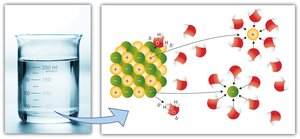
Solvation (Hydration): When ionic substances dissolve in water, the positive ions (cations) are attracted to the oxygen end, and the negative ions (anions) are attracted to the hydrogen end of water molecules.
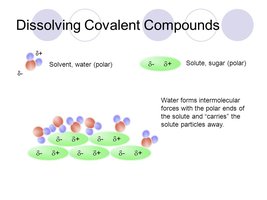
Dissolving Polar Covalent Substances: Polar covalent molecules dissolve in water through interactions between the partial charges of the solute and solvent.
The Nature of Aqueous Solutions: Electrolytes
An electrolyte is a substance that, when dissolved in water, produces a solution that conducts electricity. The degree of ionization determines the strength of the electrolyte.
Strong Electrolytes: Ionize completely in water and conduct electricity efficiently. Examples: soluble ionic compounds, strong acids (e.g., HNO3), and strong bases (e.g., KOH).
Weak Electrolytes: Only partially ionize in water and conduct a small amount of current. Examples: weak acids (e.g., organic acids) and weak bases (e.g., ammonia).
Nonelectrolytes: Do not produce ions in solution and do not conduct electricity. Examples: alcohols and sugars.
Concentration Calculations
Concentration is a measure of the amount of solute dissolved in a given quantity of solvent or solution. The most common unit is molarity (M), defined as moles of solute per liter of solution.
Molarity (M): $M = \frac{\text{moles of solute}}{\text{liters of solution}}$
Moles of Solute: $\text{moles} = \text{liters} \times \text{molarity}$
Preparation of Standard Solution: $\text{grams required} = \text{liters} \times \text{molarity} \times \text{molar mass}$
Dilution Equation: $M_1 V_1 = M_2 V_2$
Concentration of Ions: For ionic compounds, multiply the molarity by the number of ions produced upon dissociation.
Types of Chemical Reactions in Solution
Precipitate Reactions
Precipitate reactions occur when two solutions are mixed and an insoluble solid (precipitate) forms. These reactions are important for identifying ions in solution and for purification processes.
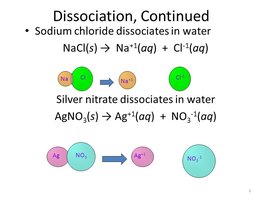
Dissociation: Ionic compounds dissolve in water and their ions separate and move independently.
Solubility Rules: Used to predict whether a precipitate will form when solutions are mixed. If no insoluble product forms, there is no reaction.
Other Types of Reactions
Acid-Base Reactions: A soluble acid reacts with a soluble hydroxide to form water and a salt.
Oxidation-Reduction (Redox) Reactions: Involve the transfer of one or more electrons between reactants.
Describing Reactions in Solution
Chemists often use net ionic equations (NIE) to represent only the species that actually participate in the reaction, omitting spectator ions.
Write the balanced molecular equation.
Break all soluble strong electrolytes into their ions (complete ionic equation).
Cancel out spectator ions to write the net ionic equation.
Stoichiometry of Precipitate Reactions
Stoichiometry allows calculation of the amounts of reactants and products in a chemical reaction.
Determine the reaction and write the balanced (net ionic) equation.
Calculate moles of reactants and identify the limiting reactant.
Calculate moles of products and convert to grams or other units as required.
Practice Problems and Examples
Net Ionic Equations
Example: HBr (aq) + Ca(OH)2 (aq) →
Example: Cu(OH)2 (s) + HClO4 (aq) →
Predicting Precipitation
Example: Will precipitation occur when Na2CO3 and AgNO3 are mixed? If so, write a balanced equation.
Na2CO3 + 2 AgNO3 → Ag2CO3 (s) + 2 NaNO3
If no insoluble product forms, write "no reaction".
Classifying Electrolytes
H2SO4: strong acid, strong electrolyte
CH3CH2OH (ethanol): nonelectrolyte
NH3: weak base, weak electrolyte
KClO4: strong electrolyte
Cu(NO3)2: strong electrolyte
Sample Calculations
What mass of AgCl is produced when 100.00 mL of 0.350 M AgNO3 is added to excess NaCl?
Calculate concentration of each ion in 0.65 M Ca3(PO3)2.
Calcium metal reacts with water: Ca(s) + 2 H2O (l) → Ca(OH)2 (aq) + H2 (g). What is the molarity of hydroxide ions when 4.25 g Ca is dissolved in 225 mL water?
Rust removal with oxalic acid: Fe2O3 (s) + 6 H2C2O4 (aq) → 2 Fe(C2O4)33- (aq) + 3 H2O (l) + 6 H+ (aq). What mass of rust can be removed by 1.0 L of 0.14 M oxalic acid?
Douglasite analysis: Calculate mass percent in a sample using AgNO3 titration data.
Vinegar titration: What is the molarity and mass percent of acetic acid in vinegar titrated with NaOH?
Additional info: For all calculations, use stoichiometric relationships, molar masses, and appropriate unit conversions as needed. Practice writing net ionic equations and applying solubility rules for predicting precipitation.
