 뒤로
뒤로Solutions: Properties, Formation, and Solubility in General Chemistry
스터디 가이드 - 스마트 노트
 자료에 맞춘 맞춤형 노트, 핵심 정의, 예시, 맥락을 확장해 제공합니다.
Solutions
Definition and Characteristics
A solution is a homogeneous mixture in which one substance (the solute) is uniformly dispersed in another substance (the solvent). Solutions are characterized by the even distribution of solute particles among the molecules of the solvent. The physical state of the solution is typically the same as that of the solvent. Solutions can involve solids, liquids, or gases as solutes or solvents, but water is the most common solvent in chemistry.
Solute: The substance present in a lesser amount.
Solvent: The substance present in a greater amount.
Solutes and solvents generally do not react with each other.
They can be mixed in varying proportions.
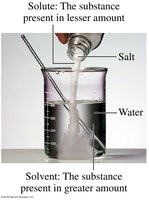
Examples of Solutions
Solutions are found in many everyday contexts, such as saltwater (salt dissolved in water), air (a mixture of gases), and alloys (solid solutions of metals).
Water as a Solvent
Polarity and Hydrogen Bonding
Water is a polar solvent due to the significant difference in electronegativity between oxygen and hydrogen atoms, resulting in polar O-H bonds. This polarity allows water molecules to form hydrogen bonds—weak attractions between the partially positive hydrogen of one molecule and the partially negative atom (N, O, or F) of another. Hydrogen bonding is crucial for many biological and chemical processes.
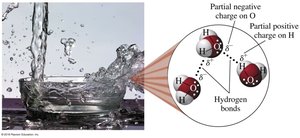
Formation of Solutions
Solute-Solvent Interactions
The formation of a solution depends on the interactions between solute and solvent particles. Energy is required to separate both solute and solvent particles, but energy is released when new attractions form between solute and solvent. Solutions form most readily when the solute and solvent have similar polarities, summarized by the rule: "Like dissolves like".
Polar solutes dissolve in polar solvents.
Nonpolar solutes dissolve in nonpolar solvents.
Polar and nonpolar substances generally do not form solutions together.
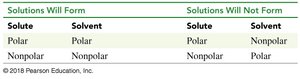
Solutions with Ionic and Polar Solutes
Ionic Solutes in Water
Ionic compounds, such as sodium chloride (NaCl), dissolve in water through a process called hydration. The partially negative oxygen atoms in water attract the positive sodium ions (Na+), while the partially positive hydrogen atoms attract the negative chloride ions (Cl-). This process is represented by the dissociation equation:

Hydration decreases the attraction between ions, keeping them dispersed in solution.
Polar Solutes in Water
Polar solutes, such as methanol (CH3OH), are soluble in water because their polar groups (e.g., –OH) can form hydrogen bonds with water molecules.
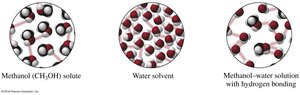
Nonpolar Solutes
Nonpolar solutes do not dissolve in water because there are no significant attractions between nonpolar molecules and the polar water molecules. Nonpolar solutes require nonpolar solvents to form solutions.
Electrolytes and Nonelectrolytes
Electrolytes
Electrolytes are substances that produce ions when dissolved in water, allowing the solution to conduct electricity. They are classified as:
Strong electrolytes: Completely dissociate into ions in solution (e.g., NaCl).
Weak electrolytes: Partially dissociate, producing fewer ions (e.g., HF).
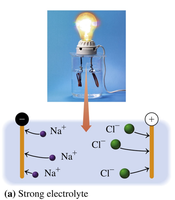
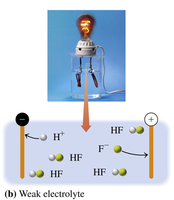
Nonelectrolytes
Nonelectrolytes dissolve as molecules in water, do not produce ions, and do not conduct electricity (e.g., methanol, CH3OH).
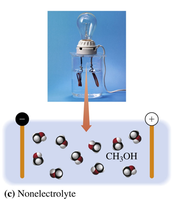
Solubility
Definition and Factors Affecting Solubility
Solubility is the maximum amount of solute that can dissolve in a given amount of solvent at a specific temperature, usually expressed as grams of solute per 100 grams of solvent. Factors affecting solubility include:
Type of solute
Type of solvent
Temperature
Unsaturated vs. Saturated Solutions
An unsaturated solution contains less solute than the maximum amount that can dissolve. A saturated solution contains the maximum amount of dissolved solute; any additional solute will not dissolve and may crystallize out. At saturation, the rate of dissolving equals the rate of crystallization:

Temperature and Solubility
The solubility of most solid solutes increases with temperature, while the solubility of gases in water decreases as temperature increases. For example, more sugar dissolves in hot tea than in iced tea, and carbonated drinks lose more gas when warm.
Henry’s Law
Henry’s Law states that the solubility of a gas in a liquid is directly proportional to the pressure of the gas above the liquid. Higher pressure increases gas solubility; releasing pressure decreases it, as seen with carbonated beverages:
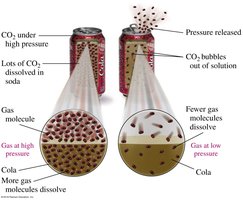
Solubility Rules for Ionic Compounds in Water
General Solubility Rules
Not all ionic compounds are soluble in water. Solubility depends on the presence of certain ions. Ionic compounds containing at least one of the following ions are generally soluble:
Positive Ions | Negative Ions |
|---|---|
Li+, Na+, K+, Rb+, Cs+, NH4+ | NO3-, C2H3O2- |
Cl-, Br-, I- (except with Ag+, Pb2+, or Hg22+) | |
SO42- (except with Ba2+, Pb2+, Ca2+, Sr2+, or Hg22+) |
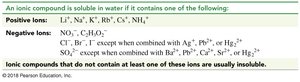
Ionic compounds that do not contain at least one of these ions are usually insoluble.
Practice Problems
Identifying Solutes and Solvents
A) 2 grams of sugar and 100 mL of water: Sugar is the solute, water is the solvent.
B) 60.0 mL of ethyl alcohol and 30.0 mL of methyl alcohol: Methyl alcohol is the solute, ethyl alcohol is the solvent.
C) 55.0 mL of water and 1.50 grams of NaCl: NaCl is the solute, water is the solvent.
D) Air: 200 mL of O2 and 800 mL of N2: O2 is the solute, N2 is the solvent.
Solubility and Solution Types
Unsaturated: Solute readily dissolves; solution does not contain the maximum amount of solute.
Saturated: Solution contains all the solute it can dissolve; excess solute will not dissolve.
Temperature and Solubility Practice
A) 60 g of KBr in 100 g of water at 40°C (solubility = 80 g/100 g H2O): Unsaturated
B) 200 g of KBr in 200 g of water at 40°C: 200 g KBr / 200 g H2O = 100 g/100 g H2O, which is saturated (with excess undissolved).
C) 25 g of KBr in 50 g of water at 40°C: 25 g / 50 g = 50 g/100 g H2O, which is unsaturated.
