 뒤로
뒤로Step-by-Step Study Guide for CHM 2045 Exam 3 (Chapters 7–9)
스터디 가이드 - 스마트 노트
 자료에 맞춘 맞춤형 노트, 핵심 정의, 예시, 맥락을 확장해 제공합니다.
Q1. What is the change in internal energy of a system that absorbs 198 kJ of heat and has 110 kJ of work done on it by the surroundings?
Background
Topic: Thermochemistry – First Law of Thermodynamics
This question tests your understanding of how heat and work contribute to the change in internal energy () of a system.
Key formula:
= heat absorbed by the system (positive if absorbed)
= work done on the system (positive if done on the system)
Step-by-Step Guidance
Identify the values: kJ (heat absorbed), kJ (work done on the system).
Recall that both values are positive because the system gains energy from both heat and work.
Set up the equation: .
Plug in the values for and to prepare for the calculation.
Try solving on your own before revealing the answer!
Final Answer: +308 kJ
The system's internal energy increases by 308 kJ because both heat and work are added to the system.
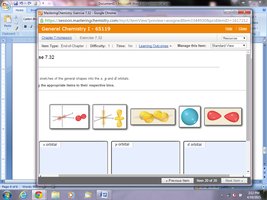
Q22. Which orbital shape does not match the description?
Background
Topic: Quantum Mechanics – Atomic Orbitals
This question tests your ability to recognize and match the visual shapes of atomic orbitals (s, p, d, f) to their correct labels.
Key Terms:
s orbital: spherical shape
p orbital: two lobes (balloon-like) tied at the center
d orbital: four lobes or a donut with lobes
Step-by-Step Guidance
Review the visual descriptions of each orbital shape provided in the question.
Recall the typical shapes: s (sphere), p (two lobes), d (four lobes or donut with lobes).
Compare each image and description to the standard orbital shapes.
Identify which option does not match the expected orbital shape for its label.
Try solving on your own before revealing the answer!
Final Answer: 3d – orbital shaped like 4 balloons tied together in the middle (option c)
The 3d orbital should have four lobes, but the image provided for option c does not match the standard 3d orbital shape.
