뒤로
뒤로Study Guide: Mass, Moles, and Atoms in General Chemistry
스터디 가이드 - 스마트 노트
 자료에 맞춘 맞춤형 노트, 핵심 정의, 예시, 맥락을 확장해 제공합니다.
Q1. How many gold atoms are there in 9.67 g of gold?
Background
Topic: The Mole Concept & Dimensional Analysis
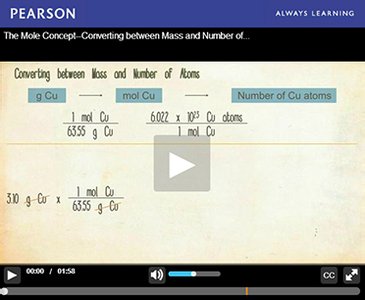
This question tests your ability to convert between mass, moles, and the number of atoms using the molar mass and Avogadro's number.
Key Terms and Formulas
Mole: A unit representing particles (atoms, molecules, etc.)
Molar Mass: The mass (in grams) of one mole of a substance. For gold (Au), g/mol.
Avogadro's Number: atoms/mol
Key formula:
Step-by-Step Guidance
Identify the given mass of gold: g.
Find the molar mass of gold: g/mol.
Set up the conversion from grams to moles: .
Use Avogadro's number to convert moles to atoms: .
Write out the full dimensional analysis setup, but stop before calculating the final value.
Try solving on your own before revealing the answer!
Final Answer: atoms
Using the setup: atoms.
This calculation uses both the molar mass and Avogadro's number to convert from grams to atoms.
Q2. What is the mass of atoms of lead?
Background
Topic: The Mole Concept & Dimensional Analysis
This question tests your ability to convert from the number of atoms to mass using Avogadro's number and the molar mass of lead.
Key Terms and Formulas
Avogadro's Number: atoms/mol
Molar Mass of Lead (Pb): g/mol
Key formula:
Step-by-Step Guidance
Identify the number of lead atoms: atoms.
Set up the conversion from atoms to moles: .
Find the molar mass of lead: g/mol.
Set up the conversion from moles to grams: g/mol.
Write out the full dimensional analysis setup, but stop before calculating the final value.
Try solving on your own before revealing the answer!
Final Answer: g
Using the setup: g.
This calculation converts atoms to moles, then moles to grams using the molar mass.
Q3. Calculate the mass, in grams, of a single iodine atom ( g/mol).
Background
Topic: The Mole Concept & Atomic Mass
This question tests your ability to convert from a single atom to mass using Avogadro's number and the atomic mass.
Key Terms and Formulas
Avogadro's Number: atoms/mol
Atomic Mass of Iodine: g/mol
Key formula:
Step-by-Step Guidance
Identify the atomic mass of iodine: g/mol.
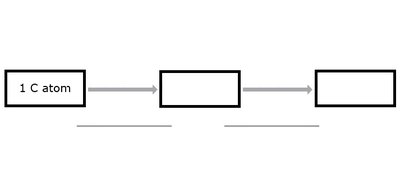
Recall that 1 mole contains atoms.
Set up the conversion: .
Write out the setup for the calculation, but stop before calculating the final value.
Try solving on your own before revealing the answer!
Final Answer: g
Using the setup: g.
This calculation divides the molar mass by Avogadro's number to find the mass of a single atom.
Q4. Which of the following would you expect to be a molecule and which would you expect to be part of an ionic solid?
Background
Topic: Chemical Bonding (Ionic vs Covalent)
This question tests your understanding of the difference between molecular (covalent) and ionic compounds, based on the types of elements involved.
Key Terms
Covalent Bond: A bond formed by sharing electrons between two nonmetals.
Ionic Bond: A bond formed by transferring electrons from a metal to a nonmetal, resulting in oppositely charged ions.
Molecule: A cluster of atoms held together by covalent bonds.
Ionic Solid: A lattice of ions held together by ionic bonds.
Step-by-Step Guidance
Identify whether each compound is made of metals, nonmetals, or both.
Recall that covalent bonds occur between two nonmetals, forming molecules.
Recall that ionic bonds occur between a metal and a nonmetal, forming ionic solids.
Classify each compound based on the elements present, but stop before stating the final classification.
Try solving on your own before revealing the answer!
Final Answer:
Compounds made of two nonmetals are molecules (covalent), while those made of a metal and a nonmetal are ionic solids.
For example, is a molecule, is an ionic solid.