 뒤로
뒤로The Clapeyron and Clausius-Clapeyron Equations: Thermodynamics of Phase Transitions
스터디 가이드 - 스마트 노트
 자료에 맞춘 맞춤형 노트, 핵심 정의, 예시, 맥락을 확장해 제공합니다.
The Clapeyron Equation and Phase Equilibria
Introduction to Phase Equilibria
Phase equilibria describe the balance between different states of matter (solid, liquid, gas) under varying conditions of temperature and pressure. The Clapeyron equation provides a thermodynamic relationship for the slope of the equilibrium line between two phases in a one-component system. This is fundamental for understanding phase diagrams and the behavior of substances during phase transitions.
The Clapeyron Equation: Derivation and Meaning
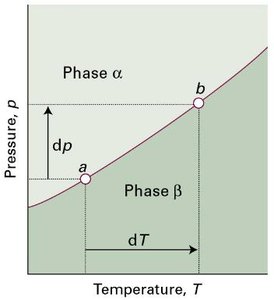
The Clapeyron equation relates the change in pressure with temperature along a phase boundary where two phases are in equilibrium. It is derived from the equality of chemical potentials at equilibrium and the thermodynamic definitions of entropy and volume changes during a phase transition.
General Form:
Where:
= entropy change of transition
= volume change of transition
= enthalpy change of transition
= temperature (in Kelvin)
Physical Interpretation
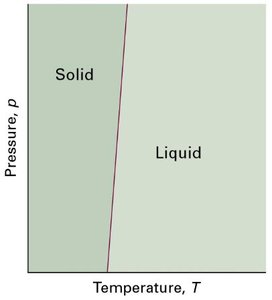
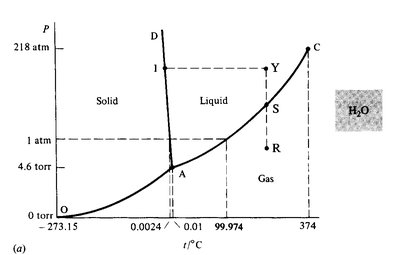
The equation shows that the slope of the phase boundary depends on the entropy and volume changes during the transition. For example, the solid-liquid equilibrium line for water slopes to the left because ice has a larger molar volume than liquid water, and melting is endothermic.
Example: For H2O, kJ mol-1, cm3 mol-1, cm3 mol-1. The negative slope means ice melts at lower temperatures under higher pressure.
Application: Calculating the Effect of Pressure on Melting Point
Given the enthalpy and volume changes, the Clapeyron equation can be used to calculate how the melting point of a substance changes with pressure:
Formula:
For ice: K bar-1 (melting point decreases as pressure increases)
The Clausius-Clapeyron Equation
Introduction and Approximations
The Clausius-Clapeyron equation is a simplified form of the Clapeyron equation, particularly useful for liquid-vapour and solid-vapour equilibria where the volume change is dominated by the gas phase. It assumes the vapour behaves ideally and the volume of the condensed phase is negligible compared to the vapour.
Differential Form:
Where: = enthalpy of vaporization, = gas constant, = temperature (K), = vapour pressure
Integrated Form and Its Use
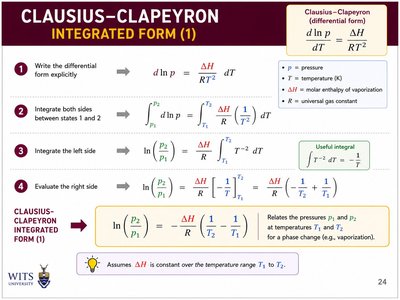
Assuming is constant over a small temperature range, the equation can be integrated to relate vapour pressures at two temperatures:
Integrated Form:
This form is widely used to estimate enthalpy of vaporization from experimental vapour pressure data.
Example Calculation: Determining Enthalpy of Vaporization
Given the normal boiling point and vapour pressure at another temperature, the Clausius-Clapeyron equation can be used to estimate .
Example: A liquid with a normal boiling point of -93°C and vapour pressure of 0.296 atm at -113°C. Calculated kJ mol-1.
Phase Diagrams and the Clausius-Clapeyron Equation
Understanding Phase Boundaries
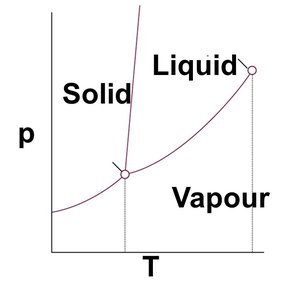
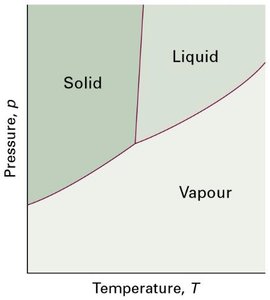
The Clausius-Clapeyron equation explains the shape and slope of phase boundaries in phase diagrams. The solid-liquid boundary is typically much steeper than the solid-vapour or liquid-vapour boundaries due to the much smaller volume change during melting compared to vaporization or sublimation.
Key Point: , so the solid-liquid line is steeper.
Solid-Solid Phase Transitions and Polymorphism
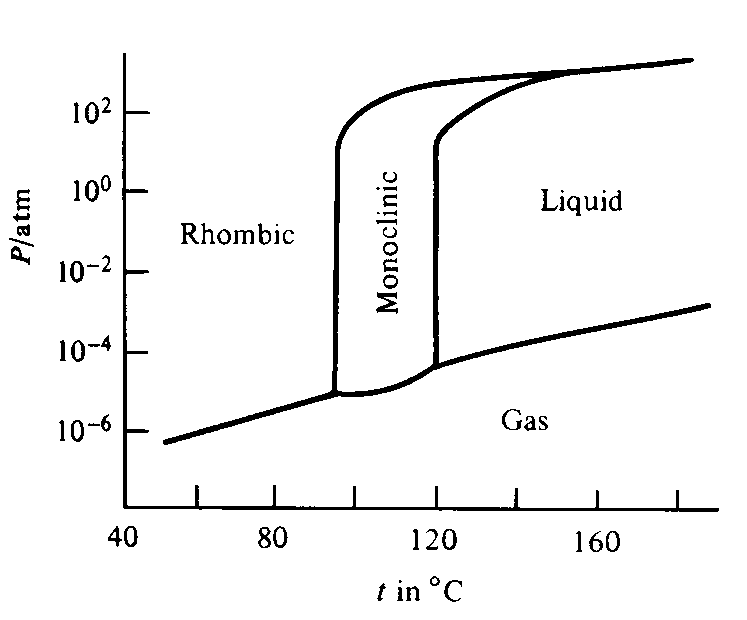
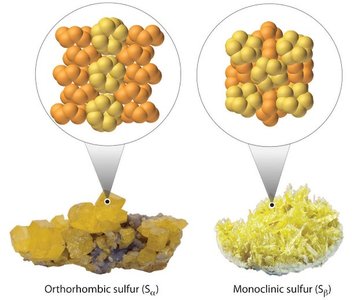
Some substances can exist in more than one solid phase (polymorphs), each with a different crystal structure. The phase diagram for such substances will show the stability regions for each polymorph or allotrope.
Example: Sulfur exists as rhombic and monoclinic polymorphs, each stable under different conditions of temperature and pressure.
Metastable Phases
A metastable phase is one that is not the most stable form under given conditions but persists because the transformation to the stable phase is kinetically hindered. For example, diamond is a metastable allotrope of carbon at room temperature and pressure.
Applications: Metastable phases are important in materials science, pharmaceuticals, and food chemistry (e.g., chocolate tempering).
Summary Table: Key Equations
Equation | Form | Application |
|---|---|---|
Clapeyron | General phase transitions | |
Clausius-Clapeyron (differential) | Liquid-vapour, solid-vapour | |
Clausius-Clapeyron (integrated) | Estimating |
Conclusion
The Clapeyron and Clausius-Clapeyron equations are essential tools for understanding and predicting the behavior of substances during phase transitions. They provide quantitative relationships between pressure, temperature, and enthalpy changes, and are widely used in physical chemistry, materials science, and engineering.
