 뒤로
뒤로The Gaseous State of Matter: Properties, Laws, and Applications
스터디 가이드 - 스마트 노트
 자료에 맞춘 맞춤형 노트, 핵심 정의, 예시, 맥락을 확장해 제공합니다.
The Gaseous State of Matter
Introduction to Gases
Gases are one of the three primary states of matter, characterized by low density and high mobility of their particles. The study of gases is fundamental in understanding atmospheric phenomena and various chemical processes.
Composition of Air: The atmosphere is a mixture of gases, primarily nitrogen, oxygen, argon, carbon dioxide, and trace gases.
Importance: Understanding gas behavior is essential for applications such as respiration, combustion, and industrial processes.
Properties of Solids, Liquids, and Gases
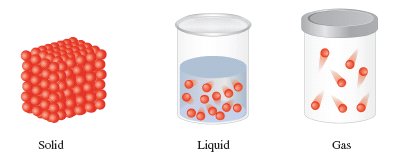
The three states of matter differ in particle arrangement and movement:
Solids: Particles are closely packed in a fixed structure.
Liquids: Particles are close but can move past each other.
Gases: Particles are far apart and move freely.
Kinetic-Molecular Theory of Gases
Postulates of the Kinetic-Molecular Theory
This theory explains the macroscopic properties of gases by considering their molecular composition and motion:
Random Motion: Gas molecules move in random directions with various speeds.
Negligible Molecular Volume: The volume of individual molecules is much smaller than the volume the gas occupies.
Negligible Forces: Intermolecular forces are insignificant except during collisions.
Constant Average Kinetic Energy: The average kinetic energy of gas molecules remains constant at a given temperature.
Kinetic Energy and Temperature: The average kinetic energy is directly proportional to the absolute temperature (Kelvin).
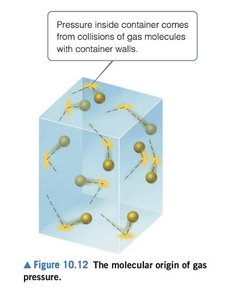
Key Point: Gas pressure results from collisions of molecules with the walls of their container.
Measurement of Gases
Units of Measurement
Gases are described using several physical quantities and units:
Pressure: Common units include atmosphere (atm), torr, mm Hg, Pascal (Pa), kilopascal (kPa), bar, and psi.
Volume: 1 m³ = 1000 dm³ = 1000 L
Temperature: Kelvin (K) is the SI unit; 0 K = -273 °C.
Amount of Substance: Represented as n (in moles).
Pressure Measurement
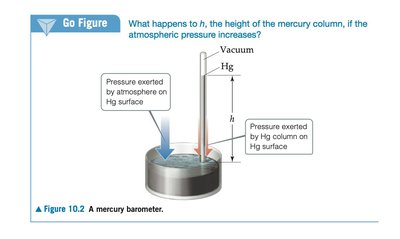
Atmospheric pressure is commonly measured using a mercury barometer. The height of the mercury column is proportional to the atmospheric pressure exerted.

Empirical Gas Laws
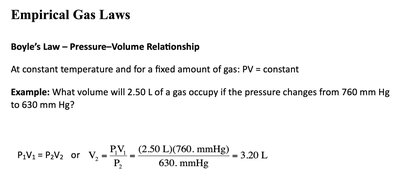
Boyle's Law: Pressure–Volume Relationship
At constant temperature and for a fixed amount of gas, the pressure and volume are inversely related:
Mathematical Expression:
Example: If the pressure on a gas decreases, its volume increases proportionally.
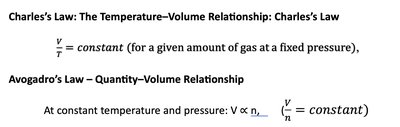
Charles's Law: Temperature–Volume Relationship
At constant pressure, the volume of a gas is directly proportional to its absolute temperature:
Mathematical Expression:
Avogadro's Law: Quantity–Volume Relationship
At constant temperature and pressure, the volume of a gas is directly proportional to the number of moles:
Mathematical Expression:
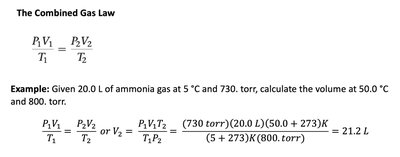
The Combined Gas Law
The combined gas law relates pressure, volume, and temperature for a fixed amount of gas:
Mathematical Expression:
Application: Used when more than one variable changes simultaneously.
The Ideal Gas Law
Formulation and Application
The ideal gas law combines Boyle's, Charles's, and Avogadro's laws into a single equation:
Equation:
Variables: P = pressure, V = volume, n = moles, R = ideal gas constant, T = temperature (K)

Note: The ideal gas law can be used to derive Boyle's, Charles's, and Avogadro's laws.
Values of the Gas Constant (R)
The value of R depends on the units used for pressure and volume:
R = 0.0821 L·atm·mol−1·K−1 (when P in atm, V in L)
R = 8.314 J·mol−1·K−1 (when P in Pa, V in m³)

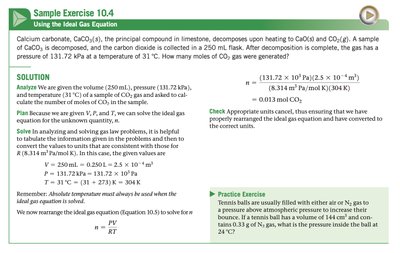
Sample Calculation Using the Ideal Gas Law
To solve for an unknown variable, rearrange the ideal gas law as needed. For example, to find the number of moles:

Gas Mixtures and Partial Pressures
Dalton’s Law of Partial Pressures
In a mixture of non-reacting gases, the total pressure is the sum of the partial pressures of each component:
Mathematical Expression:
Each gas behaves independently and exerts pressure as if it were alone in the container.
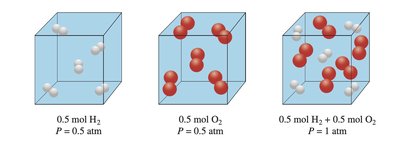
Sample Calculation: Partial Pressures
To find the partial pressure of each gas in a mixture, use the ideal gas law for each component and sum the results for the total pressure.

Summary Table: Gas Laws
The following table summarizes the main gas laws, their formulas, and descriptions:
Gas Law | Formula | Description |
|---|---|---|
Boyle's Law | At constant T, as pressure increases, volume decreases. | |
Charles' Law | At constant P, as volume increases, temperature increases. | |
Gay-Lussac's Law | At constant V, as pressure increases, temperature increases. | |
Combined Gas Law | Combines Boyle's, Charles', and Gay-Lussac's Laws. | |
Ideal Gas Law | Relates P, V, n, and T for an ideal gas. |

Conclusion
The study of gases and their laws provides a foundation for understanding chemical reactions, atmospheric science, and various industrial applications. Mastery of these concepts is essential for further studies in chemistry and related fields.
