 뒤로
뒤로The Periodic Table and Periodic Properties: Structure, Electron Configurations, and Trends
스터디 가이드 - 스마트 노트
 자료에 맞춘 맞춤형 노트, 핵심 정의, 예시, 맥락을 확장해 제공합니다.
The Periodic Table and Periodic Law
Historical Development of the Periodic Table
The periodic table is a fundamental tool in chemistry, organizing elements according to their properties and atomic structure. Early chemists, such as John Newlands, Dmitri Mendeleev, and Lothar Meyer, recognized recurring patterns in elemental properties when arranged by increasing atomic mass. Mendeleev's approach allowed for the prediction of undiscovered elements and grouped elements more accurately by their chemical behavior. Later, Henry Moseley established that the atomic number, not atomic mass, is the basis for element arrangement, correlating with the number of protons in the nucleus.
Periodic Law: Properties of elements recur in a regular pattern when arranged by increasing atomic number.
Atomic Number: The number of protons in the nucleus; determines the element's identity.
Law of Octaves: Early observation that every eighth element had similar properties (limited to lighter elements).
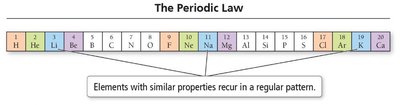
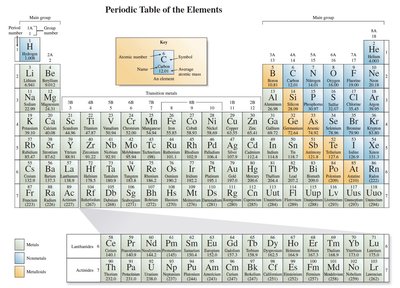
Organization of the Periodic Table: Rows and Columns
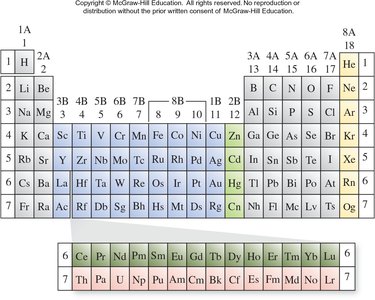
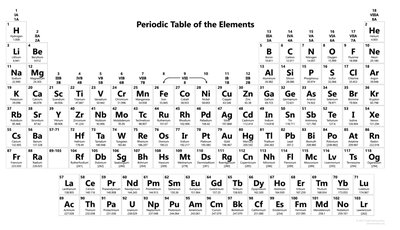
The periodic table is organized into rows (periods) and columns (groups or families), each reflecting specific trends and properties. Groups contain elements with similar chemical behaviors due to their valence electron configurations.
Periods: Horizontal rows; elements in the same period have the same number of electron shells.
Groups/Families: Vertical columns; elements in the same group have similar valence electron arrangements and properties.
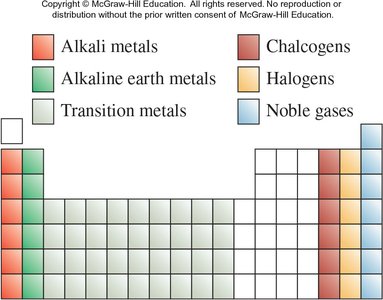
Periodic Table Blocks
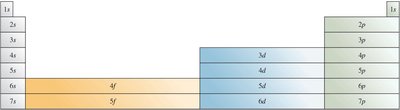
The periodic table is divided into blocks based on the type of atomic orbital that is being filled with electrons: s, p, d, and f blocks. This division helps predict electron configurations and chemical properties.
s-block: Groups 1 and 2, plus helium.
p-block: Groups 13–18.
d-block: Transition metals (Groups 3–12).
f-block: Lanthanides and actinides.
Electron Configurations and Valence Electrons
Electrons and Their Role in Reactivity
Electrons occupy the space around the nucleus and are responsible for the chemical reactivity of elements. The octet rule states that atoms tend to gain, lose, or share electrons to achieve a stable configuration similar to the nearest noble gas.
Valence Electrons: Electrons in the outermost shell; determine an element's chemical properties and reactivity.
Core Electrons: Inner electrons; do not participate in bonding.
Orbital Energies and Electron Arrangement
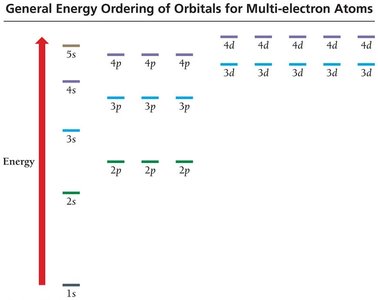
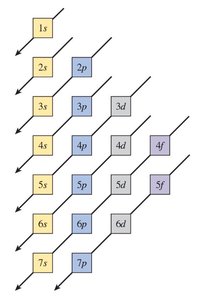
Electron configurations describe the distribution of electrons among atomic orbitals. The arrangement follows three guiding principles:
Aufbau Principle: Electrons fill the lowest energy orbitals first.
Pauli Exclusion Principle: No two electrons in an atom can have the same set of four quantum numbers.
Hund's Rule: Electrons occupy orbitals singly with parallel spins before pairing.
Reading the Periodic Table for Electron Configurations
The periodic table can be used to determine electron configurations. The principal quantum number (n) varies by block:
s- and p-blocks: n equals the period number.
d-block: n equals the period number minus one.
f-block: n equals the period number minus two.
Practice: Writing Electron Configurations
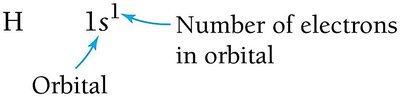
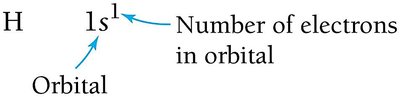
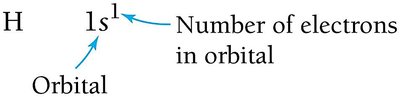
Electron configurations can be written for any element using the periodic table. For example:
Magnesium (Z = 12):
Bromine (Z = 35):
Tantalum (Z = 73):
Noble Gas Configuration
Noble gas configuration is a shorthand notation that uses the electron configuration of the nearest noble gas in brackets, followed by the remaining electrons. This simplifies the representation of electron configurations for larger elements.
Example: Silicon (Si): Full configuration: Noble gas configuration: [Ne]
Magnesium (Mg): [Ne]
Bromine (Br): [Ar]
Tantalum (Ta): [Xe]
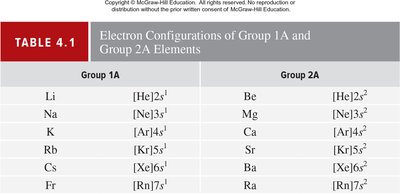
Electron Configurations of Group 1A and 2A Elements
Group 1A and 2A elements have characteristic electron configurations, often summarized in tables for quick reference.
Group 1A | Group 2A |
|---|---|
Li: [He]2s1 | Be: [He]2s2 |
Na: [Ne]3s1 | Mg: [Ne]3s2 |
K: [Ar]4s1 | Ca: [Ar]4s2 |
Rb: [Kr]5s1 | Sr: [Kr]5s2 |
Cs: [Xe]6s1 | Ba: [Xe]6s2 |
Fr: [Rn]7s1 | Ra: [Rn]7s2 |
Periodic Properties and Trends
Metallic Character
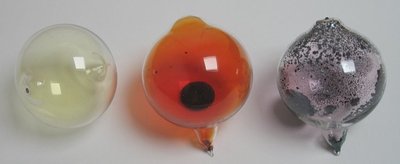
Metallic character describes how readily an element loses electrons to form positive ions (cations). Metals are typically shiny, malleable, and good conductors of heat and electricity. Semi-metals (metalloids) have intermediate properties, while non-metals are poor conductors and tend to gain electrons.
Metals: Lose electrons, form cations, high conductivity.
Semi-metals: Intermediate properties.
Non-metals: Gain electrons, form anions, low conductivity.
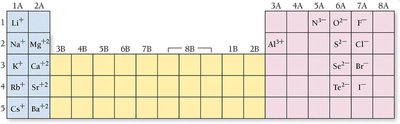
Trends in Predicting Ions
Atoms form ions by gaining or losing electrons to achieve a stable electron configuration. Main group elements tend to form ions with charges predictable by their group number.
Cation: Positively charged ion (loss of electrons).
Anion: Negatively charged ion (gain of electrons).
Groups 1A-3A: Form cations with charges +1, +2, +3.
Groups 5A-7A: Form anions with charges -3, -2, -1.
Electron Configurations of Main Group and Transition Metal Ions
To write the electron configuration of ions, start with the neutral atom's configuration and add or remove electrons from the valence shell. Transition metal cations lose electrons from the highest energy s orbital before the d orbital.
Isoelectronic: Ions or atoms with the same electron configuration.
Example: Na: Na+: F: F-: $1s^2\ 2s^2\ 2p^6$ Fe: Fe2+: Fe3+:
Summary Table: Classification of Elements
Type | Properties | Examples |
|---|---|---|
Metals | Shiny, malleable, conduct electricity | Na, Fe, Cu |
Semi-metals | Intermediate properties | B, Si, As |
Non-metals | Dull, brittle, poor conductors | O, N, Cl |
Additional info: The notes above expand on brief points from the original material, providing academic context, definitions, and examples for clarity and completeness.
