 뒤로
뒤로CHEM 131 Chapter 8: The Quantum-Mechanical Model of the Atom: Foundations, Light, and Atomic Structure
스터디 가이드 - 스마트 노트
 자료에 맞춘 맞춤형 노트, 핵심 정의, 예시, 맥락을 확장해 제공합니다.
The Quantum-Mechanical Model of the Atom
Introduction and Importance
The quantum-mechanical model forms the foundation of modern chemistry, explaining the organization of the periodic table, the behavior of elements in bonding, and the chemical and physical properties of elements. It is essential for understanding why elements behave as metals or nonmetals, their reactivity, and their tendencies to gain or lose electrons.
The Nature of Light and Electromagnetic Radiation
Electromagnetic Radiation: The Nature of Light
Light is a form of electromagnetic radiation, consisting of oscillating electric and magnetic fields that propagate through space at the speed of light (c = 3.00 × 10⁸ m/s in vacuum). The electric and magnetic fields are perpendicular to each other and to the direction of wave propagation.
Electric field: Region where an electrically charged particle experiences a force.
Magnetic field: Region where a magnetized particle experiences a force.
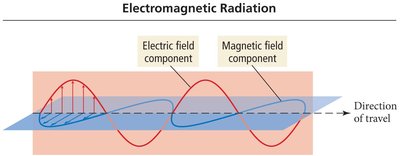
Wave Properties: Wavelength, Amplitude, and Frequency
Light waves are characterized by their wavelength (λ), amplitude, and frequency (ν):
Wavelength (λ): The distance between two consecutive crests or troughs. Determines the color of visible light.
Amplitude: The height of the wave from the center line to the crest or trough. Determines the brightness (intensity) of light.
Frequency (ν): The number of wave cycles that pass a point per second. Measured in hertz (Hz), where 1 Hz = 1 s−1.
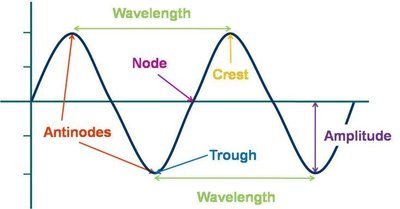
Wavelength and frequency are inversely proportional:
Total energy (E) of a wave is proportional to both its amplitude and frequency:
Electromagnetic Spectrum
The electromagnetic spectrum encompasses all types of electromagnetic radiation, from radio waves (longest wavelength, lowest energy) to gamma rays (shortest wavelength, highest energy). Visible light is a small portion of this spectrum, ranging from approximately 400 nm (violet) to 750 nm (red).
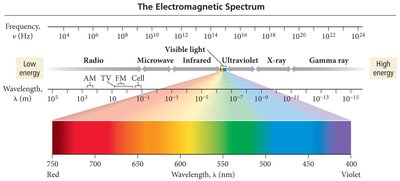
Color and Brightness
Different wavelengths correspond to different colors, while different amplitudes correspond to different brightness levels.
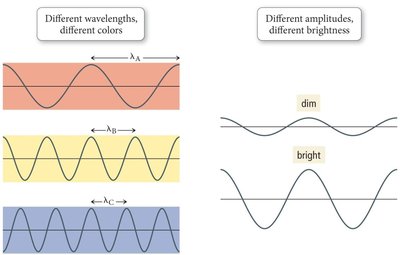
Wave-Like Behavior: Interference and Diffraction
Interference
When two or more waves overlap, they interact through interference:
Constructive interference: Waves in phase add together to form a larger wave.
Destructive interference: Waves out of phase cancel each other, reducing amplitude.
Ultimate constructive interference can lead to phenomena such as rogue waves in the ocean.
Diffraction
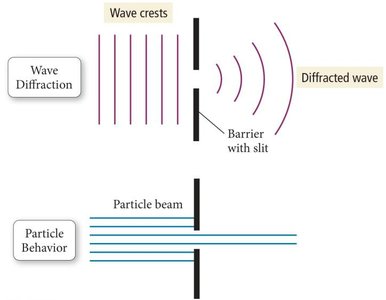
Diffraction occurs when a wave encounters an obstacle or slit comparable in size to its wavelength, causing the wave to bend around the barrier. This is a property unique to waves and not observed in classical particles.
Particle Nature of Light: The Photoelectric Effect
Photoelectric Effect and Quantization
The photoelectric effect demonstrated that light can behave as particles called photons. When light of sufficient frequency strikes a metal surface, electrons are ejected. The energy of a photon is given by:
h: Planck’s constant (6.626 × 10⁻³⁴ J·s)
c: Speed of light (3.00 × 10⁸ m/s)
Electrons are only ejected if the photon energy exceeds the metal’s binding energy (ϕ):
This effect could not be explained by classical wave theory, confirming the quantized nature of light.
Atomic Spectra and Bohr’s Model
Atomic Emission Spectra
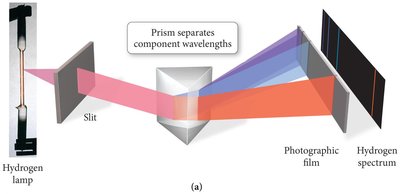
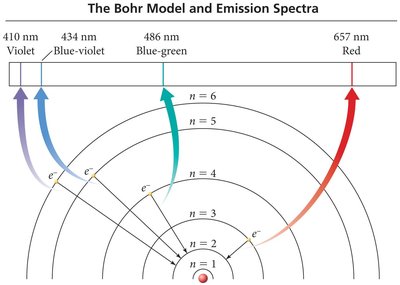
When atoms absorb energy, electrons are excited to higher energy levels. As they return to lower energy states, they emit photons of specific wavelengths, producing a line spectrum unique to each element. This is the basis for atomic spectroscopy and flame tests.
Bohr’s Model of the Atom
Bohr proposed that electrons travel in fixed orbits (energy levels) around the nucleus. Transitions between these orbits involve absorption or emission of photons with energy equal to the difference between the levels:
For hydrogen:
n: Principal quantum number (energy level)
Quantum Mechanics and the Modern Atomic Model
Heisenberg’s Uncertainty Principle
Quantum mechanics states that it is impossible to know both the exact position and momentum of an electron simultaneously. This is known as the Heisenberg uncertainty principle:
As a result, electrons are described by probability distributions rather than fixed orbits.
Schrödinger’s Equation and Atomic Orbitals
The behavior of electrons in atoms is described by Schrödinger’s equation:
Solutions to this equation, called wave functions (ψ), describe the probability of finding an electron in a particular region of space, known as an orbital.
Quantum Numbers
Each electron in an atom is described by a set of four quantum numbers:
Principal quantum number (n): Specifies energy level and size of orbital (n = 1, 2, 3, ...).
Angular momentum quantum number (l): Specifies shape of orbital (l = 0 to n-1; s, p, d, f).
Magnetic quantum number (ml): Specifies orientation of orbital (ml = -l to +l).
Spin quantum number (ms): Specifies electron spin (+1/2 or -1/2).
Quantum Number | Symbol | Allowed Values | Physical Meaning |
|---|---|---|---|
Principal | n | 1, 2, 3, ... | Energy level, size |
Angular momentum | l | 0 to n-1 | Shape (s, p, d, f) |
Magnetic | ml | -l to +l | Orientation |
Spin | ms | +1/2, -1/2 | Spin direction |
Shapes and Types of Atomic Orbitals
s orbitals (l = 0): Spherical shape, one per energy level.
p orbitals (l = 1): Dumbbell shape, three orientations (px, py, pz).
d orbitals (l = 2): Four-lobed shapes, five orientations.
f orbitals (l = 3): Complex shapes, seven orientations.
Probability and Radial Distribution Functions
The probability of finding an electron at a certain distance from the nucleus is given by the radial distribution function. Nodes are regions where the probability drops to zero. The number of nodes increases with energy level.
Key Equations and Relationships
De Broglie relation:
Frequency-wavelength relation:
Planck’s equation:
Photon energy:
Heisenberg uncertainty:
Energy of electron in hydrogen:
Energy change for transitions:
Conclusion
The quantum-mechanical model explains the arrangement of electrons in atoms, the origin of atomic spectra, and the chemical properties of elements. Quantum numbers serve as an "electronic zip code" for electrons, specifying their energy, shape, orientation, and spin within the atom. Understanding these principles is essential for further study of chemical bonding and periodic trends.
