뒤로
뒤로CHEM 131 Chapter 7: Thermochemistry and Thermodynamics: Study Notes for General Chemistry
스터디 가이드 - 스마트 노트
 자료에 맞춘 맞춤형 노트, 핵심 정의, 예시, 맥락을 확장해 제공합니다.
Thermochemistry and Thermodynamics
Introduction to Thermochemistry
Thermochemistry is the branch of chemistry that studies the energy and heat associated with chemical reactions and physical transformations. It is a key part of thermodynamics, which deals with the principles governing energy changes in matter.
Energy: Forms and Units
Types of Energy
Potential Energy: Energy due to position or composition. Examples include gravitational energy (position in a gravitational field), electrostatic energy (relative positions of charges), and chemical energy (energy stored in chemical bonds).
Kinetic Energy: Energy due to motion. Includes thermal energy (random motion of molecules), mechanical energy (macroscopic movement), electrical energy (movement of electrons), sound energy (compression and expansion of molecules), and light/radiant energy (energy transitions in atoms).
Energy is the capacity to do work. The relationship is given by:
The kinetic energy (KE) of an object is:
where m is mass (kg) and v is velocity (m/s). The SI unit for energy is the joule (J):
Other common units:
calorie (cal): Energy needed to raise 1 g of water by 1°C.
kilocalorie (kcal): 1 kcal = 1000 cal = energy to raise 1000 g of water by 1°C.
Food Calorie (Cal): 1 Cal = 1 kcal = 4184 J.
Conversion: 1 cal = 4.184 J.
System and Surroundings
Definitions and Energy Flow
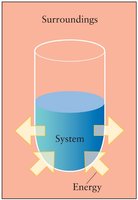
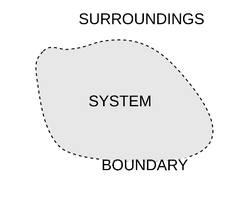
In thermodynamics, the universe is divided into the system (the part under study) and the surroundings (everything else that can exchange energy with the system). Energy can flow between the system and surroundings as heat or work.
Exothermic process: System releases energy to surroundings (surroundings feel hot).
Endothermic process: System absorbs energy from surroundings (surroundings feel cold).
Law of Conservation of Energy and the First Law of Thermodynamics
Fundamental Principles
Law of Conservation of Energy: Energy can neither be created nor destroyed.
First Law of Thermodynamics: The total energy of the universe is constant.
Heat and work can be interconverted, but their total remains constant. The sum of all energy changes in the universe is zero.
Energy Exchange: Heat and Work
Mechanisms of Energy Transfer
Energy is exchanged between the system and surroundings as heat (q) and work (w):
q: Heat (thermal energy)
w: Work (mechanical energy)
Neither q nor w are state functions; their values depend on the process. The change in internal energy is:
For work done by expansion/compression at constant pressure:

Internal Energy and State Functions
Definition and Properties
Internal energy is the total energy (kinetic + potential) possessed by a system. The change in internal energy depends only on the initial and final states, not the path taken (state function):
For a chemical reaction:
A state function depends only on the state of the system, not on how it got there.

Enthalpy: Heat at Constant Pressure
Definition and Interpretation
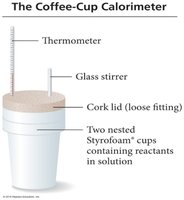
Enthalpy (H) is the heat content of a system at constant pressure. The enthalpy change, , is the heat evolved or absorbed in a reaction at constant pressure:
: Exothermic (heat released, surroundings feel hot)
: Endothermic (heat absorbed, surroundings feel cold)
Enthalpy is an extensive property: it depends on the amount of reactants used.

Hess’s Law
Summing Enthalpy Changes
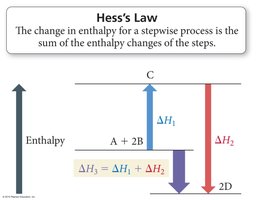
Hess’s Law states that if a reaction can be expressed as a series of steps, the overall enthalpy change is the sum of the enthalpy changes for each step:
For example:
A + 2B → C
C → 2D
-----------------
A + 2B → 2D
Standard State and Standard Enthalpy Change
Definitions
Standard state: The state of a material at a defined set of conditions:
Pure gas at exactly 1 atm pressure
Pure solid or liquid in its most stable form at 1 atm and 25°C
Substance in solution at 1 M concentration
Standard enthalpy change (): The enthalpy change when all reactants and products are in their standard states.

Standard Enthalpy of Formation ()
Definition and Calculation
The standard enthalpy of formation () is the enthalpy change for the formation of 1 mole of a compound from its elements in their standard states. For any pure element in its standard state, kJ/mol.
To calculate the enthalpy change for a reaction:
where n is the stoichiometric coefficient from the balanced equation.

Examples: Exothermic vs. Endothermic Processes
Classification of Processes
Process | Type |
|---|---|
Sweat evaporating from skin | Endothermic |
Wood burning in a fire | Exothermic |
Water freezing in a freezer | Exothermic |
Ice cube melting | Endothermic |
Gasoline burning in engine | Exothermic |
Nail polish remover evaporating | Endothermic |

Trends in Lattice Energy: Ion Size and Charge
Lattice Energy Trends
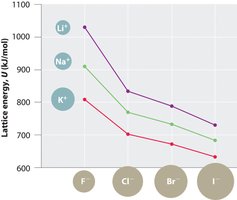
Lattice energy is the energy required to separate one mole of an ionic solid into its gaseous ions. It depends on the size and charge of the ions:
Lattice energy increases with higher ionic charge.
Lattice energy decreases as ionic radius increases.