뒤로
뒤로Thermochemistry: Energy, Enthalpy, and Calorimetry
스터디 가이드 - 스마트 노트
 자료에 맞춘 맞춤형 노트, 핵심 정의, 예시, 맥락을 확장해 제공합니다.
Thermochemistry
Introduction to Thermochemistry
Thermochemistry is the study of energy changes, particularly heat, that accompany chemical reactions and physical transformations. Understanding the flow of energy is essential for predicting reaction behavior and designing chemical processes.
Energy (E): The ability to do work or produce heat; the sum of all potential and kinetic energy in a system is called the internal energy.
Potential Energy: Stored energy, often in chemical bonds.
Kinetic Energy: Energy of motion, proportional to mass and velocity:
Law of Conservation of Energy: Energy cannot be created or destroyed (First Law of Thermodynamics).
Heat (q): Transfer of energy due to temperature difference; flows from hot to cold.
Enthalpy (H): Heat content at constant pressure; is the change in enthalpy.
System and Surroundings: The system is the part of the universe under study; everything else is the surroundings.
Endothermic Process: Absorbs heat (system gains energy).
Exothermic Process: Releases heat (system loses energy).
State Function: Property dependent only on the current state, not the path taken.
Entropy (S): Measure of disorder or randomness.
Gibbs Free Energy (G): Determines spontaneity and available energy for work.
Work (w): Force acting over a distance.
Energy, Work, and Internal Energy
Internal Energy and Its Components
The internal energy change () of a system is the sum of heat exchanged and work done:
Sign conventions:
+q: Heat absorbed by the system
-q: Heat released by the system
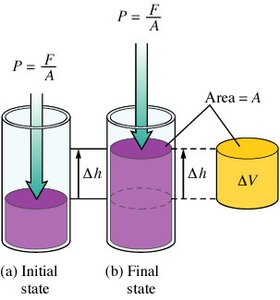
+w: Work done on the system (compression)
-w: Work done by the system (expansion)
For gases, work is related to pressure and volume change:
Energy is a state function; heat and work are not.
Enthalpy and Enthalpy Changes
Definition and Calculation of Enthalpy
Enthalpy () is a state function representing heat content at constant pressure. The change in enthalpy () is measured as the heat exchanged under constant pressure conditions.
(at constant pressure)
Enthalpy changes can be determined by:
Stoichiometry
Calorimetry
Standard enthalpies of formation
Hess's Law
Bond energies
Types of enthalpy changes:
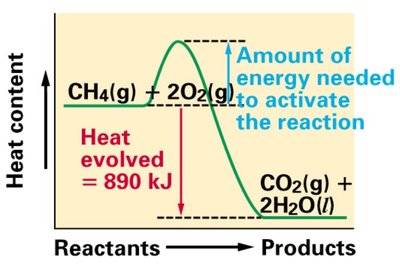
Enthalpy of reaction (): Heat absorbed or released in a reaction.
Enthalpy of combustion (): Heat from burning a substance.
Enthalpy of formation (): Heat change when one mole of a compound forms from its elements in standard states.
Enthalpy of fusion (): Heat absorbed to melt one mole of solid.
Enthalpy of vaporization (): Heat absorbed to vaporize one mole of liquid.
Calorimetry: Measuring Heat Changes
Coffee-Cup and Bomb Calorimetry
Calorimetry is the experimental measurement of heat changes in chemical reactions. Two common types are:
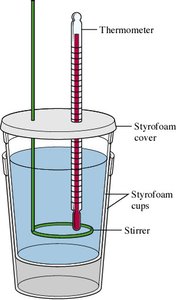
Coffee-cup calorimetry: Measures heat at constant pressure (q = ). Typically uses a Styrofoam cup as an insulating container.
Bomb calorimetry: Measures heat at constant volume. Used for combustion reactions in a rigid steel container.
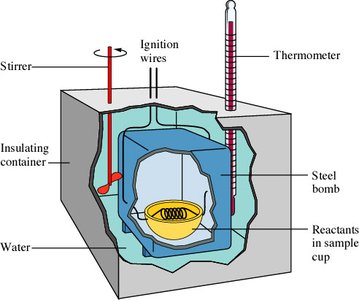
Heat capacity (C): Energy required to raise temperature by 1°C (J/°C).
Specific heat capacity (C_p): Energy required to raise 1 g of substance by 1°C (J/g°C).
Molar heat capacity: Energy required to raise 1 mol of substance by 1°C (J/mol·K).
Calculating heat:
q = heat (J)
m = mass (g)
= specific heat capacity (J/g°C)
= change in temperature (°C)
Specific heat of water (liquid): 4.184 J/g°C
Units of energy: 1 calorie (cal) = 4.184 joules (J)
Standard Enthalpies of Formation and Reaction
Using Standard Enthalpies of Formation
The standard enthalpy of formation () is the enthalpy change when one mole of a compound forms from its elements in their standard states (25°C, 1 atm, 1 M concentration).
for elements in their standard states is zero.
Standard enthalpy change of reaction:
(products) (reactants)
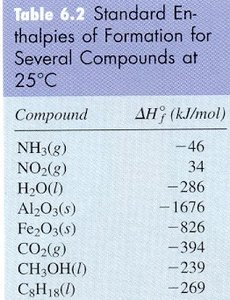
Compound | (kJ/mol) |
|---|---|
NH3(g) | -46 |
NO2(g) | 34 |
H2O(l) | -286 |
Al2O3(s) | -1676 |
Fe2O3(s) | -826 |
CO2(g) | -394 |
CH3OH(l) | -239 |
C8H18(l) | -269 |
Hess's Law
Combining Equations to Find Enthalpy Changes
Hess's Law states that the total enthalpy change for a reaction is the same, no matter how many steps the reaction is carried out in. This allows calculation of by combining known equations and their enthalpy changes.
Reverse an equation: reverse the sign of .
Multiply an equation: multiply by the same factor.
Add equations: add their values.
Bond Energies
Calculating Enthalpy from Bond Energies
Bond energy is the energy required to break one mole of a bond in a molecule. The enthalpy change for a reaction can be estimated by considering the energies required to break bonds in reactants and the energies released when new bonds form in products:
Breaking bonds: endothermic (energy absorbed, positive value)
Forming bonds: exothermic (energy released, negative value)
Summary of Enthalpy Changes
: Endothermic reaction (absorbs heat)
: Exothermic reaction (releases heat; favored by nature)
Application: The Thermite Reaction
Example of a Highly Exothermic Reaction
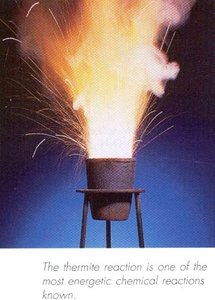
The thermite reaction is a dramatic demonstration of a highly exothermic process, producing intense heat and light as aluminum reacts with iron(III) oxide to form aluminum oxide and molten iron.