 뒤로
뒤로Thermodynamics: Entropy, Free Energy, and Spontaneity
스터디 가이드 - 스마트 노트
 자료에 맞춘 맞춤형 노트, 핵심 정의, 예시, 맥락을 확장해 제공합니다.
Thermodynamics: Entropy, Free Energy, and Spontaneity
Spontaneity in Chemical Reactions
Chemical reactions are considered spontaneous if they occur without outside intervention. The spontaneity of a reaction is determined by two main factors: enthalpy (ΔH) and entropy (ΔS). Exothermic reactions (negative ΔH) and increased disorder (positive ΔS) are generally favored. However, spontaneity does not indicate the speed of a reaction, which is governed by kinetics.
Enthalpy (ΔH): The heat content of a system. Exothermic reactions (ΔH < 0) are usually favored.
Entropy (ΔS): The measure of disorder or randomness in a system. Nature tends toward greater disorder.
Spontaneous reactions: Occur without external input; may be fast or slow.
Entropy (ΔS)
Entropy is a thermodynamic property that quantifies the degree of disorder or randomness in a system. The Second Law of Thermodynamics states that the entropy of the universe tends to increase. The Third Law of Thermodynamics establishes that the entropy of a perfect crystal at absolute zero (0 K) is zero, allowing the calculation of absolute entropy values for substances at higher temperatures.
Greater disorder means higher entropy.
Entropy increases as substances change from solid → liquid → gas.
Dissolving a solid or liquid in a solvent usually increases entropy (with some exceptions, e.g., carbonates).
When a gas escapes from a solvent, entropy increases.
Increasing molecular complexity generally increases entropy.
Reactions that increase the number of moles of particles often increase entropy.
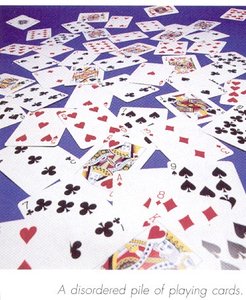
Example: The image above shows a disordered pile of playing cards, which visually represents the concept of entropy as disorder.
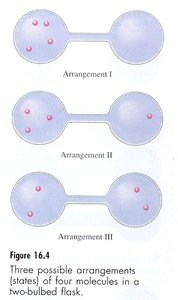
Example: The image above demonstrates three possible arrangements (microstates) of four molecules in a two-bulbed flask. The greater the number of possible arrangements, the higher the entropy.
Predicting Entropy Changes
Solid sugar dissolving in water: Entropy increases (ΔS > 0).
Iodine vapor condensing to crystals: Entropy decreases (ΔS < 0).
Calculating Entropy Changes
Standard entropy changes can be calculated using tabulated values:
ΔSrxn = Σ ΔS (products) - Σ ΔS (reactants)
Units: J/(K·mol)
Sample Problem
Which of the following has the largest increase in entropy?
CO2(s) → CO2(g): Largest increase (solid to gas transition).
Entropy Changes for Reversible Phase Changes
For a phase change at constant temperature:
where q is the heat transferred and T is the temperature in Kelvin.
Entropy of the Universe and Spontaneity
The spontaneity of a reaction can be determined by the total entropy change of the universe:
If ΔSuniverse > 0, the process is spontaneous.
If ΔSuniverse < 0, the process is nonspontaneous.
For the surroundings:
Gibbs Free Energy (ΔG)
Gibbs free energy combines enthalpy and entropy to predict spontaneity at constant temperature and pressure. A negative ΔG indicates a spontaneous process.
Standard free energy change:
General equation:
Non-standard conditions:
At equilibrium:
Electrochemistry:
Where:
R = 8.3145 J/(mol·K) (universal gas constant)
T = temperature in Kelvin
Q = reaction quotient
K = equilibrium constant
n = moles of electrons transferred
F = Faraday's constant (96,485 C/mol e-)
E° = standard cell potential
Sample Problem
Calculate ΔG° for the reaction:
2SO2(g) + O2(g) → 2SO3(g)
ΔH° = -198 kJ
ΔS° = -187 J/K
ΔG° = -142 kJ
Relationship Between ΔG, K, and Spontaneity
ΔG | K | Spontaneity |
|---|---|---|
0 | 1 | At equilibrium |
< 0 | > 1 | Spontaneous (products favored) |
> 0 | < 1 | Nonspontaneous (reactants favored) |
Temperature Dependence of Spontaneity
ΔH | ΔS | Spontaneity |
|---|---|---|
negative | positive | Spontaneous at all temperatures |
positive | positive | Spontaneous at high temperatures |
negative | negative | Spontaneous at low temperatures |
positive | negative | Never spontaneous |
Free Energy and Maximum Work
Gibbs free energy also represents the maximum amount of work a system can perform at constant temperature and pressure:
When ΔG is negative, the system can do work; when positive, work must be done on the system to make the process occur.
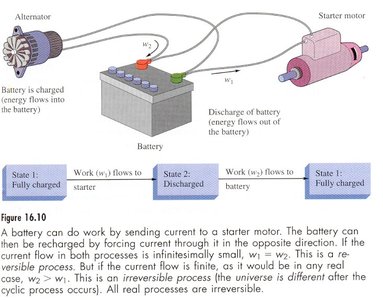
Example: The image above shows a battery performing work in a reversible and irreversible process, illustrating the concept of maximum work and the difference between ideal and real processes.
Free Energy Profiles and Equilibrium
The free energy profile of a reaction shows how the Gibbs free energy changes as the reaction progresses. Equilibrium occurs at the minimum point of the free energy curve.
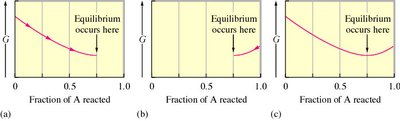
Example: The image above displays free energy curves for different reactions, with equilibrium points marked where the free energy is minimized.
Summary Table: Key Thermodynamic Quantities
Quantity | Symbol | Definition | Units |
|---|---|---|---|
Enthalpy | ΔH | Heat content | kJ/mol |
Entropy | ΔS | Disorder/randomness | J/(K·mol) |
Gibbs Free Energy | ΔG | Maximum work at constant T, P | kJ/mol |
