 뒤로
뒤로Thermodynamics of Simple Mixtures: Definitions, Properties, and Chemical Potential
스터디 가이드 - 스마트 노트
 자료에 맞춘 맞춤형 노트, 핵심 정의, 예시, 맥락을 확장해 제공합니다.
Thermodynamics of Simple Mixtures
Introduction to Mixtures
Mixtures are systems composed of two or more substances that are combined physically, not chemically. Understanding the thermodynamics of mixtures is essential for predicting their behavior, especially in chemical and physical processes. Mixtures can be classified as either heterogeneous or homogeneous based on their visual and compositional uniformity.
Heterogeneous mixtures: Visibly distinguishable components (e.g., sand in water).
Homogeneous mixtures (solutions): Uniform composition throughout; can be solid, liquid, or gas (e.g., saltwater, air).
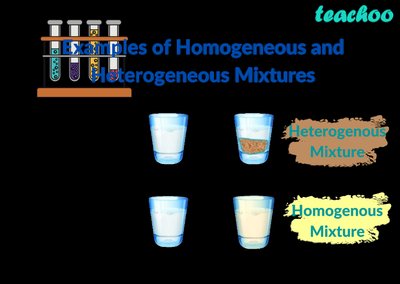
Example: A glass of water with dissolved salt is homogeneous, while a glass with undissolved sand is heterogeneous.
Solutions and Their Components
A solution is a homogeneous mixture consisting of a solvent (the component in the greatest amount) and one or more solutes (the components present in lesser amounts). Solutions can exist in any phase: solid, liquid, or gas.
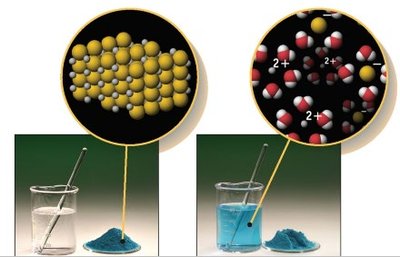
Specifying Solution Composition
Measures of Concentration
The composition of a solution can be described in several ways, each useful for different thermodynamic calculations:
Molarity (ci): Amount of solute per unit volume of solution.
Molality (mi): Amount of solute per unit mass of solvent.
Mole fraction (xA): Ratio of moles of component A to total moles.
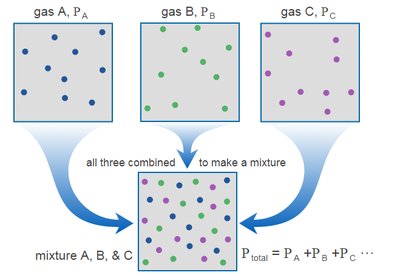
Partial pressure (for gases): The pressure exerted by a single component in a mixture.
Example: In a mixture of gases A, B, and C, the total pressure is the sum of the partial pressures: .
Dalton’s Law of Partial Pressures
Dalton’s Law states that the total pressure exerted by a mixture of non-reacting gases is equal to the sum of the partial pressures of each individual gas:
Each partial pressure can be calculated as:
Worked Example: Calculating Partial Pressures
Given a mixture of He, Ne, and Xe in separate containers, the total pressure and partial pressures after mixing can be calculated using the ideal gas law and mole fractions.
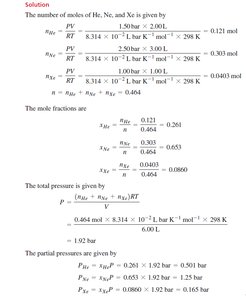
Steps:
Calculate moles of each gas using .
Find mole fractions: .
Calculate total pressure using .
Find partial pressures: .
Thermodynamics of Simple Gas Mixtures
Mixing of Gases
When two or more gases are mixed, their molecules distribute evenly throughout the available volume, and the system reaches a new equilibrium state.

Key Point: The mixing process is spontaneous for ideal gases and increases the entropy of the system.
Chemical Potential and Gibbs Energy
Chemical Potential (μ)
The chemical potential () of a component in a mixture is defined as the change in the Gibbs free energy when one additional mole of that component is added, at constant temperature, pressure, and amounts of other components:
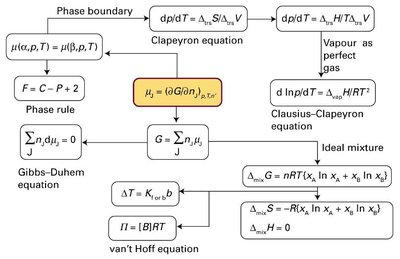
Significance: Chemical potential determines the direction of mass transfer and chemical reactions in mixtures.
Gibbs Energy in Mixtures
The total Gibbs energy of a mixture is the sum of the chemical potentials of each component multiplied by the number of moles:
For a binary mixture (A and B):
Gibbs-Duhem Equation
The Gibbs-Duhem equation relates the changes in chemical potentials of the components in a mixture at constant temperature and pressure:
This means that the chemical potentials of the components in a mixture are not independent; a change in one affects the others.
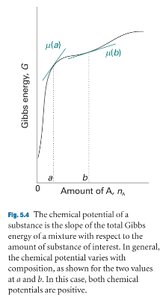
Graphical Representation of Chemical Potential
The chemical potential of a substance in a mixture is the slope of the total Gibbs energy with respect to the amount of that substance. It varies with composition.
Comparison: Pure Substances vs. Mixtures
Key Differences
Pure Substance: Adding one mole does not change the composition; chemical potential is the same for every mole.
Mixture: Adding one mole changes the composition; each component has its own chemical potential, which depends on the mixture's composition.
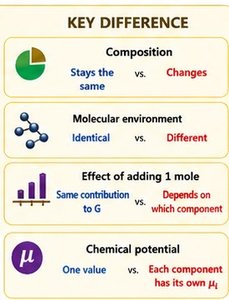
Summary Table: Pure Substance vs. Mixture
Property | Pure Substance | Mixture |
|---|---|---|
Composition | Stays the same | Changes |
Molecular Environment | Identical | Different |
Effect of Adding 1 Mole | Same contribution to G | Depends on component |
Chemical Potential | One value | Each component has its own μi |
Summary of Key Equations
Dalton’s Law:
Partial Pressure:
Chemical Potential:
Gibbs Energy of Mixture:
Gibbs-Duhem Equation:
Conclusion
Understanding the thermodynamics of mixtures, especially the concept of chemical potential, is fundamental for predicting the behavior of solutions and gas mixtures in chemistry. These principles are widely applicable in chemical engineering, physical chemistry, and related fields.
