 뒤로
뒤로Thermodynamics of Simple Mixtures: Gibbs Energy, Mixing, and Raoult’s Law
스터디 가이드 - 스마트 노트
 자료에 맞춘 맞춤형 노트, 핵심 정의, 예시, 맥락을 확장해 제공합니다.
Thermodynamics of Simple Mixtures
Introduction to Mixtures and Gibbs Energy
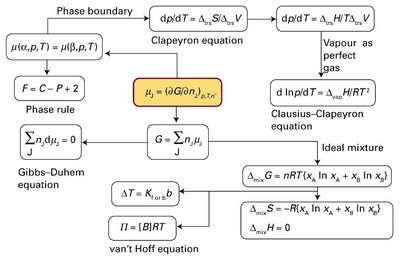
Mixtures are systems containing more than one chemical component, and their thermodynamic properties are essential for understanding chemical processes. The Gibbs energy (G) is a central thermodynamic function used to predict the spontaneity of mixing and phase equilibria in mixtures.
Gibbs Energy for a Binary Mixture: For a mixture of two components, A and B, the total Gibbs energy is given by: where and are the number of moles, and , are the chemical potentials of A and B, respectively.
Chemical Potential: The chemical potential is the partial molar Gibbs energy, representing the contribution of each component to the total Gibbs energy.
Mixing of Ideal Gases
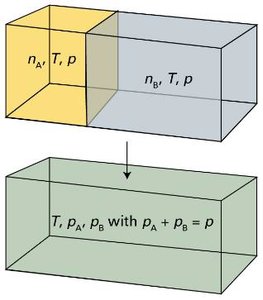
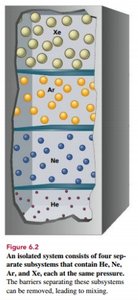
Mixing two ideal gases is a spontaneous process, driven by an increase in entropy and a decrease in Gibbs energy. The process can be visualized as two separate containers of gases being combined into one.
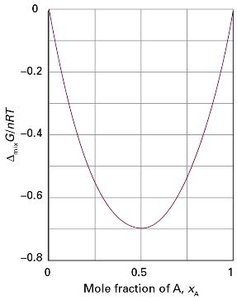
Spontaneity: Mixing is spontaneous if .
Gibbs Energy Change for Mixing: For ideal gases initially at the same pressure and temperature: where and are the mole fractions of A and B, respectively.
Example: Mixing 1.0 mol A and 1.0 mol B at 298 K and 1 bar yields kJ.

Mathematical Derivation: Chemical Potential and Pressure Dependence
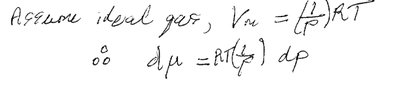
The chemical potential of an ideal gas depends on pressure at constant temperature. The relationship is derived as follows:
(general form)
For isothermal conditions:
For an ideal gas: , so
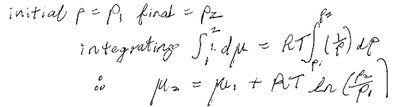
Integrating from to :

Mixing Gases with Different Initial Pressures
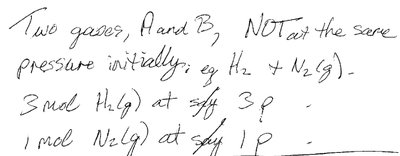
When two gases are initially at different pressures, the calculation of requires determining the final and initial states, including partial pressures and mole fractions.
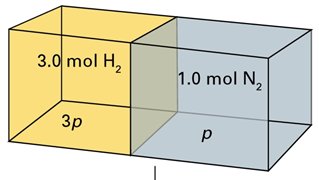
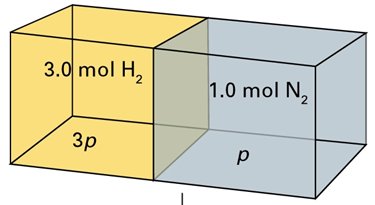
Example: Mixing 3.0 mol H2 at 3p and 1.0 mol N2 at p.
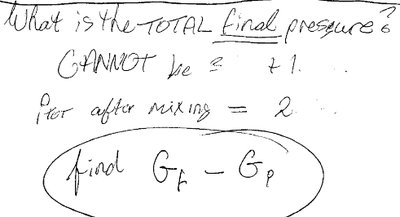
After mixing, total pressure is not simply the sum of initial pressures; it must be calculated based on the final volume and total moles.
Partial pressures are determined by mole fractions: , ,
Gibbs energy change:
Thermodynamic Functions of Mixing
Mixing affects several thermodynamic quantities, including enthalpy, entropy, and Gibbs energy.
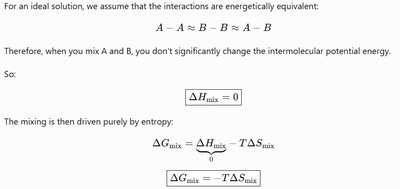
Enthalpy of Mixing (): For ideal gases and ideal solutions, .
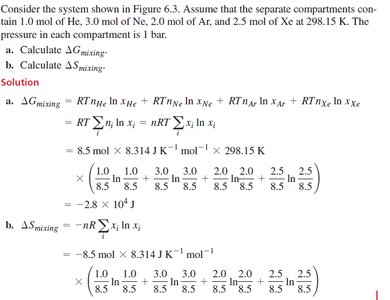
Entropy of Mixing (): The increase in entropy drives the mixing process:
Gibbs Energy of Mixing (): For ideal mixtures:
Key Point: For ideal mixtures, the enthalpy change is zero, and the process is driven entirely by entropy.
Liquid Mixtures and Vapour Pressure
Raoult’s Law and Ideal Solutions
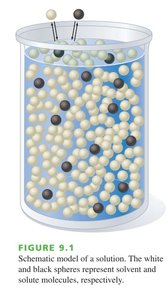
Raoult’s Law describes the vapor pressure of each component in an ideal liquid mixture. An ideal solution is one in which the intermolecular interactions between unlike molecules are similar to those between like molecules.
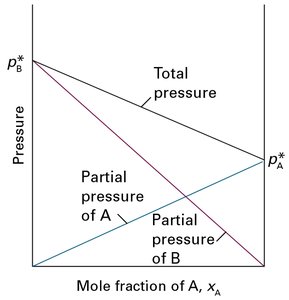
Raoult’s Law: The partial vapor pressure of component A in a mixture is: where is the mole fraction of A in the liquid, and is the vapor pressure of pure A.
Total Vapor Pressure: For a binary mixture:
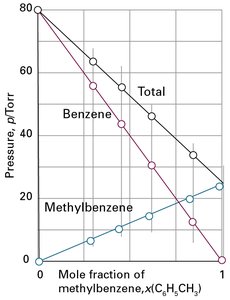
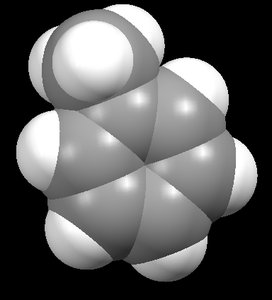
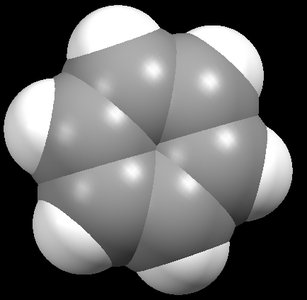
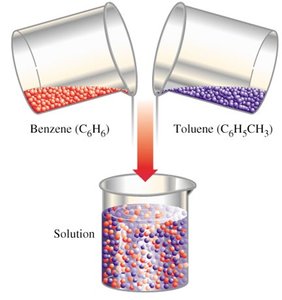
Ideal Solution Criteria: The best examples are isotopic mixtures or closely related substances (e.g., benzene/toluene).
Phase Equilibrium and Chemical Potential
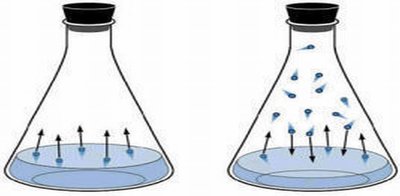
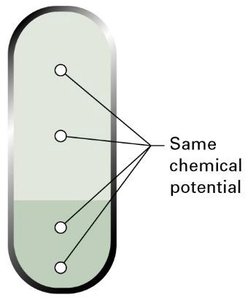
At equilibrium, the chemical potential of a component is equal in both the liquid and vapor phases:
This condition determines the distribution of components between phases and is fundamental to understanding vapor-liquid equilibrium.
Summary Table: Thermodynamic Quantities for Ideal Mixtures
Quantity | Expression (Ideal Mixture) |
|---|---|
Gibbs Energy of Mixing () | |
Entropy of Mixing () | |
Enthalpy of Mixing () | 0 |
Key Takeaways
Mixing of ideal gases and liquids is driven by entropy, with no enthalpy change for ideal systems.
Raoult’s Law applies to ideal solutions, predicting linear relationships between vapor pressure and composition.
Phase equilibrium is established when the chemical potential of each component is equal in all phases present.
