Ch.21 - Nuclear Chemistry
Brown - Chemistry: The Central Science 14th Edition
Brown14th EditionChemistry: The Central ScienceISBN: 9780134414232당신이 사용하는 게 아니라요?교과서 변경
21장, 문제 13a

Write balanced nuclear equations for the following processes: (a) rubidium-90 undergoes beta emission.

검증된 단계별 안내
1
Step 1: Identify the initial isotope and its properties. Rubidium-90 (\(^{90}_{37}\text{Rb}\)) is the starting isotope, where 90 is the mass number and 37 is the atomic number.
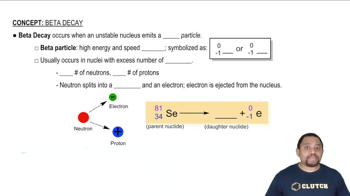
Step 2: Understand the process of beta emission. In beta emission, a neutron in the nucleus is converted into a proton, and a beta particle (an electron, \(\beta^-\)) is emitted. This increases the atomic number by 1 while the mass number remains unchanged.
Step 3: Determine the new element formed. Since the atomic number increases by 1, the new element will have an atomic number of 38, which is strontium (\(\text{Sr}\)).
Step 4: Write the balanced nuclear equation. The equation will show the transformation of rubidium-90 into strontium-90 with the emission of a beta particle: \(^{90}_{37}\text{Rb} \rightarrow \, ^{90}_{38}\text{Sr} + \beta^-\).
Step 5: Verify the balance of the equation. Ensure that the sum of mass numbers and atomic numbers on both sides of the equation are equal. The mass number is 90 on both sides, and the atomic numbers are 37 (Rb) and 38 (Sr) with the \(\beta^-\) particle accounting for the change.

비슷한 문제에 대한 검증된 영상 답변:

이 영상 해법은 위 문제에 도움이 된다고 튜터들이 추천한 것입니다.
영상 길이:
4m
도움이 되었나요?

주요 개념

질문에 올바르게 답하기 위해 반드시 이해해야 하는 핵심 개념들은 다음과 같습니다.

Beta Emission

Beta emission is a type of radioactive decay in which a beta particle, which is an electron or positron, is emitted from an atomic nucleus. In this process, a neutron is transformed into a proton, increasing the atomic number of the element by one while the mass number remains unchanged. This transformation alters the identity of the element, leading to the formation of a new element.
추천 영상:

Nuclear Equations

Nuclear equations are symbolic representations of nuclear reactions that show the initial and final states of the particles involved. They typically include the atomic number and mass number of the isotopes, allowing for the conservation of mass and charge. In a balanced nuclear equation, the sum of the atomic numbers and mass numbers on both sides must be equal, reflecting the conservation laws in nuclear processes.
추천 영상:
가이드 코스
02:06
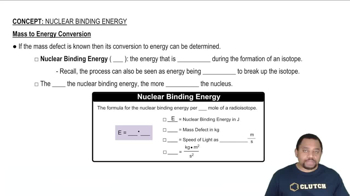
Nuclear Binding Energy

Isotopes

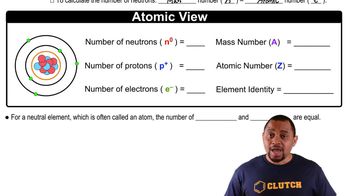
Isotopes are variants of a particular chemical element that have the same number of protons but different numbers of neutrons, resulting in different mass numbers. For example, rubidium-90 is an isotope of rubidium with 37 protons and 53 neutrons. Understanding isotopes is crucial for writing balanced nuclear equations, as the specific isotope undergoing decay determines the products formed during the reaction.
추천 영상: