Ch.5 - Thermochemistry
Brown - Chemistry: The Central Science 14th Edition
Brown14th EditionChemistry: The Central ScienceISBN: 9780134414232당신이 사용하는 게 아니라요?교과서 변경
5장, 문제 13

(a) What is the electrostatic potential energy (in joules) between an electron and a proton that are separated by 230 pm? (b) What is the change in potential energy if the distance separating the electron and proton is increased to 1.0 nm? (c) Does the potential energy of the two particles increase or decrease when the distance is increased to 1.0 nm?

검증된 단계별 안내
1
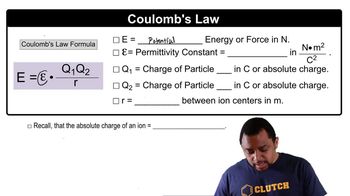
Step 1: Understand the concept of electrostatic potential energy, which is given by the formula: \(U = \frac{k \cdot q_1 \cdot q_2}{r}\), where \(k\) is Coulomb's constant (\(8.99 \times 10^9 \text{ N m}^2/\text{C}^2\)), \(q_1\) and \(q_2\) are the charges of the particles, and \(r\) is the separation distance between the charges.
Step 2: Identify the charges involved. For an electron, \(q_1 = -1.602 \times 10^{-19}\) C, and for a proton, \(q_2 = 1.602 \times 10^{-19}\) C. The separation distance \(r\) for part (a) is 230 pm, which needs to be converted to meters (1 pm = \(10^{-12}\) m).
Step 3: Calculate the electrostatic potential energy for part (a) using the formula from Step 1 with the given values for \(q_1\), \(q_2\), and \(r\).
Step 4: For part (b), calculate the potential energy again using the new separation distance of 1.0 nm (1 nm = \(10^{-9}\) m) and the same charges.
Step 5: Compare the potential energies calculated in parts (a) and (b) to determine the change in potential energy and whether it increases or decreases when the distance is increased to 1.0 nm.

주요 개념

질문에 올바르게 답하기 위해 반드시 이해해야 하는 핵심 개념들은 다음과 같습니다.

Electrostatic Potential Energy

Electrostatic potential energy is the energy stored due to the position of charged particles relative to each other. It is calculated using the formula U = k * (q1 * q2) / r, where U is the potential energy, k is Coulomb's constant, q1 and q2 are the charges, and r is the distance between them. For an electron and a proton, this energy is negative, indicating an attractive force.
추천 영상:
가이드 코스
00:34
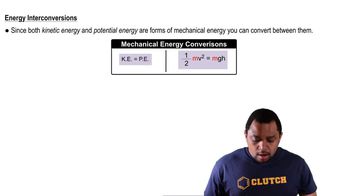
Kinetic & Potential Energy

Coulomb's Law

Coulomb's Law describes the force between two charged particles, stating that the force is directly proportional to the product of the magnitudes of the charges and inversely proportional to the square of the distance between them. This law is fundamental in understanding how the distance between charges affects both the force and the potential energy in electrostatic interactions.
추천 영상:
가이드 코스
01:15
Coulomb's Law Concept 2

Distance and Potential Energy Relationship

The relationship between distance and potential energy is crucial in electrostatics. As the distance between two opposite charges increases, the potential energy becomes less negative (or increases), indicating a decrease in the attractive force. This concept helps in understanding how changes in separation distance affect the stability and energy of charged systems.
추천 영상:
가이드 코스
00:34
Kinetic & Potential Energy