
Ch.1 - Introduction: Matter, Energy, and Measurement
Brown - Chemistry: The Central Science 14th Edition
Brown14th EditionChemistry: The Central ScienceISBN: 9780134414232당신이 사용하는 게 아니라요?교과서 변경
1장, 문제 64

A copper refinery produces a copper ingot weighing 70 kg. If the copper is drawn into wire whose diameter is 7.50 mm, how many meters of copper can be obtained from the ingot? The density of copper is 8.94 g/cm3. (Assume that the wire is a cylinder whose volume V = πr2h, where r is its radius and h is its height or length.)

검증된 단계별 안내
1
Convert the mass of the copper ingot from kilograms to grams by multiplying by 1000, since 1 kg = 1000 g.
Use the density formula \( \text{Density} = \frac{\text{Mass}}{\text{Volume}} \) to find the volume of the copper ingot in cubic centimeters. Rearrange the formula to \( \text{Volume} = \frac{\text{Mass}}{\text{Density}} \).
Convert the diameter of the wire from millimeters to centimeters by dividing by 10, since 1 cm = 10 mm. Then, calculate the radius by dividing the diameter by 2.
Use the formula for the volume of a cylinder \( V = \pi r^2 h \) to express the volume of the wire in terms of its length \( h \). Rearrange the formula to solve for \( h \): \( h = \frac{V}{\pi r^2} \).
Substitute the volume of the copper ingot and the radius of the wire into the rearranged formula to calculate the length \( h \) of the wire in centimeters, and then convert the length from centimeters to meters by dividing by 100.

비슷한 문제에 대한 검증된 영상 답변:

이 영상 해법은 위 문제에 도움이 된다고 튜터들이 추천한 것입니다.
영상 길이:
3m

주요 개념

질문에 올바르게 답하기 위해 반드시 이해해야 하는 핵심 개념들은 다음과 같습니다.

Density

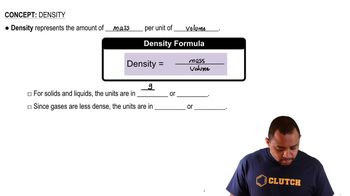
Density is defined as mass per unit volume and is a crucial property of materials. In this problem, the density of copper (8.94 g/cm³) allows us to convert the mass of the copper ingot (70 kg) into volume. Understanding how to manipulate the density formula (Density = Mass/Volume) is essential for determining how much space the copper occupies.
추천 영상:
가이드 코스
01:56
Density Concepts

Volume of a Cylinder

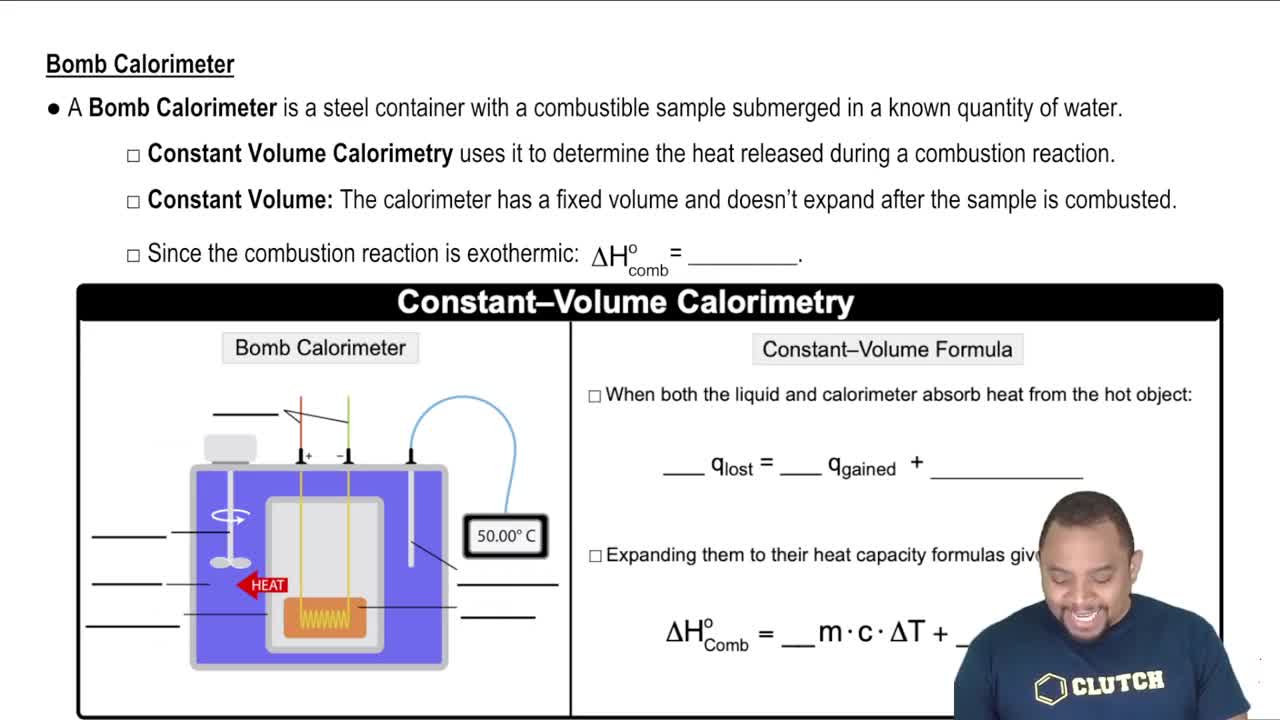
The volume of a cylinder can be calculated using the formula V = πr²h, where r is the radius and h is the height (or length) of the cylinder. In this scenario, the copper wire is modeled as a cylinder, and knowing this formula is necessary to relate the volume of the copper ingot to the length of wire that can be produced.
추천 영상:
가이드 코스
02:35
Constant-Volume Calorimetry

Unit Conversion

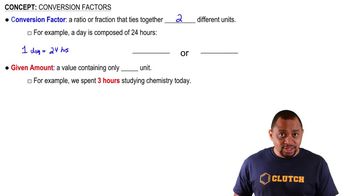
Unit conversion is the process of converting a quantity from one unit to another, which is often necessary in chemistry problems. In this case, converting the mass of copper from kilograms to grams (1 kg = 1000 g) is essential for using the density value correctly. Mastery of unit conversions ensures accurate calculations and results.
추천 영상:
가이드 코스
01:56
Conversion Factors