Ch.1 - Introduction: Matter, Energy, and Measurement
Brown - Chemistry: The Central Science 14th Edition
Brown14th EditionChemistry: The Central ScienceISBN: 9780134414232당신이 사용하는 게 아니라요?교과서 변경
1장, 문제 71a,b,c,d,e

What type of quantity (for example, length, volume, density) do the following units indicate? (a) m3 (b) ns (c) mm (d) g/dm3 (e) °C

검증된 단계별 안내
1
Identify the unit given in the problem: m^3.
Recall that the unit 'm' stands for meters, which is a unit of length.
Understand that when a unit of length is cubed, it represents a three-dimensional space.
Recognize that a three-dimensional space is a measure of volume.
Conclude that the unit m^3 indicates a quantity of volume.

비슷한 문제에 대한 검증된 영상 답변:

이 영상 해법은 위 문제에 도움이 된다고 튜터들이 추천한 것입니다.
영상 길이:
33s
도움이 되었나요?

주요 개념

질문에 올바르게 답하기 위해 반드시 이해해야 하는 핵심 개념들은 다음과 같습니다.

Volume

Volume is a measure of the three-dimensional space occupied by a substance or an object. It is commonly expressed in cubic units, such as cubic meters (m³), which indicate the amount of space within a defined boundary. Understanding volume is essential for various applications in chemistry, including calculating concentrations and understanding the behavior of gases and liquids.
추천 영상:
가이드 코스
02:35
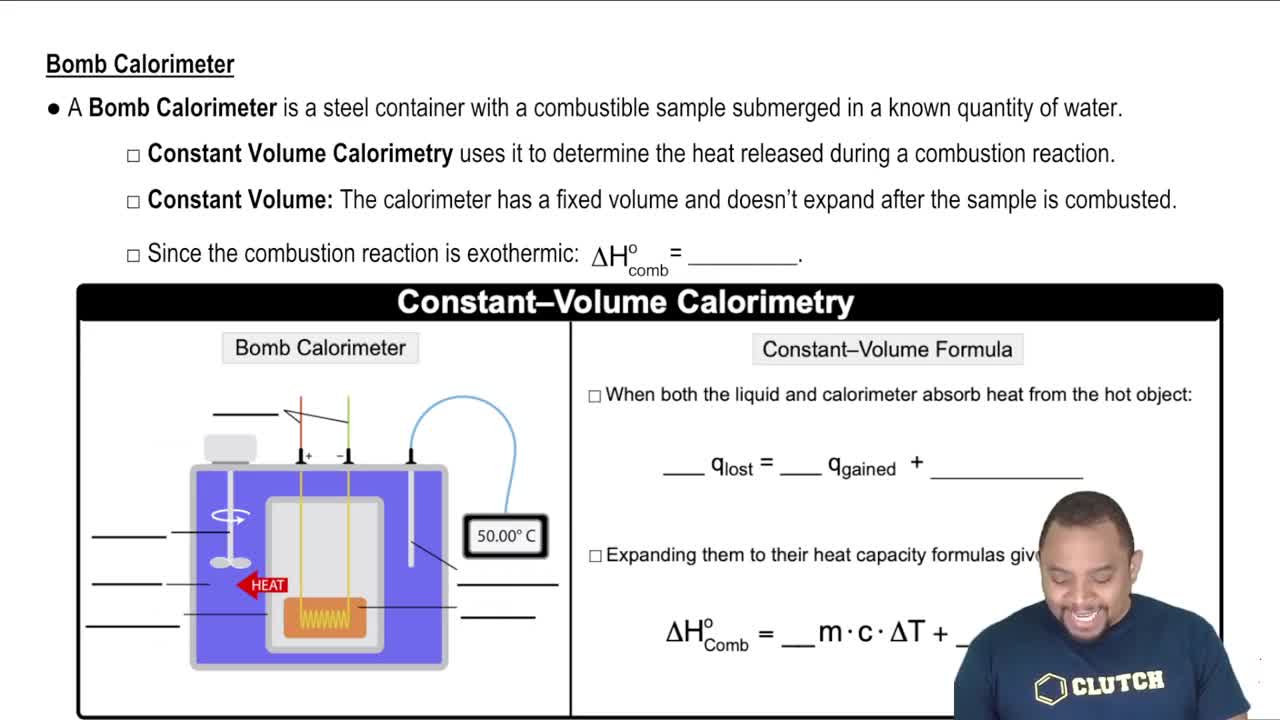
Constant-Volume Calorimetry

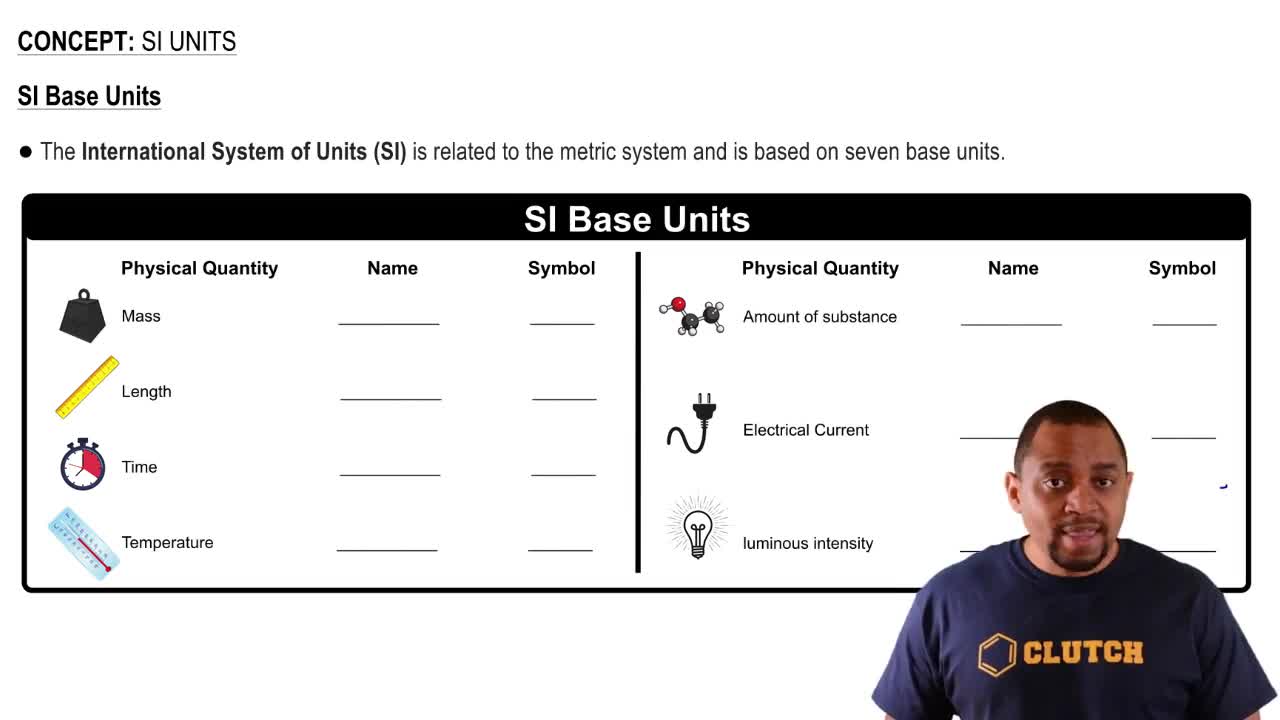
SI Units

The International System of Units (SI) is the standard system of measurement used in science and engineering. It provides a consistent framework for expressing physical quantities, including length, mass, and volume. The cubic meter (m³) is the SI unit for volume, derived from the meter, which is the base unit for length. Familiarity with SI units is crucial for accurate scientific communication and calculations.
추천 영상:

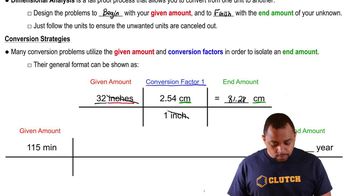
Dimensional Analysis

Dimensional analysis is a mathematical technique used to convert between different units of measurement and to check the consistency of equations. By analyzing the dimensions of physical quantities, one can ensure that equations are dimensionally homogeneous. This concept is particularly useful in chemistry for converting units and understanding relationships between different physical properties, such as volume and density.
추천 영상:
가이드 코스
06:11
Dimensional Analysis
관련 실천
교과서 질문

What type of quantity (for example, length, volume, density) do the following units indicate? (g) Pa.

409
views

교과서 질문

Give the derived SI units for each of the following quantities in base SI units: (a) acceleration = distance/time2 (b) force = mass × acceleration (c) work = force × distance (d) pressure = force/area

458
views
교과서 질문

Two students determine the percentage of lead in a sample as a laboratory exercise. The true percentage is 22.52%. The students’ results for three determinations are as follows: (1) 22.52, 22.48, 22.54 (2) 22.64, 22.58, 22.62 (a) Calculate the average percentage for each set of data and state which set is the more accurate based on the average.

1
views
교과서 질문

What type of quantity (for example, length, volume, density) do the following units indicate? (f) ms-1

527
views
교과서 질문

Two students determine the percentage of lead in a sample as a laboratory exercise. The true percentage is 22.52%. The students' results for three determinations are as follows: (1) 22.52, 22.48, 22.54 (2) 22.64, 22.58, 22.62 (b) Precision can be judged by examining the average of the deviations from the average value for that data set. (Calculate the average value for each data set; then calculate the average value of the absolute deviations of each measurement from the average.) Which set is more precise?

421
views
교과서 질문
Is the use of significant figures in each of the following statements appropriate? (a) The 2005 circulation of National Geographic was 7,812,564.
468
views