
Ch.10 - Gases
Brown - Chemistry: The Central Science 14th Edition
Brown14th EditionChemistry: The Central ScienceISBN: 9780134414232당신이 사용하는 게 아니라요?교과서 변경
10장, 문제 88

A gas of unknown molecular mass was allowed to effuse through a small opening under constant-pressure conditions. It required 105 s for 1.0 L of the gas to effuse. Under identical experimental conditions it required 31 s for 1.0 L of O2 gas to effuse. Calculate the molar mass of the unknown gas. (Remember that the faster the rate of effusion, the shorter the time required for effusion of 1.0 L; in other words, rate is the amount that diffuses over the time it takes to diffuse.)

검증된 단계별 안내
1
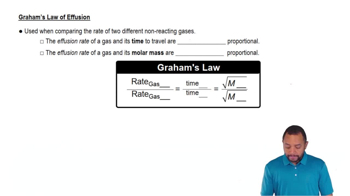
Identify the relationship between the rates of effusion and the molar masses of the gases using Graham's Law of Effusion: \( \frac{\text{Rate}_1}{\text{Rate}_2} = \sqrt{\frac{M_2}{M_1}} \), where Rate is inversely proportional to time.
Express the rates of effusion in terms of time: \( \text{Rate}_{\text{unknown}} = \frac{1.0 \text{ L}}{105 \text{ s}} \) and \( \text{Rate}_{\text{O}_2} = \frac{1.0 \text{ L}}{31 \text{ s}} \).
Substitute the rates into Graham's Law: \( \frac{\frac{1.0}{105}}{\frac{1.0}{31}} = \sqrt{\frac{32.00}{M_{\text{unknown}}}} \), where 32.00 g/mol is the molar mass of \( \text{O}_2 \).
Simplify the expression: \( \frac{31}{105} = \sqrt{\frac{32.00}{M_{\text{unknown}}}} \).
Square both sides to solve for the molar mass of the unknown gas: \( \left(\frac{31}{105}\right)^2 = \frac{32.00}{M_{\text{unknown}}} \), then rearrange to find \( M_{\text{unknown}} \).

비슷한 문제에 대한 검증된 영상 답변:

이 영상 해법은 위 문제에 도움이 된다고 튜터들이 추천한 것입니다.
영상 길이:
4m
도움이 되었나요?

주요 개념

질문에 올바르게 답하기 위해 반드시 이해해야 하는 핵심 개념들은 다음과 같습니다.

Graham's Law of Effusion

Graham's Law states that the rate of effusion of a gas is inversely proportional to the square root of its molar mass. This means that lighter gases effuse faster than heavier gases. The relationship can be expressed mathematically as (Rate1/Rate2) = √(Molar Mass2/Molar Mass1), allowing for the comparison of effusion rates between two gases.
추천 영상:
가이드 코스
2:03
Graham's Law of Effusion

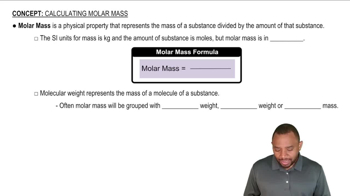
Molar Mass

Molar mass is the mass of one mole of a substance, typically expressed in grams per mole (g/mol). It is a critical property in stoichiometry and gas calculations, as it relates the mass of a substance to the number of particles it contains. In the context of effusion, knowing the molar mass allows for the determination of the rate at which a gas will effuse compared to another gas.
추천 영상:
가이드 코스
02:11
Molar Mass Concept

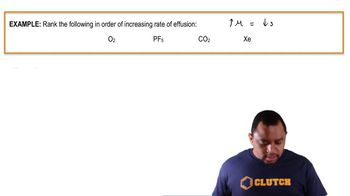
Rate of Effusion

The rate of effusion refers to the volume of gas that escapes through a small opening per unit of time. It is influenced by factors such as the size of the gas molecules and the temperature of the system. In this problem, the time taken for a specific volume of gas to effuse is used to calculate the rate, which is then compared to the rate of effusion of oxygen to find the molar mass of the unknown gas.
추천 영상:
가이드 코스
01:31
Effusion Rate Example