
Ch.10 - Gases
Brown - Chemistry: The Central Science 14th Edition
Brown14th EditionChemistry: The Central ScienceISBN: 9780134414232당신이 사용하는 게 아니라요?교과서 변경
10장, 문제 90

The planet Jupiter has a surface temperature of 140 K and a mass 318 times that of Earth. Mercury (the planet) has a surface temperature between 600 K and 700 K and a mass 0.05 times that of Earth. On which planet is the atmosphere more likely to obey the ideal-gas law? Explain.

검증된 단계별 안내
1
Step 1: Understand the ideal gas law. The ideal gas law is a good approximation for many gases under many conditions, but it becomes less accurate at very high pressures and very low temperatures. This is because the ideal gas law assumes that gas molecules do not interact with each other and occupy no volume, which is less true under these extreme conditions.
Step 2: Compare the conditions on Jupiter and Mercury. Jupiter has a very low temperature (140 K) and a high mass (318 times that of Earth), which suggests high pressure. Mercury has a higher temperature (between 600 K and 700 K) and a lower mass (0.05 times that of Earth), which suggests lower pressure.
Step 3: Consider the implications of these conditions. The ideal gas law is more likely to be accurate under conditions of higher temperature and lower pressure, because these conditions make the assumptions of the ideal gas law more valid. Therefore, the atmosphere of Mercury is more likely to obey the ideal gas law than the atmosphere of Jupiter.
Step 4: Remember that this is a simplification. In reality, the behavior of a gas depends on many factors, including its specific properties and the exact conditions. This question is asking for a general comparison based on the ideal gas law, not a precise prediction.

비슷한 문제에 대한 검증된 영상 답변:

이 영상 해법은 위 문제에 도움이 된다고 튜터들이 추천한 것입니다.
영상 길이:
1m

주요 개념

질문에 올바르게 답하기 위해 반드시 이해해야 하는 핵심 개념들은 다음과 같습니다.

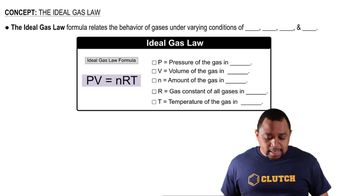
Ideal Gas Law

The Ideal Gas Law is a fundamental equation in chemistry that relates the pressure, volume, temperature, and number of moles of a gas. It is expressed as PV = nRT, where P is pressure, V is volume, n is the number of moles, R is the ideal gas constant, and T is temperature in Kelvin. This law assumes that gas particles do not interact and occupy no volume, which is more applicable under certain conditions of low pressure and high temperature.
추천 영상:
가이드 코스
01:15
Ideal Gas Law Formula

Temperature and Gas Behavior

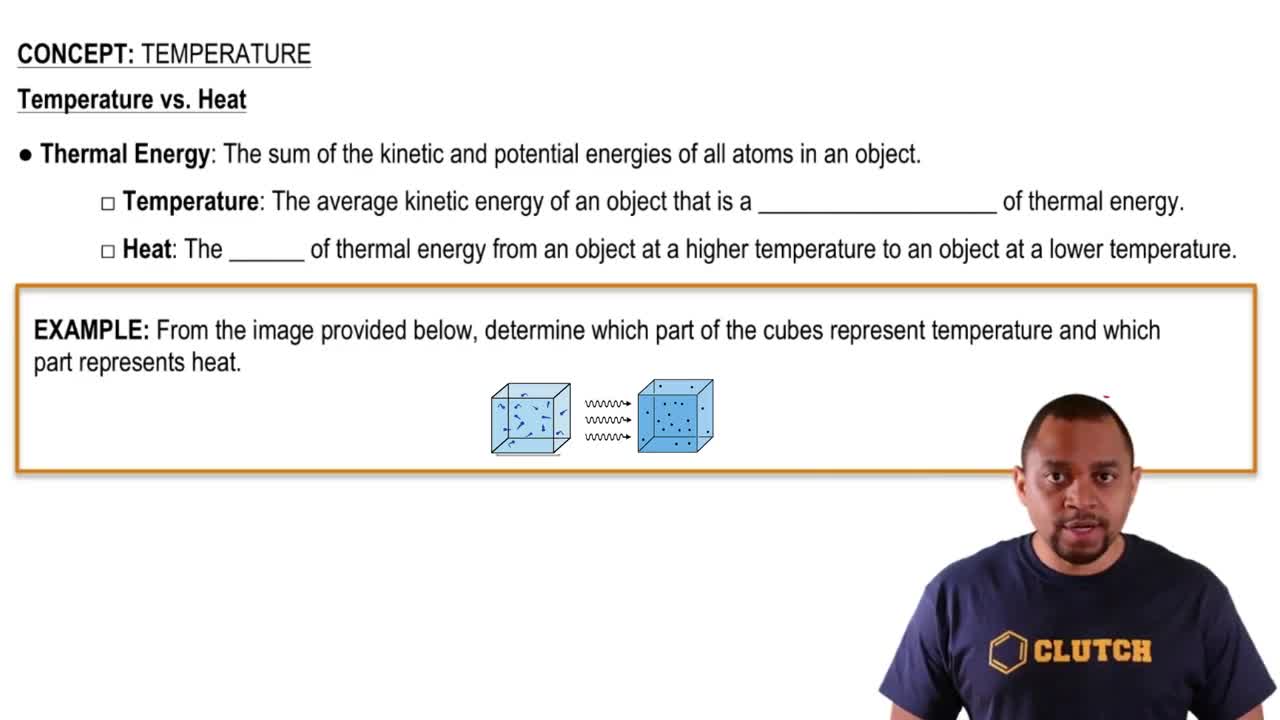
Temperature significantly affects gas behavior, influencing the kinetic energy of gas molecules. Higher temperatures generally increase molecular motion, leading to more ideal behavior as gas particles are less likely to condense or interact. In contrast, lower temperatures can result in deviations from ideal behavior, especially if the gas is near its condensation point or if intermolecular forces become significant.
추천 영상:
가이드 코스
03:48
Temperature vs Heat

Atmospheric Composition and Pressure

The composition and pressure of a planet's atmosphere play crucial roles in determining whether it behaves like an ideal gas. A dense atmosphere with high pressure can lead to interactions between gas molecules, causing deviations from ideal behavior. Conversely, a thinner atmosphere with lower pressure, like that of Jupiter, may allow gases to behave more ideally, especially at higher temperatures, where molecular interactions are minimized.
추천 영상:
가이드 코스
02:09
Total Pressure Example
관련 실천
교과서 질문

A gas of unknown molecular mass was allowed to effuse through a small opening under constant-pressure conditions. It required 105 s for 1.0 L of the gas to effuse. Under identical experimental conditions it required 31 s for 1.0 L of O2 gas to effuse. Calculate the molar mass of the unknown gas. (Remember that the faster the rate of effusion, the shorter the time required for effusion of 1.0 L; in other words, rate is the amount that diffuses over the time it takes to diffuse.)

1825
views
교과서 질문

(b) List two reasons why the gases deviate from ideal behavior.

746
views
1
rank
교과서 질문

Arsenic(III) sulfide sublimes readily, even below its melting point of 320 °C. The molecules of the vapor phase are found to effuse through a tiny hole at 0.52 times the rate of effusion of Xe atoms under the same conditions of temperature and pressure. What is the molecular formula of arsenic(III) sulfide in the gas phase?

1628
views
교과서 질문
Based on their respective van der Waals constants ( Table 10.3), is Ar or CO2 expected to behave more nearly like an ideal gas at high pressures?
993
views
교과서 질문

Which statement concerning the van der Waals constants a and b is true? (a) The magnitude of a relates to molecular volume, whereas b relates to attractions between molecules. (b) The magnitude of a relates to attractions between molecules, whereas b relates to molecular volume. (c) The magnitudes of a and b depend on pressure. (d) The magnitudes of a and b depend on temperature.

1795
views