
Ch.10 - Gases
Brown - Chemistry: The Central Science 14th Edition
Brown14th EditionChemistry: The Central ScienceISBN: 9780134414232당신이 사용하는 게 아니라요?교과서 변경
10장, 문제 15a

A person weighing 75 kg is standing on a threelegged stool. The stool momentarily tilts so that the entire weight is on one foot. If the contact area of each foot is 5.0 cm2, calculate the pressure exerted on the underlying surface in (a) bars

검증된 단계별 안내
1
Convert the weight of the person from kilograms to newtons by multiplying by the acceleration due to gravity (9.8 m/s^2).
Calculate the pressure using the formula: Pressure = Force / Area.
Convert the contact area from cm^2 to m^2 by multiplying by 1e-4.
Substitute the force (in newtons) and the area (in m^2) into the pressure formula to find the pressure in pascals (Pa).
Convert the pressure from pascals to bars, knowing that 1 bar = 100,000 Pa.

비슷한 문제에 대한 검증된 영상 답변:

이 영상 해법은 위 문제에 도움이 된다고 튜터들이 추천한 것입니다.
영상 길이:
3m
도움이 되었나요?

주요 개념

질문에 올바르게 답하기 위해 반드시 이해해야 하는 핵심 개념들은 다음과 같습니다.

Pressure

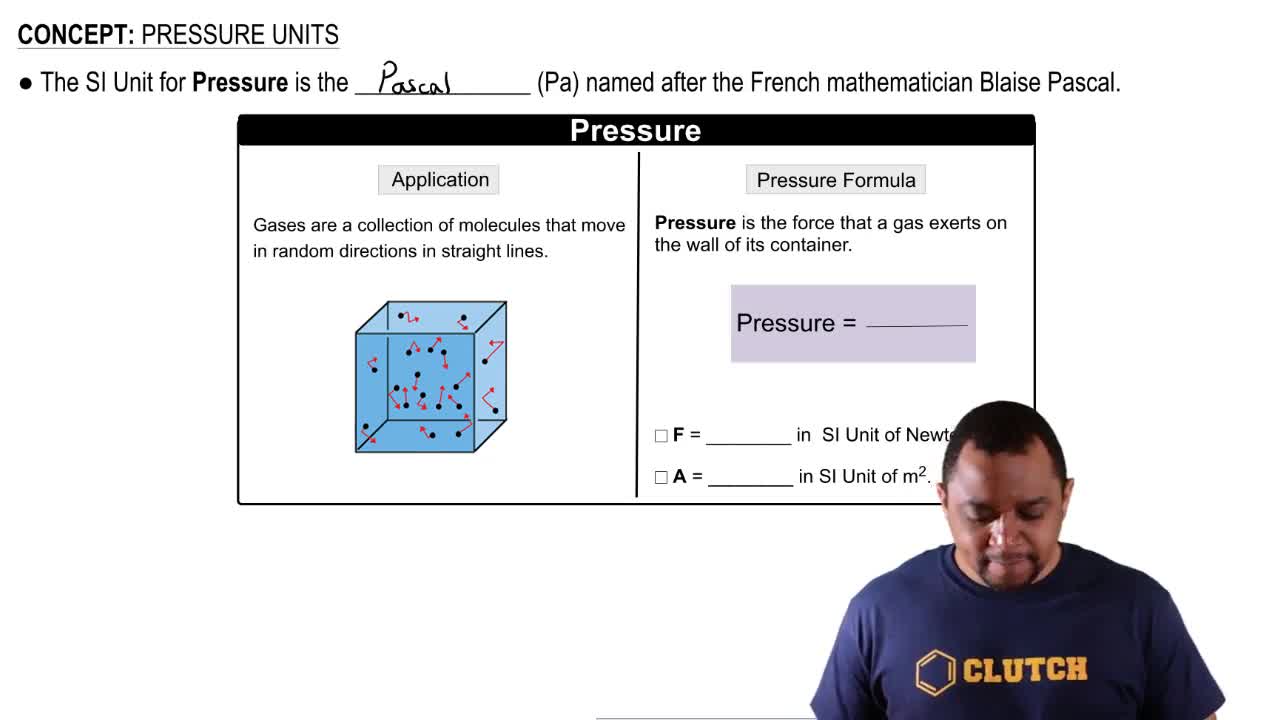
Pressure is defined as the force exerted per unit area. In this context, it is calculated by dividing the weight of the person by the contact area of the stool's foot that is in contact with the ground. The formula for pressure (P) is P = F/A, where F is the force (weight) and A is the area.
추천 영상:

Units of Pressure

Pressure can be expressed in various units, including pascals (Pa), bars, and atmospheres. One bar is equivalent to 100,000 pascals. Understanding how to convert between these units is essential for solving problems related to pressure, especially when the required answer is in a specific unit like bars.
추천 영상:

Weight and Force

Weight is the force exerted by gravity on an object and is calculated as the mass of the object multiplied by the acceleration due to gravity (approximately 9.81 m/s² on Earth). In this scenario, the weight of the person (75 kg) is the force that will be used to calculate the pressure exerted on the surface when the stool tilts.
추천 영상:
가이드 코스
06:44
Types of Intermolecular Forces