
Ch.10 - Gases
Brown - Chemistry: The Central Science 14th Edition
Brown14th EditionChemistry: The Central ScienceISBN: 9780134414232당신이 사용하는 게 아니라요?교과서 변경
10장, 문제 15c

A person weighing 75 kg is standing on a threelegged stool. The stool momentarily tilts so that the entire weight is on one foot. If the contact area of each foot is 5.0 cm2, calculate the pressure exerted on the underlying surface in (c) pounds per square inch

검증된 단계별 안내
1
Convert the weight of the person from kilograms to pounds using the conversion factor: 1 kg = 2.20462 lbs.
Calculate the force exerted by the person in pounds. Since weight is a force, use the converted weight in pounds.
Convert the contact area from square centimeters to square inches using the conversion factor: 1 cm^2 = 0.1550 in^2.
Calculate the pressure exerted on the surface using the formula: Pressure = Force / Area.
Express the pressure in pounds per square inch (psi) using the values obtained from the previous steps.

비슷한 문제에 대한 검증된 영상 답변:

이 영상 해법은 위 문제에 도움이 된다고 튜터들이 추천한 것입니다.
영상 길이:
3m
도움이 되었나요?

주요 개념

질문에 올바르게 답하기 위해 반드시 이해해야 하는 핵심 개념들은 다음과 같습니다.

Pressure

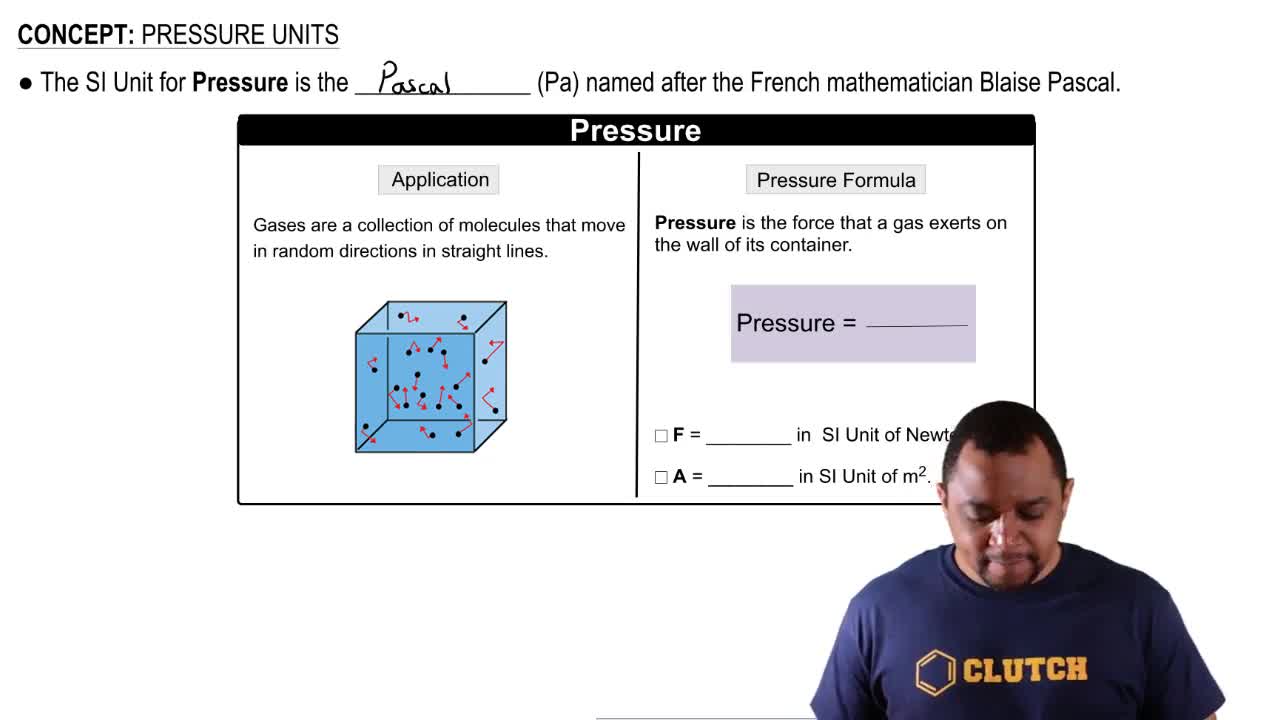
Pressure is defined as the force applied per unit area. In this context, it is calculated by dividing the weight of the person by the contact area of the stool's foot that is in contact with the ground. The formula for pressure (P) is P = F/A, where F is the force (weight) and A is the area.
추천 영상:

Unit Conversion

Unit conversion is the process of converting a quantity expressed in one set of units to another. In this problem, the pressure needs to be expressed in pounds per square inch (psi). This requires converting the area from square centimeters to square inches and ensuring that the weight is in pounds, which may involve converting kilograms to pounds.
추천 영상:
가이드 코스
01:56
Conversion Factors

Force due to Gravity

The force due to gravity acting on an object is calculated using the equation F = mg, where m is the mass of the object and g is the acceleration due to gravity (approximately 9.81 m/s² on Earth). For this problem, the person's weight in pounds can be determined by converting their mass from kilograms to pounds, which is essential for calculating the pressure exerted on the surface.
추천 영상:
가이드 코스
06:44
Types of Intermolecular Forces
관련 실천
교과서 질문

A person weighing 75 kg is standing on a threelegged stool. The stool momentarily tilts so that the entire weight is on one foot. If the contact area of each foot is 5.0 cm2, calculate the pressure exerted on the underlying surface in (b) atmospheres

교과서 질문

A person weighing 75 kg is standing on a threelegged stool. The stool momentarily tilts so that the entire weight is on one foot. If the contact area of each foot is 5.0 cm2, calculate the pressure exerted on the underlying surface in (a) bars

387
views
교과서 질문

(a) The compound 1-iodododecane is a nonvolatile liquid with a density of 1.20 g>mL. The density of mercury is 13.6 g>mL. What do you predict for the height of a barometer column based on 1-iodododecane, when the atmospheric pressure is 749 torr?

656
views
1
rank
교과서 질문

(b) What pressure, in atmospheres, is exerted on the body of a diver if she is 10 m below the surface of the water when the atmospheric pressure is 100 kPa? Assume that the density of the water is 1.00 5 1.00 3 103 kg/m3. The gravitational constant is 9.81 m/s2, and 1 Pa 5 1 kg/ms2

1815
views
교과서 질문

(c) Which is most likely to be a gas at room temperature and ordinary atmospheric pressure, F2, Br2, K2O?

1182
views
교과서 질문

(a) How high in meters must a column of ethanol be to exert a pressure equal to that of a 100-mm column of mercury? The density of ethanol is 0.79 g/mL, whereas that of mercury is 13.6 g/mL. Assume that the density of the water is 1.00 5 1.00 3 103 kg/m3. The gravitational constant is 9.81 m/s2, and 1 Pa 5 1 kg/ms2.

599
views