
Ch.10 - Gases
Brown - Chemistry: The Central Science 14th Edition
Brown14th EditionChemistry: The Central ScienceISBN: 9780134414232당신이 사용하는 게 아니라요?교과서 변경
10장, 문제 114

Does the effect of intermolecular attraction on the properties of a gas become more significant or less significant if the gas is compressed to a smaller volume at constant temperature?

검증된 단계별 안내
1
Step 1: Understand the concept of intermolecular forces. These are forces of attraction or repulsion between neighboring particles (atoms, molecules, or ions). In gases, these forces are generally weak due to the large distances between particles.
Step 2: Recall the ideal gas law, PV = nRT, which assumes that there are no intermolecular forces and that the volume of the gas particles is negligible. This is a good approximation under conditions of low pressure and high temperature.
Step 3: Consider what happens when a gas is compressed to a smaller volume at constant temperature. The particles are forced closer together, which increases the significance of intermolecular forces because the particles are now closer and can interact more strongly.
Step 4: Recognize that as the volume decreases, the gas deviates from ideal behavior. The attractive forces between particles become more significant, affecting properties such as pressure and volume.
Step 5: Conclude that the effect of intermolecular attraction on the properties of a gas becomes more significant when the gas is compressed to a smaller volume at constant temperature, leading to deviations from ideal gas behavior.

주요 개념

질문에 올바르게 답하기 위해 반드시 이해해야 하는 핵심 개념들은 다음과 같습니다.

Intermolecular Forces

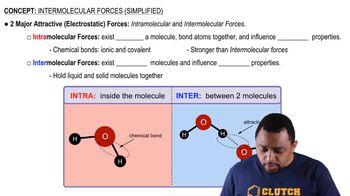
Intermolecular forces are the attractive forces between molecules that influence the physical properties of substances. In gases, these forces are generally weak compared to those in liquids and solids, allowing gas molecules to move freely. However, when a gas is compressed, the proximity of the molecules increases, enhancing the effect of these forces on the gas's behavior.
추천 영상:
가이드 코스
01:59
Intermolecular vs Intramolecular Forces

Ideal Gas Law

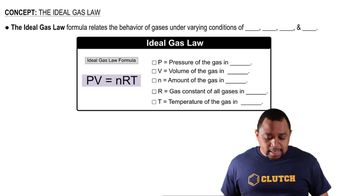
The Ideal Gas Law, represented as PV=nRT, describes the relationship between pressure (P), volume (V), temperature (T), and the number of moles (n) of a gas. It assumes that gas molecules do not interact with each other, which is a valid approximation at low pressures and high temperatures. However, deviations from ideal behavior occur when gases are compressed, as intermolecular attractions become more significant.
추천 영상:
가이드 코스
01:15
Ideal Gas Law Formula

Compressibility and Real Gases

Compressibility refers to the ability of a substance to decrease in volume under pressure. Real gases deviate from ideal behavior at high pressures and low temperatures, where intermolecular attractions become significant. When a gas is compressed, these attractions can lead to a decrease in pressure compared to what the Ideal Gas Law would predict, indicating that intermolecular forces play a more critical role in the gas's properties.
추천 영상:
가이드 코스
02:27
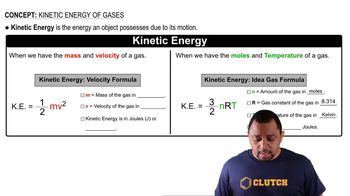
Kinetic Energy Formulas