Ch.10 - Gases
Brown - Chemistry: The Central Science 14th Edition
Brown14th EditionChemistry: The Central ScienceISBN: 9780134414232당신이 사용하는 게 아니라요?교과서 변경
10장, 문제 8

Suppose you have two 1-L flasks, one containing N2 at STP, the other containing CH4 at STP. How do these systems compare with respect to (d) the rate of effusion through a pinhole leak?

검증된 단계별 안내
1
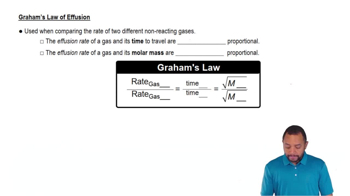
Step 1: Understand the concept of effusion, which is the process by which gas molecules escape through a small hole into a vacuum. The rate of effusion is inversely proportional to the square root of the molar mass of the gas, according to Graham's law of effusion.
Step 2: Write down Graham's law of effusion: \( \text{Rate of effusion} \propto \frac{1}{\sqrt{M}} \), where \( M \) is the molar mass of the gas.
Step 3: Identify the molar masses of the gases involved. For \( N_2 \), the molar mass is approximately 28 g/mol, and for \( CH_4 \), the molar mass is approximately 16 g/mol.
Step 4: Compare the rates of effusion for \( N_2 \) and \( CH_4 \) using Graham's law. Since the rate of effusion is inversely proportional to the square root of the molar mass, calculate the ratio of the rates: \( \frac{\text{Rate of effusion of } CH_4}{\text{Rate of effusion of } N_2} = \sqrt{\frac{M_{N_2}}{M_{CH_4}}} \).
Step 5: Conclude that the gas with the lower molar mass, \( CH_4 \), will effuse faster than \( N_2 \) because the rate of effusion is inversely proportional to the square root of the molar mass.

주요 개념

질문에 올바르게 답하기 위해 반드시 이해해야 하는 핵심 개념들은 다음과 같습니다.

Graham's Law of Effusion

Graham's Law states that the rate of effusion of a gas is inversely proportional to the square root of its molar mass. This means that lighter gases effuse faster than heavier gases. In this scenario, comparing nitrogen (N2) and methane (CH4), we can determine their effusion rates based on their respective molar masses.
추천 영상:
가이드 코스
2:03
Graham's Law of Effusion

Molar Mass

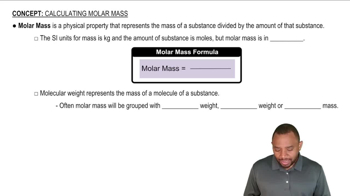
Molar mass is the mass of one mole of a substance, typically expressed in grams per mole (g/mol). For nitrogen (N2), the molar mass is approximately 28 g/mol, while for methane (CH4), it is about 16 g/mol. The difference in molar mass between these two gases is crucial for applying Graham's Law to predict their effusion rates.
추천 영상:
가이드 코스
02:11
Molar Mass Concept

Standard Temperature and Pressure (STP)

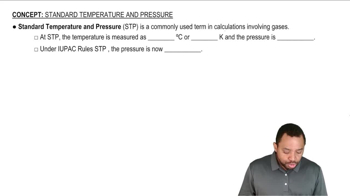
Standard Temperature and Pressure (STP) is defined as a temperature of 0 degrees Celsius (273.15 K) and a pressure of 1 atmosphere (atm). At STP, one mole of an ideal gas occupies 22.4 liters. This standardization allows for consistent comparisons of gas behavior, including effusion rates, under controlled conditions.
추천 영상:
가이드 코스
01:08
Standard Temperature and Pressure