Ch.10 - Gases
Brown - Chemistry: The Central Science 14th Edition
Brown14th EditionChemistry: The Central ScienceISBN: 9780134414232당신이 사용하는 게 아니라요?교과서 변경
10장, 문제 110b

The density of a gas of unknown molar mass was measured as a function of pressure at 0 C, as in the table that follows. (b) Why is d>P not a constant as a function of pressure?
Graph showing the relationship between d/P and pressure P for a gas at 0 C.

검증된 단계별 안내
1
Step 1: Observe the graph provided, which shows the relationship between d/P (density divided by pressure) and pressure (P) for a gas at 0°C.
Step 2: Note that the y-axis represents d/P in units of g/(atm·L) and the x-axis represents pressure (P) in units of atm.
Step 3: Identify that the graph shows a non-linear relationship, indicating that d/P is not constant as pressure increases.
Step 4: Understand that according to the ideal gas law (PV = nRT), for an ideal gas, the density (d) should be directly proportional to pressure (P) at constant temperature, making d/P a constant value.
Step 5: Conclude that the deviation from a constant d/P value suggests that the gas does not behave ideally at higher pressures, likely due to intermolecular forces and the finite volume of gas molecules.

비슷한 문제에 대한 검증된 영상 답변:

이 영상 해법은 위 문제에 도움이 된다고 튜터들이 추천한 것입니다.
영상 길이:
1m

주요 개념

질문에 올바르게 답하기 위해 반드시 이해해야 하는 핵심 개념들은 다음과 같습니다.

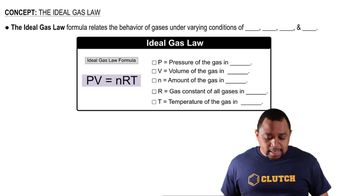
Ideal Gas Law

The Ideal Gas Law (PV=nRT) relates the pressure (P), volume (V), temperature (T), and number of moles (n) of a gas. It assumes that gas particles do not interact and occupy no volume, which is a good approximation under many conditions. Understanding this law is crucial for analyzing gas behavior, especially when considering how density changes with pressure.
추천 영상:
가이드 코스
01:15
Ideal Gas Law Formula

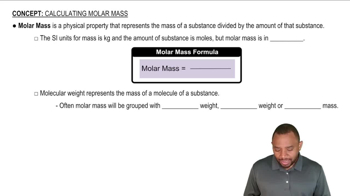
Density and Molar Mass Relationship

Density (d) is defined as mass per unit volume (d = m/V). For gases, density can also be expressed in terms of molar mass (M) and the Ideal Gas Law. The relationship shows that density is directly proportional to molar mass and inversely proportional to temperature and pressure, which is essential for understanding why d/P varies with pressure.
추천 영상:
가이드 코스
02:11
Molar Mass Concept

Real Gas Behavior

Real gases deviate from ideal behavior at high pressures and low temperatures due to intermolecular forces and the volume occupied by gas particles. This deviation can lead to non-constant relationships between density and pressure, as seen in the provided graph. Recognizing these deviations is important for interpreting experimental data and understanding gas properties under varying conditions.
추천 영상:
가이드 코스
01:15
Ideal Gas Law Formula