
Ch.10 - Gases
Brown - Chemistry: The Central Science 14th Edition
Brown14th EditionChemistry: The Central ScienceISBN: 9780134414232당신이 사용하는 게 아니라요?교과서 변경
10장, 문제 35

The Goodyear blimps, which frequently fly over sporting events, hold approximately 4955 m3 of helium. If the gas is at 23 °C and 101.33 kPa, what mass of helium is in a blimp?

검증된 단계별 안내
1
Step 1: Use the Ideal Gas Law equation, PV = nRT, to find the number of moles (n) of helium. Here, P is the pressure (101.33 kPa), V is the volume (4955 m^3), R is the ideal gas constant (8.314 J/(mol·K)), and T is the temperature in Kelvin (23 °C + 273.15).
Step 2: Convert the pressure from kPa to Pa by multiplying by 1000, since the ideal gas constant R is in J/(mol·K) and 1 J = 1 Pa·m^3.
Step 3: Convert the temperature from Celsius to Kelvin by adding 273.15 to the Celsius temperature.
Step 4: Rearrange the Ideal Gas Law equation to solve for n (number of moles): n = PV / RT.
Step 5: Calculate the mass of helium by multiplying the number of moles (n) by the molar mass of helium (4.00 g/mol).

주요 개념

질문에 올바르게 답하기 위해 반드시 이해해야 하는 핵심 개념들은 다음과 같습니다.

Ideal Gas Law

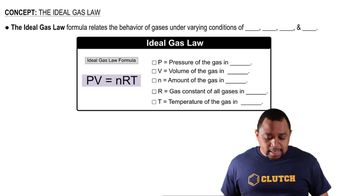
The Ideal Gas Law is a fundamental equation in chemistry that relates the pressure, volume, temperature, and number of moles of a gas. It is expressed as PV = nRT, where P is pressure, V is volume, n is the number of moles, R is the ideal gas constant, and T is temperature in Kelvin. This law allows us to calculate the properties of gases under various conditions.
추천 영상:
가이드 코스
01:15
Ideal Gas Law Formula

Molar Mass

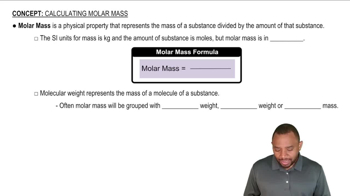
Molar mass is the mass of one mole of a substance, typically expressed in grams per mole (g/mol). For helium, the molar mass is approximately 4.00 g/mol. Understanding molar mass is essential for converting between the mass of a gas and the number of moles, which is necessary for applying the Ideal Gas Law.
추천 영상:
가이드 코스
02:11
Molar Mass Concept

Gas Density

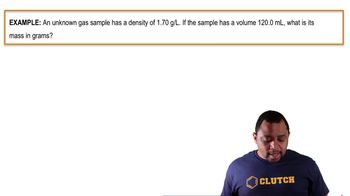
Gas density is defined as the mass of a gas per unit volume, usually expressed in grams per liter (g/L). It can be calculated using the formula density = mass/volume. Knowing the density of a gas allows for the determination of its mass when the volume is known, which is crucial for solving problems involving gas quantities.
추천 영상:
가이드 코스
01:21
Gas Density Example