Ch.10 - Gases
Brown - Chemistry: The Central Science 14th Edition
Brown14th EditionChemistry: The Central ScienceISBN: 9780134414232당신이 사용하는 게 아니라요?교과서 변경
10장, 문제 34

Calculate each of the following quantities for an ideal gas: (a) the volume of the gas, in liters, if 1.50 mol has a pressure of 126.7 kPa at a temperature of -6 °C, (b) the absolute temperature of the gas at which 3.33 * 10^-3 mol occupies 478 mL at 99.99 kPa, (c) the pressure, in pascals, if 0.00245 mol occupies 413 mL at 138 °C.

검증된 단계별 안내
1
Step 1: Identify the ideal gas law equation: PV = nRT, where P is pressure, V is volume, n is the number of moles, R is the ideal gas constant, and T is temperature in Kelvin.
Step 2: For part (a), convert the given temperature from Celsius to Kelvin by adding 273.15 to the Celsius temperature. Use the ideal gas constant R = 8.314 J/(mol·K) and rearrange the ideal gas law to solve for volume V: V = nRT/P.
Step 3: For part (b), convert the given volume from milliliters to liters by dividing by 1000. Rearrange the ideal gas law to solve for temperature T: T = PV/(nR). Ensure the pressure is in the correct units (Pa) by converting kPa to Pa (1 kPa = 1000 Pa).
Step 4: For part (c), convert the given temperature from Celsius to Kelvin. Convert the volume from milliliters to liters. Rearrange the ideal gas law to solve for pressure P: P = nRT/V. Ensure the final pressure is in pascals.
Step 5: Substitute the known values into the rearranged equations for each part and solve for the unknown quantity, ensuring all units are consistent throughout the calculations.

주요 개념

질문에 올바르게 답하기 위해 반드시 이해해야 하는 핵심 개념들은 다음과 같습니다.

Ideal Gas Law

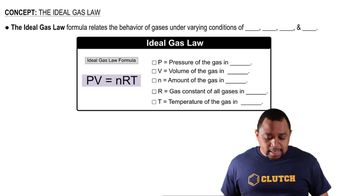
The Ideal Gas Law is a fundamental equation in chemistry that relates the pressure, volume, temperature, and number of moles of an ideal gas. It is expressed as PV = nRT, where P is pressure, V is volume, n is the number of moles, R is the ideal gas constant, and T is the absolute temperature in Kelvin. This law allows for the calculation of one variable when the others are known, making it essential for solving problems involving gases.
추천 영상:
가이드 코스
01:15
Ideal Gas Law Formula

Absolute Temperature

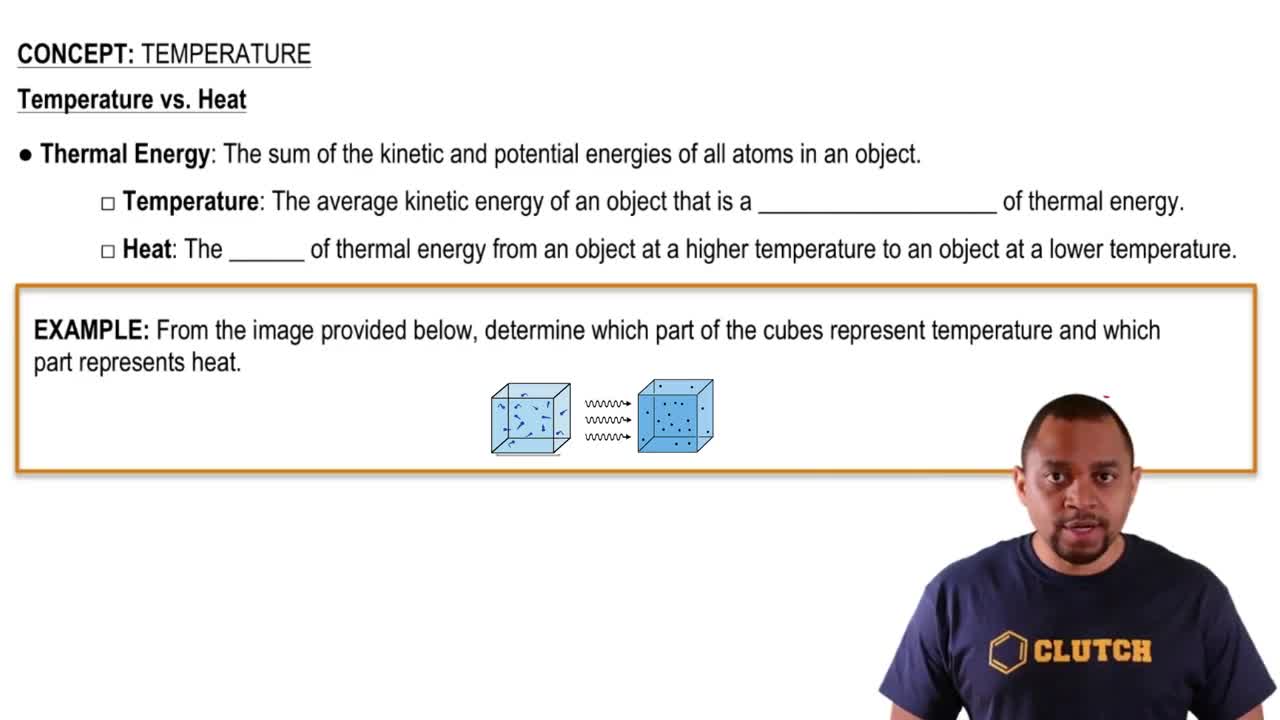
Absolute temperature is a temperature measurement on the Kelvin scale, which starts at absolute zero (0 K), the point at which molecular motion ceases. To convert Celsius to Kelvin, one adds 273.15 to the Celsius temperature. Understanding absolute temperature is crucial in gas calculations, as the Ideal Gas Law requires temperature to be in Kelvin to ensure accurate results.
추천 영상:
가이드 코스
03:48
Temperature vs Heat

Units of Measurement

In gas calculations, it is important to use consistent units for pressure, volume, and temperature. Pressure can be measured in pascals (Pa) or kilopascals (kPa), volume in liters (L) or milliliters (mL), and temperature in Kelvin (K). Converting between these units is often necessary to apply the Ideal Gas Law correctly, ensuring that all variables are compatible for accurate calculations.
추천 영상:
가이드 코스
02:52
Units of Radiation Measurement