
Ch.10 - Gases
Brown - Chemistry: The Central Science 14th Edition
Brown14th EditionChemistry: The Central ScienceISBN: 9780134414232당신이 사용하는 게 아니라요?교과서 변경
10장, 문제 12a

The graph below shows the change in pressure as the temperature increases for a 1-mol sample of a gas confined to a 1-L container. The four plots correspond to an ideal gas and three real gases: CO2, N2, and Cl2. (a) At room temperature, all three real gases have a pressure less than the ideal gas. Which van der Waals constant, a or b, accounts for the influence intermolecular forces have in lowering the pressure of a real gas?

검증된 단계별 안내
1
Identify the van der Waals equation: \( \left( P + \frac{a}{V^2} \right)(V - b) = nRT \).
Understand the role of the constant \(a\): It accounts for the attractive forces between gas molecules, which reduces the pressure exerted by the gas.
Recognize that the constant \(b\) accounts for the volume occupied by the gas molecules themselves, which affects the volume term in the equation.
Since the pressure of real gases is less than that of an ideal gas due to intermolecular attractions, the constant \(a\) is responsible for this effect.
Conclude that the van der Waals constant \(a\) accounts for the influence of intermolecular forces in lowering the pressure of a real gas compared to an ideal gas.

비슷한 문제에 대한 검증된 영상 답변:

이 영상 해법은 위 문제에 도움이 된다고 튜터들이 추천한 것입니다.
영상 길이:
3m
도움이 되었나요?

주요 개념

질문에 올바르게 답하기 위해 반드시 이해해야 하는 핵심 개념들은 다음과 같습니다.

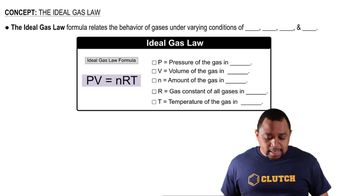
Ideal Gas Law

The Ideal Gas Law describes the relationship between pressure, volume, temperature, and the number of moles of a gas, expressed as PV = nRT. It assumes that gas particles do not interact and occupy no volume. This law serves as a baseline for understanding gas behavior, particularly in comparing real gases to ideal gases.
추천 영상:
가이드 코스
01:15
Ideal Gas Law Formula

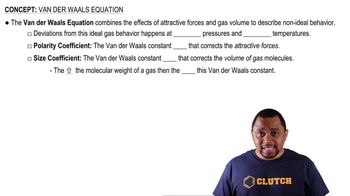
Van der Waals Equation

The Van der Waals equation modifies the Ideal Gas Law to account for the volume occupied by gas particles and the attractive forces between them. It introduces two constants, 'a' and 'b', where 'a' corrects for intermolecular attractions and 'b' accounts for the finite size of gas molecules. This equation helps explain why real gases deviate from ideal behavior, especially under high pressure and low temperature.
추천 영상:
가이드 코스
01:40
Van der Waals Equation

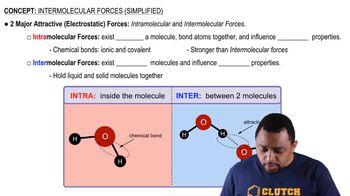
Intermolecular Forces

Intermolecular forces are the attractive forces between molecules that influence their physical properties, including pressure. In real gases, these forces can lead to lower pressure readings compared to ideal gases, as they cause molecules to stick together, reducing the effective pressure exerted by the gas. Understanding these forces is crucial for interpreting the behavior of real gases in various conditions.
추천 영상:
가이드 코스
01:59
Intermolecular vs Intramolecular Forces