
Ch.10 - Gases
Brown - Chemistry: The Central Science 14th Edition
Brown14th EditionChemistry: The Central ScienceISBN: 9780134414232당신이 사용하는 게 아니라요?교과서 변경
10장, 문제 10c

Consider the following samples of gases:
If the three samples are all at the same temperature, rank them with respect to (c) density

검증된 단계별 안내
1
Step 1: Recall that the density of a gas is given by the formula: Density = mass/volume. In this case, we are not given the mass or volume of the gases, but we know that all gases at the same temperature and pressure occupy the same volume. Therefore, the density of a gas is directly proportional to its molar mass.
Step 2: Identify the molar mass of each gas. The molar mass of a gas can be found by adding up the atomic masses of all the atoms in a molecule of the gas. For example, the molar mass of O2 (oxygen) is approximately 32 g/mol, the molar mass of N2 (nitrogen) is approximately 28 g/mol, and the molar mass of He (helium) is approximately 4 g/mol.
Step 3: Rank the gases by their molar mass. The gas with the highest molar mass will have the highest density, and the gas with the lowest molar mass will have the lowest density.
Step 4: Therefore, the order of the gases from highest to lowest density is O2 > N2 > He.
Step 5: Remember that this ranking is based on the assumption that all gases are at the same temperature and pressure. If the temperature or pressure changes, the density of the gases may also change.

비슷한 문제에 대한 검증된 영상 답변:

이 영상 해법은 위 문제에 도움이 된다고 튜터들이 추천한 것입니다.
영상 길이:
2m

주요 개념

질문에 올바르게 답하기 위해 반드시 이해해야 하는 핵심 개념들은 다음과 같습니다.

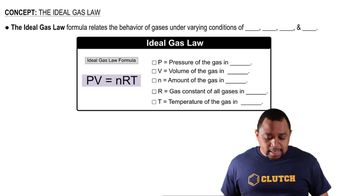
Ideal Gas Law

The Ideal Gas Law, represented as PV = nRT, relates the pressure (P), volume (V), number of moles (n), gas constant (R), and temperature (T) of an ideal gas. This law helps in understanding how changes in these variables affect the behavior of gases, including their density, which is defined as mass per unit volume.
추천 영상:
가이드 코스
01:15
Ideal Gas Law Formula

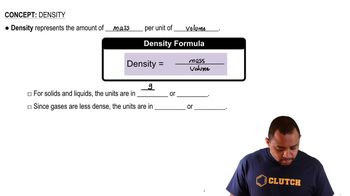
Density of Gases

Density is a physical property defined as mass divided by volume (ρ = m/V). For gases, density can vary significantly with changes in temperature and pressure. At constant temperature, the density of a gas is influenced by its molar mass; heavier gases will generally have higher densities than lighter gases under the same conditions.
추천 영상:
가이드 코스
01:56
Density Concepts

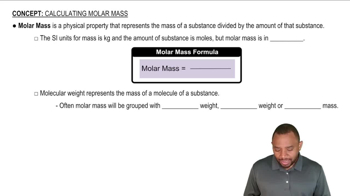
Molar Mass

Molar mass is the mass of one mole of a substance, typically expressed in grams per mole (g/mol). In the context of gases, a higher molar mass indicates a greater mass of gas molecules in a given volume, leading to higher density. Thus, when comparing gases at the same temperature, those with higher molar masses will rank higher in density.
추천 영상:
가이드 코스
02:11
Molar Mass Concept