Ch.11 - Liquids and Intermolecular Forces
Brown - Chemistry: The Central Science 14th Edition
Brown14th EditionChemistry: The Central ScienceISBN: 9780134414232당신이 사용하는 게 아니라요?교과서 변경
11장, 문제 10a

(a) How does the average kinetic energy of molecules com- pare with the average energy of attraction between mole- cules in solids, liquids, and gases?

검증된 단계별 안내
1
1. The average kinetic energy of molecules is a measure of how fast the molecules are moving. This energy is related to the temperature of the substance. The higher the temperature, the higher the average kinetic energy of the molecules.
2. The average energy of attraction between molecules, also known as intermolecular forces, is a measure of how strongly the molecules are attracted to each other. This energy is related to the phase of the substance. In solids, the intermolecular forces are strong enough to keep the molecules in a fixed position. In liquids, the intermolecular forces are weaker, allowing the molecules to slide past each other. In gases, the intermolecular forces are very weak or negligible, allowing the molecules to move freely.
3. In solids, the average energy of attraction between molecules is greater than the average kinetic energy of the molecules. This is why the molecules are held in a fixed position.
4. In liquids, the average kinetic energy of the molecules is comparable to the average energy of attraction between molecules. This is why the molecules can slide past each other but are still held together to some extent.
5. In gases, the average kinetic energy of the molecules is much greater than the average energy of attraction between molecules. This is why the molecules can move freely and are not held together.

비슷한 문제에 대한 검증된 영상 답변:

이 영상 해법은 위 문제에 도움이 된다고 튜터들이 추천한 것입니다.
영상 길이:
1m
도움이 되었나요?

주요 개념

질문에 올바르게 답하기 위해 반드시 이해해야 하는 핵심 개념들은 다음과 같습니다.

Kinetic Molecular Theory

The Kinetic Molecular Theory explains the behavior of gases in terms of the motion of their molecules. It posits that gas molecules are in constant, random motion and that the temperature of a gas is directly proportional to the average kinetic energy of its molecules. This theory helps to understand how kinetic energy varies in solids, liquids, and gases, influencing their physical properties.
추천 영상:
가이드 코스
01:19
Kinetic Molecular Theory

Intermolecular Forces

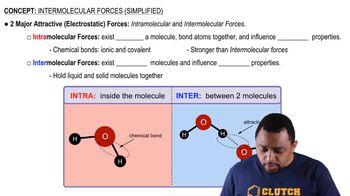
Intermolecular forces are the attractive forces between molecules that influence the physical state of a substance. In solids, these forces are strong, keeping molecules closely packed; in liquids, they are moderate, allowing for some movement; and in gases, they are weak, resulting in free movement of molecules. Understanding these forces is crucial for comparing them to kinetic energy in different states of matter.
추천 영상:
가이드 코스
01:59
Intermolecular vs Intramolecular Forces

Phase Changes

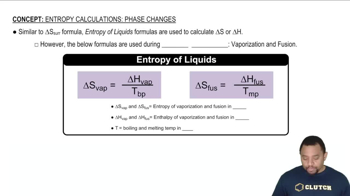
Phase changes refer to the transitions between solid, liquid, and gas states, which occur due to changes in temperature and pressure. During these changes, the balance between kinetic energy and intermolecular forces shifts, affecting the average energy of attraction. For instance, as a solid melts into a liquid, the kinetic energy increases, overcoming some intermolecular forces, which is essential for understanding the energy dynamics in different phases.
추천 영상:
가이드 코스
01:46
Entropy in Phase Changes