Ch.11 - Liquids and Intermolecular Forces
Brown - Chemistry: The Central Science 14th Edition
Brown14th EditionChemistry: The Central ScienceISBN: 9780134414232당신이 사용하는 게 아니라요?교과서 변경
11장, 문제 9b

List the three states of matter in order of (b) increasing intermolecular attraction.

검증된 단계별 안내
1
1. The three states of matter are solid, liquid, and gas.
2. Intermolecular attraction refers to the forces between molecules that hold them together. These forces are strongest in solids, intermediate in liquids, and weakest in gases.
3. Therefore, to list the states of matter in order of increasing intermolecular attraction, we start with the state where these forces are weakest.
4. The state with the weakest intermolecular forces is gas. In a gas, the molecules are far apart and move freely, so the forces between them are minimal.
5. Next comes the liquid state, where the molecules are closer together and the intermolecular forces are stronger than in gases but weaker than in solids. Finally, the solid state has the strongest intermolecular forces because the molecules are tightly packed together.

비슷한 문제에 대한 검증된 영상 답변:

이 영상 해법은 위 문제에 도움이 된다고 튜터들이 추천한 것입니다.
영상 길이:
1m

주요 개념

질문에 올바르게 답하기 위해 반드시 이해해야 하는 핵심 개념들은 다음과 같습니다.

States of Matter

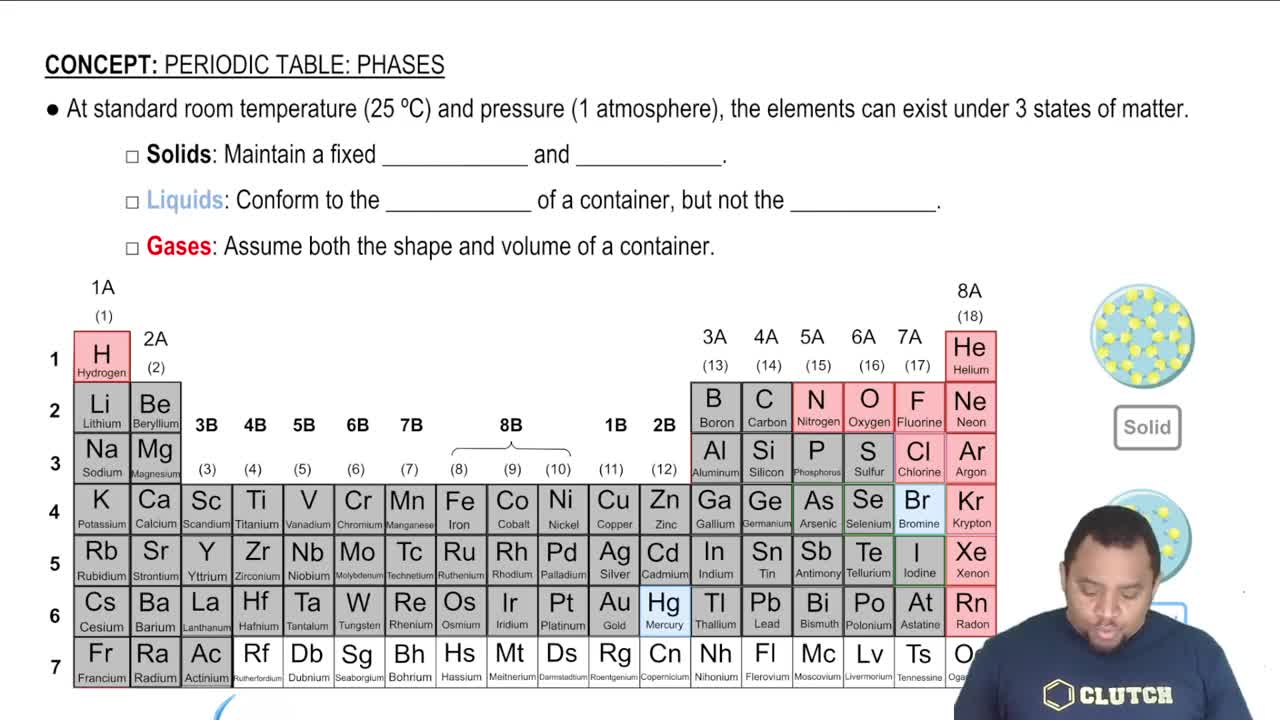
The three primary states of matter are solid, liquid, and gas. Solids have tightly packed particles that vibrate in place, liquids have particles that are close but can move past each other, and gases have widely spaced particles that move freely. Understanding these states is essential for discussing their properties and behaviors.
추천 영상:
가이드 코스
03:25
Element States of Matter

Intermolecular Forces

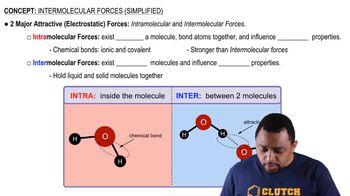
Intermolecular forces are the attractions between molecules that influence the physical properties of substances. These forces vary in strength, with solids having the strongest intermolecular forces, followed by liquids, and then gases, which have the weakest. Recognizing these forces helps explain why substances behave differently in each state.
추천 영상:
가이드 코스
01:59
Intermolecular vs Intramolecular Forces

Increasing Intermolecular Attraction

Increasing intermolecular attraction refers to the trend where the strength of forces between particles increases from gas to liquid to solid. This concept is crucial for understanding the arrangement and movement of particles in different states of matter, as stronger attractions lead to more ordered structures and less freedom of movement.
추천 영상:
가이드 코스
01:59
Intermolecular vs Intramolecular Forces