
Ch.11 - Liquids and Intermolecular Forces
Brown - Chemistry: The Central Science 14th Edition
Brown14th EditionChemistry: The Central ScienceISBN: 9780134414232당신이 사용하는 게 아니라요?교과서 변경
11장, 문제 89

A particular liquid crystalline substance has the phase diagram shown in the figure. By analogy with the phase diagram for a nonliquid crystalline substance, identify the phase present in each area.

검증된 단계별 안내
1
Identify the axes of the phase diagram. Typically, the x-axis represents temperature and the y-axis represents pressure.
Locate the different regions or areas on the phase diagram. Each region corresponds to a different phase of the substance.
Identify the phase boundaries, which are the lines separating different regions. These lines indicate the conditions under which two phases coexist in equilibrium.
Determine the phases present in each region by comparing the phase diagram to a typical phase diagram for a nonliquid crystalline substance. Common phases include solid, liquid, and gas, but liquid crystalline substances may have additional phases such as nematic, smectic, or cholesteric.
Label each region with the appropriate phase name based on the characteristics of liquid crystalline substances and the analogy to nonliquid crystalline phase diagrams.

비슷한 문제에 대한 검증된 영상 답변:

이 영상 해법은 위 문제에 도움이 된다고 튜터들이 추천한 것입니다.
영상 길이:
58s
도움이 되었나요?

주요 개념

질문에 올바르게 답하기 위해 반드시 이해해야 하는 핵심 개념들은 다음과 같습니다.

Phase Diagrams

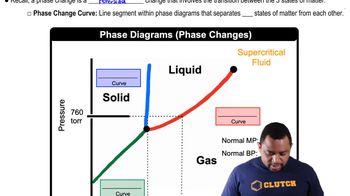
Phase diagrams are graphical representations that show the phases of a substance as a function of temperature and pressure. They illustrate the conditions under which distinct phases, such as solid, liquid, and gas, exist and transition into one another. Understanding phase diagrams is crucial for predicting the state of a substance under varying environmental conditions.
추천 영상:
가이드 코스
03:22
Phase Changes in Diagrams

Liquid Crystals

Liquid crystals are materials that exhibit properties between those of conventional liquids and solid crystals. They can flow like a liquid but have some degree of order, typically in their molecular arrangement. This unique behavior allows them to respond to electric fields and temperature changes, making them important in applications like displays and sensors.
추천 영상:
가이드 코스
03:04
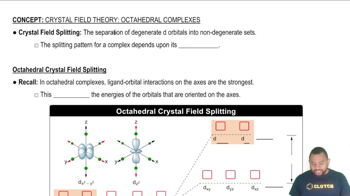
The crystal field splitting pattern for octahedral complexes has the d orbitals on or along the axes as having the higher energy.

Phase Transitions

Phase transitions refer to the changes in the state of matter that occur when a substance absorbs or releases energy, typically in the form of heat. Common transitions include melting, freezing, boiling, and condensation. In the context of liquid crystals, understanding these transitions is essential for identifying the different phases represented in a phase diagram.
추천 영상:
가이드 코스
03:22
Phase Changes in Diagrams