Ch.11 - Liquids and Intermolecular Forces
Brown - Chemistry: The Central Science 14th Edition
Brown14th EditionChemistry: The Central ScienceISBN: 9780134414232당신이 사용하는 게 아니라요?교과서 변경
11장, 문제 12

At room temperature, Si is a solid, CCl4 is a liquid, and Ar is a gas. List these substances in order of (b) increasing boiling point.

검증된 단계별 안내
1
Identify the type of intermolecular forces present in each substance: Si (silicon) is a network covalent solid, CCl4 (carbon tetrachloride) is a molecular compound with London dispersion forces, and Ar (argon) is a noble gas with weak London dispersion forces.
Understand that the strength of intermolecular forces affects the boiling point: stronger intermolecular forces result in higher boiling points.
Recognize that network covalent solids like Si have very strong covalent bonds throughout the structure, leading to high boiling points.
Compare the intermolecular forces: Si has the strongest forces due to its covalent network, CCl4 has moderate London dispersion forces, and Ar has the weakest London dispersion forces.
Arrange the substances in order of increasing boiling point based on the strength of their intermolecular forces: Ar < CCl4 < Si.

주요 개념

질문에 올바르게 답하기 위해 반드시 이해해야 하는 핵심 개념들은 다음과 같습니다.

Boiling Point

The boiling point of a substance is the temperature at which its vapor pressure equals the external pressure, causing it to change from a liquid to a gas. It is influenced by intermolecular forces; stronger forces typically result in higher boiling points. For example, substances with hydrogen bonding or significant dipole-dipole interactions generally have higher boiling points than those with only London dispersion forces.
추천 영상:
가이드 코스
03:05
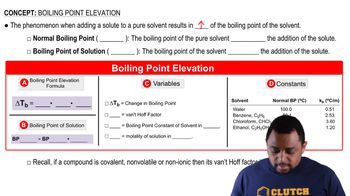
Boiling Point Elevation

Intermolecular Forces

Intermolecular forces are the forces of attraction or repulsion between molecules. They include hydrogen bonds, dipole-dipole interactions, and London dispersion forces. The strength of these forces affects the physical properties of substances, including boiling points; for instance, carbon tetrachloride (CCl4) has stronger dispersion forces than argon (Ar), leading to a higher boiling point.
추천 영상:
가이드 코스
01:59
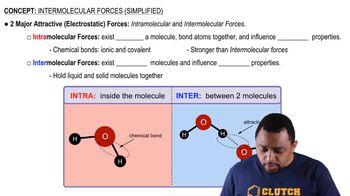
Intermolecular vs Intramolecular Forces

Phase of Matter

The phase of matter refers to the distinct forms that different phases of matter take on, primarily solid, liquid, and gas. At room temperature, silicon (Si) is a solid due to its strong covalent bonds, CCl4 is a liquid with moderate intermolecular forces, and argon (Ar) is a gas with weak dispersion forces. Understanding these phases helps in predicting the order of boiling points based on the state of matter at a given temperature.
추천 영상:
가이드 코스
03:19
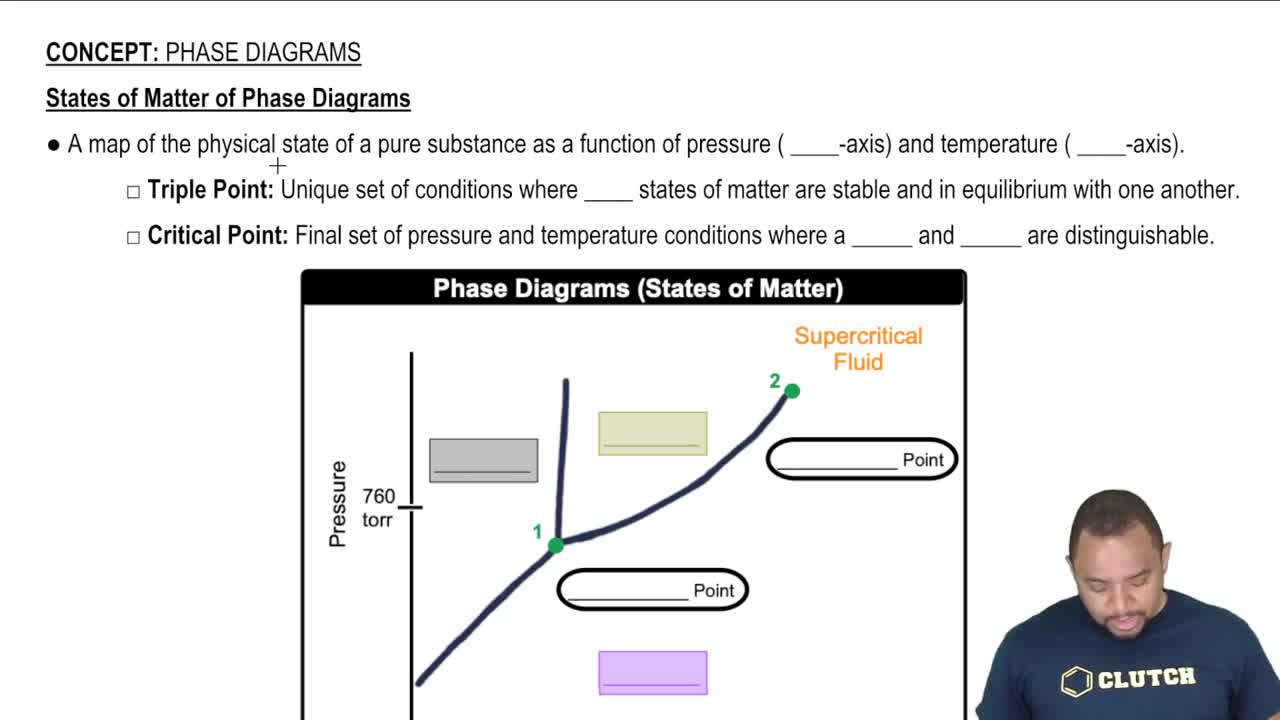
States of Matter of Phase Diagrams