Ch.11 - Liquids and Intermolecular Forces
Brown - Chemistry: The Central Science 14th Edition
Brown14th EditionChemistry: The Central ScienceISBN: 9780134414232당신이 사용하는 게 아니라요?교과서 변경
11장, 문제 16b

(b) Which of these kinds of interactions are broken when a liquid is converted to a gas?

검증된 단계별 안내
1
Identify the state change involved: The problem states that a liquid is converted to a gas, which is the process of vaporization.
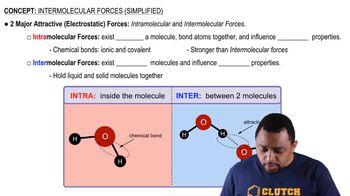
Understand the types of interactions in liquids: In liquids, molecules are held together by intermolecular forces. These include hydrogen bonds, dipole-dipole interactions, and London dispersion forces.
Recognize the effect of vaporization on intermolecular forces: When a liquid turns into a gas, the molecules must overcome the intermolecular forces that hold them together in the liquid state.
Determine which interactions are affected: During vaporization, all types of intermolecular forces (hydrogen bonds, dipole-dipole interactions, and London dispersion forces) are broken to allow the molecules to move freely and form a gas.
Conclude the specific interactions broken: Thus, when a liquid is converted to a gas, hydrogen bonds, dipole-dipole interactions, and London dispersion forces are the kinds of interactions that are broken.

비슷한 문제에 대한 검증된 영상 답변:

이 영상 해법은 위 문제에 도움이 된다고 튜터들이 추천한 것입니다.
영상 길이:
1m
도움이 되었나요?

주요 개념

질문에 올바르게 답하기 위해 반드시 이해해야 하는 핵심 개념들은 다음과 같습니다.

Intermolecular Forces

Intermolecular forces are the attractive forces between molecules that influence the physical properties of substances. In liquids, these forces, such as hydrogen bonds, dipole-dipole interactions, and London dispersion forces, hold the molecules close together. When a liquid is converted to a gas, these forces must be overcome, allowing the molecules to move freely and occupy a larger volume.
추천 영상:
가이드 코스
01:59
Intermolecular vs Intramolecular Forces

Phase Change

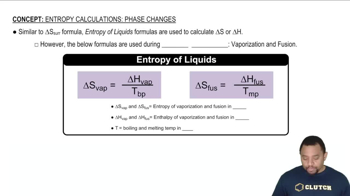
A phase change refers to the transition of a substance from one state of matter to another, such as from liquid to gas. This process involves energy changes, specifically the absorption of heat, which provides the energy needed to break intermolecular forces. Understanding phase changes is crucial for grasping how temperature and pressure affect the state of a substance.
추천 영상:
가이드 코스
01:46
Entropy in Phase Changes

Vaporization

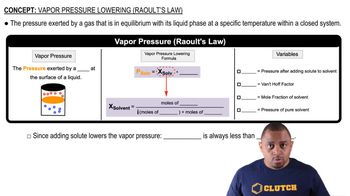
Vaporization is the process by which a liquid turns into a gas, occurring through two main mechanisms: evaporation and boiling. During vaporization, molecules at the surface of the liquid gain enough energy to overcome intermolecular forces and escape into the gas phase. This concept is essential for understanding how temperature and pressure influence the transition from liquid to gas.
추천 영상:
가이드 코스
02:40
Raoult's Law and Vapor Pressure