(c) Which type of intermolecular attractive force operates only between the hydrogen atom of a polar bond and a nearby small electronegative atom?
Ch.11 - Liquids and Intermolecular Forces
11장, 문제 17
Describe the intermolecular forces that must be overcome to convert these substances from a liquid to a gas: (a) SO2, (b) CH3COOH, (c) H2S.
검증된 단계별 안내1
Identify the molecular structure of CH3COOH (acetic acid). It contains a carboxyl group (COOH) and a methyl group (CH3).
Recognize the types of intermolecular forces present in CH3COOH. These include hydrogen bonding, dipole-dipole interactions, and London dispersion forces.
Understand that hydrogen bonding is the strongest intermolecular force in CH3COOH due to the presence of the hydroxyl group (OH) in the carboxyl group, which can form hydrogen bonds with the oxygen atom of another molecule.
Consider the dipole-dipole interactions that occur because of the polar nature of the C=O and O-H bonds in the carboxyl group, contributing to the overall polarity of the molecule.
Acknowledge that to convert CH3COOH from a liquid to a gas, energy must be supplied to overcome these intermolecular forces, with the most energy required to break the hydrogen bonds.

비슷한 문제에 대한 검증된 영상 답변:
이 영상 해법은 위 문제에 도움이 된다고 튜터들이 추천한 것입니다.
영상 길이:
1m도움이 되었나요?
주요 개념
질문에 올바르게 답하기 위해 반드시 이해해야 하는 핵심 개념들은 다음과 같습니다.
Intermolecular Forces
Intermolecular forces are the attractive forces between molecules that influence their physical properties, such as boiling and melting points. These forces include hydrogen bonding, dipole-dipole interactions, and London dispersion forces. Understanding these interactions is crucial for predicting how much energy is required to change a substance from one state to another, such as from liquid to gas.
추천 영상:
가이드 코스
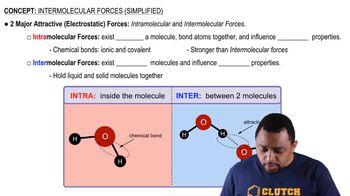
Intermolecular vs Intramolecular Forces
Hydrogen Bonding
Hydrogen bonding is a specific type of strong dipole-dipole interaction that occurs when hydrogen is bonded to highly electronegative atoms like oxygen, nitrogen, or fluorine. In the case of acetic acid (CH3COOH), hydrogen bonds form between the hydrogen atom of one molecule and the oxygen atom of another. These bonds must be overcome for the substance to vaporize, making them significant in determining the boiling point.
추천 영상:
가이드 코스
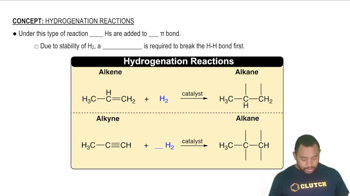
Hydrogenation Reactions
Boiling Point
The boiling point of a substance is the temperature at which its vapor pressure equals the external pressure, allowing it to transition from liquid to gas. The boiling point is influenced by the strength of intermolecular forces; stronger forces result in higher boiling points. For acetic acid, the presence of hydrogen bonding leads to a relatively high boiling point compared to other similar-sized molecules without such interactions.
추천 영상:
가이드 코스
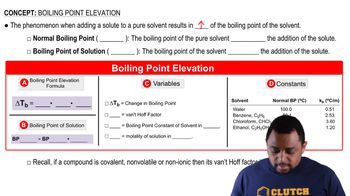
Boiling Point Elevation
관련 실천
교과서 질문
422
views
교과서 질문
Which type of intermolecular force accounts for each of these differences? (b) Xe is a liquid at atmospheric pressure and 120 K, whereas Ar is a gas under the same conditions. (c) Kr, atomic weight 84 amu, boils at 120.9 K, whereas Cl2, molecular weight about 71 amu, boils at 238 K.
781
views
교과서 질문
Which type of intermolecular force accounts for each of these differences? (a) CH3OH boils at 65 °C; CH3SH boils at 6 °C. (d) Acetone boils at 56 °C, whereas 2-methylpropane boils at -12 °C.
440
views
교과서 질문
(a) List the following molecules in order of increasing polar- izability: GeCl4, CH4, SiCl4, SiH4, and GeBr4. (b) Predict the order of boiling points of the substances in part (a).
1317
views
교과서 질문
(b) Which of these kinds of interactions are broken when a liquid is converted to a gas?
403
views